
Waterproofing San Francisco (2026): Foundation, Below Grade, Walls, Decks & Commercial
San Francisco is one of the most waterproofing-intensive cities in the country. Fog that never fully lifts. Atmospheric rivers. Salt air off the Pacific. Seismic movement in aging foundations. Hillside properties where water runs directly into the structure. Older buildings from the 1920s through 1960s that were never designed for the kind of moisture loading the marine climate delivers.
If water is getting into your building anywhere that isn’t the roof surface itself, this is the guide.
Why San Francisco Buildings Need Comprehensive Waterproofing
The Marine Climate Problem
The fog doesn’t just wet the roof. It wets everything. Exterior walls. Below-grade concrete. Foundation walls. Pedestrian decks above parking or living space. Water vapor from the marine layer penetrates masonry, concrete block, stucco, and older brick construction differently than it penetrates a roof membrane.
The Sunset, Richmond, and coastal neighborhoods get it worse. But even SOMA, Mission, and Nob Hill deal with below-grade moisture from hillside hydrostatic pressure and aging drainage infrastructure.
Learn More, Roof Leak Repair San Francisco
Seismic Movement and Foundation Cracking
San Francisco sits in earthquake country. Foundation cracks from seismic activity — even minor movement — create pathways for water infiltration that weren’t there before. A foundation that was dry in 2005 may have active seepage now from stress cracking over the intervening years.
Older unreinforced masonry and concrete foundations in the pre-1940s building stock are especially vulnerable.
Older Building Stock
Most of SF’s building inventory is over 50 years old. Waterproofing products and installation methods from the 1950s and 1960s have a lifespan. Original tar-and-felt below-grade membranes, original parging on foundation walls, and original drainage systems are all at or past the end of life in most buildings of this age.
Hillside Properties and Hydrostatic Pressure
The hills — Nob Hill, Pacific Heights, Twin Peaks, Bernal Heights, Glen Park — create hydrostatic pressure situations that flat-city waterproofing doesn’t encounter. Water runs downhill and accumulates against the low side of the foundation. Without proper drainage and waterproofing, it finds its way through.
Types of Waterproofing We Cover in San Francisco
1. Foundation Waterproofing in San Francisco
The foundation is the starting point for most serious water intrusion problems. Water gets in through:
- Cracks in concrete or masonry foundation walls
- Failed original waterproofing membrane (tar, felt, or early-generation products)
- Hydrostatic pressure from hillside water accumulation
- Poor drainage around the foundation perimeter
- Expansion joints that have failed
Positive-side foundation waterproofing: Applied to the exterior face of the foundation wall. Requires excavation in most retrofit situations. The most effective method because it stops water before it reaches the structure. Products include crystalline waterproofing, sheet-applied membranes, and fluid-applied systems.
Negative-side (interior) waterproofing: Applied from the inside when exterior access is not possible. Hydraulic cement for active leaks, crystalline coatings for ongoing protection, interior drain channel systems for persistent seepage. Less ideal than positive-side but often the practical choice in dense urban SF where excavation is difficult.
Crystalline waterproofing for SF foundations: Particularly well-suited for the marine environment. Crystalline chemistry penetrates the concrete capillaries and grows insoluble crystals that block water passage. Self-seals around hairline cracks and remains effective even with future movement.
Foundation waterproofing cost in San Francisco 2026: Varies significantly by method and access. Interior systems less expensive but less comprehensive. Exterior excavation and membrane systems higher but more permanent. Get site-specific assessment.
2. Below-Grade Waterproofing in San Francisco
Below-grade means anything underground: basements, lower-level parking, utility spaces, garden-level units, and sub-grade mechanical rooms.
San Francisco has a significant stock of buildings with basement or garden-level space — Victorian flats with basement storage, Edwardian multi-family with ground-floor units partially below grade, commercial buildings with underground parking.
Common below-grade problems in SF:
- Active seepage through concrete floor slabs
- Wall-floor joint leaks (the most common entry point)
- Window well flooding
- Sump system failure or absence
- Failed drain tile or perimeter drainage from original construction
Below-grade waterproofing methods:
- Exterior membrane application with drainage board and perimeter drainage pipe
- Interior drain channel systems with sump pump
- Injection grouting for active cracks
- Crystalline concrete treatment for slabs and walls
- Bentonite systems where soil conditions allow
The San Francisco specific challenge: Many older buildings have no original below-grade waterproofing at all. The original drainage was relied upon and has since failed or the surrounding soil conditions have changed. Seismic retrofits sometimes disturb existing drainage paths.
3. Exterior Wall Waterproofing in the Bay Area
Exterior walls in San Francisco take on moisture from multiple directions: wind-driven rain, fog condensation, and moisture vapor transmission from inside heated spaces moving outward.
Stucco walls: The majority of SF’s building exterior is stucco. Original three-coat stucco from the 1920s–1950s has a moisture performance profile different from modern one-coat systems. Cracked stucco, failed control joints, and failed caulking at penetrations are the primary water entry points.
Wall waterproofing approaches:
- Elastomeric coatings: Fluid-applied, bridges hairline cracks, breathable, available in many finishes. Appropriate for stucco, concrete, CMU.
- Clear penetrating silane/siloxane sealers: For masonry and concrete that is structurally sound but porous. Maintains original appearance.
- Full stucco system repair with integral waterproofing: Where the substrate has failed
- Cavity drain systems behind wall finishes: For persistent wall moisture in below-grade or partially below-grade situations
The fog belt wall problem: In the Outer Sunset (94116/94122), Outer Richmond (94121), and other fog-belt neighborhoods, exterior walls are in a near-constant wet-dry-wet cycle. Standard paint fails within a few years. Elastomeric systems formulated for marine climate are the appropriate solution.
Bay Area wall waterproofing cost 2026: Elastomeric coating application on a typical SF stucco wall — per square foot range depending on prep, crack repair, and system. Full assessment determines scope.
4. Pedestrian Deck Waterproofing in the Bay Area
This is a specific and technically demanding waterproofing category that most generic contractors don’t handle properly. Pedestrian decks — any walking surface over occupied or conditioned space — need a waterproofing system that handles:
- Foot traffic loads and movement
- Thermal expansion and contraction
- Drainage to prevent ponding
- Compatibility with the finish surface (tile, pavers, concrete, wood)
- Connection to walls and penetrations
Where pedestrian deck waterproofing is needed in SF:
- Rooftop decks over living space
- Parking decks over garages or lower units
- Balconies over interior space
- Plaza decks over commercial space
- Podium decks in multi-family buildings
Systems we use for pedestrian decks:
- Hot-applied rubberized asphalt: Monolithic, seamless, excellent for vehicular and pedestrian decks
- Cold-applied liquid waterproofing membranes: Polyurethane or PMMA systems, fast cure, good for detail work and smaller decks
- Sheet-applied membranes with protection board: For below-tile or below-paver applications
- Fabric-reinforced fluid systems: Good bridge for existing concrete decks with cracking
The critical detail: drainage slope. Every pedestrian deck needs positive drainage to scuppers or drains. We design slope into the waterproofing system, not just assume the substrate has it. In San Francisco’s rain and fog climate, ponding on a pedestrian deck destroys the membrane faster than anything.
Pedestrian deck waterproofing cost in SF 2026: Significantly more than standard roofing. Labor, materials, and the precision required to detail around penetrations, walls, drains, and transitions properly. Multi-family and commercial decks require engineering coordination.
5. Commercial Building Waterproofing in San Francisco
Commercial buildings in SF have every waterproofing challenge compressed together: below-grade parking, exterior walls with window systems, exposed mechanical areas, rooftop equipment platforms, and pedestrian decks — all in the marine climate.
Commercial waterproofing we address:
- Below-grade parking structure waterproofing and crack injection
- Plaza deck waterproofing over parking or commercial space
- Exterior wall system assessment and elastomeric coating application
- Balcony and terrace waterproofing in multi-family and hotel
- Foundation perimeter drainage and membrane systems
- Green roof waterproofing systems where specified
- Expansion joint systems in concrete structures
The San Francisco commercial challenge: Older buildings in SOMA, the Financial District, and Mission — many built 1950s–1980s — have original waterproofing systems that are 40–60 years past their design life. They leak. The question is whether to repair, inject, or replace.
We provide condition assessments, not just quotes. Show up, probe, test, document, and give you a clear picture of what you have and what it will take.
How We Diagnose Waterproofing Problems in San Francisco
We don’t just look from the street. Proper waterproofing diagnosis includes:
Visual inspection: Staining patterns, efflorescence, spalling, crack mapping, vegetation growth in joints.
Moisture mapping: Electronic moisture meters on walls, slabs, and decks to identify wet zones without opening everything.
Flood testing: For decks and horizontal surfaces — controlled water introduction to trace entry points.
Probe and core sampling: For existing systems where the original material is unknown.
Drain line camera: For below-grade systems where the drainage path is suspect.
Documentation: Photos, notes, condition ratings. You get a report, not just a verbal quote.
Commercial Roofing and Leak Repair in San Francisco
Since many commercial building waterproofing calls include the roof:
Who to call for a roof leak in San Francisco: Call a contractor who does both the roof system and the building envelope. A roofer who only does membranes will miss wall or deck water entry. A waterproofing contractor who doesn’t do roofing will miss the membrane failure. We do both.
Commercial roof leak repair in SF: Diagnosis first. Where is the water entering? Not where it’s showing up inside — where is it actually getting in? These are often different locations. We trace, document, and repair at the source.
Commercial roof systems we work with in SF:
- TPO single-ply on commercial flats
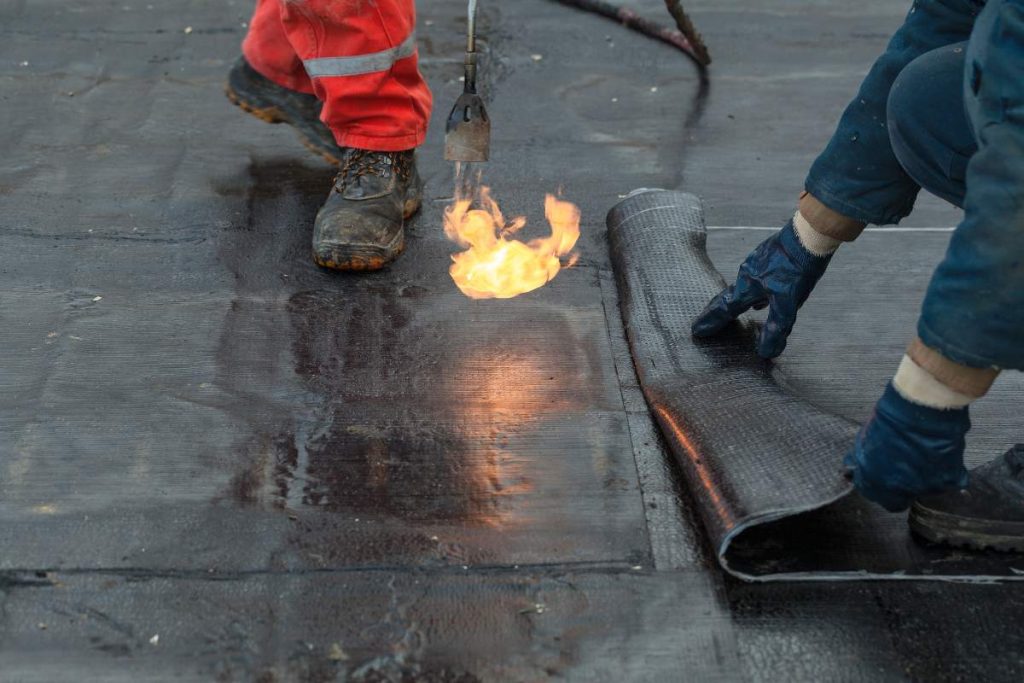
- Modified bitumen (torch-down and cold-applied)
- EPDM on older commercial buildings
- Standing seam metal on industrial and commercial
- Built-up roofing assessment and repair on older systems
- Silicone restoration coatings on aged but structurally sound roofs
Commercial re-roofing in San Francisco: Full tear-off and replacement on commercial buildings throughout SF, SOMA, Mission, Nob Hill, and the Bay Area. We handle the permits, DBI, access logistics, and phased work to keep tenants operational.
Bay Area commercial roofing costs 2026: Significantly higher than national averages. Labor, permits, Bay Area material costs, and access complexity in dense urban buildings all factor in. Get a site-specific assessment — no accurate range exists without seeing the building.
Serving These Areas for Waterproofing and Commercial Roofing
San Francisco neighborhoods:
- Outer Sunset (94116, 94122) — fog belt, worst exposure
- Outer Richmond (94118, 94121) — salt air, older stock
- SOMA (94103, 94107) — commercial concentration
- Mission (94110) — mixed residential and commercial
- Nob Hill, Pacific Heights — hillside hydrostatic pressure
- Bernal Heights (94110, 94131) — hillside drainage
- Castro, Glen Park — below-grade space
- Financial District — commercial building envelope
Bay Area:
- Marin County — marine climate, hillside properties
- San Mateo County / Peninsula
- Oakland, Berkeley — older below-grade structures
- South San Francisco — industrial and commercial