Wood Shake Roofing in San Francisco Expensive, and Not Always the Right Call Here
I’m going to start this one a little differently than most material pages, because wood shake is a material I genuinely love the look of, and also one I think gets recommended to San Francisco homeowners more often than it probably should be. Both of those things are true at once, and you deserve to hear both before you spend thirty or forty thousand dollars on a roof.
Cedar shake looks incredible. There’s a reason it shows up on so many of the city’s more character-heavy homes — the hand-split texture, the way it weathers to that silvery grey over time, the sheer warmth of it compared to a flat composition shingle. If aesthetics were the only consideration, this would be a much shorter page.
But San Francisco’s climate is persistently damp in a way that matters a lot for a natural wood product, and that’s the honest conversation most contractor websites skip past on their way to the sale. This page covers what wood shake actually is, why our specific fog belt complicates it, what it costs, and the fire code requirements that apply here whether you love the look or not.
Learn More About Metal Roofing.
What Is Wood Shake Roofing, Actually?
Quick terminology clarification first, because even some professional installers get this wrong on camera, and it matters for understanding what you’re actually buying.
Wood Shingles vs Cedar Shakes — Not the Same Thing
Wood shingles are sawn on both sides, giving a cleaner, more uniform look. Cedar shakes are hand-split — or split and then re-sawn — which gives them that rougher, more rustic, deliberately uneven texture that replicates the look of an axe or mallet cut. If a contractor uses these two terms interchangeably without distinguishing them, that’s worth noticing.
Most of what San Francisco homeowners are actually picturing when they say “wood shake roof” is the shake version — the textured, rustic one — rather than the smoother shingle option.
The Three Shake Grades You’ll Actually Be Choosing Between
Heavy split and resawn is the thickest, most rugged option, typically running three-quarters of an inch up to a full inch and a quarter, with a heavily textured, dramatic look. Medium split and resawn is similar but noticeably thinner, generally a half-inch to five-eighths, with a still-textured but less dramatic profile.
Taper sawn is sawn on both sides like a true shingle but thicker, giving a more tailored appearance with sharper shadow lines from the thickness at the butt. It’s the most popular of the three for a reason — it splits the difference between rustic character and a cleaner overall look.
Quality Grades Matter Just as Much as the Cut
Beyond the physical cut, cedar shake comes in quality tiers. Common grade is the cheapest and lowest quality. Select grade sits in the middle. Straight-grain grade — where every shake is hand-selected for consistent, straight wood grain — is the top tier, and it’s genuinely a different product in terms of durability and appearance, not just a marketing label.
If you’re getting quotes that vary wildly in price for what sounds like the same wood shake job, ask specifically which grade is being quoted. This is a common place where a lower bid quietly swaps in common-grade material without saying so directly.
Why San Francisco’s Fog Belt Complicates Wood Shake
This is the section most wood shake sales content skips, and it’s the one I think matters most for an honest recommendation.
Wood and Persistent Moisture Don’t Mix Well
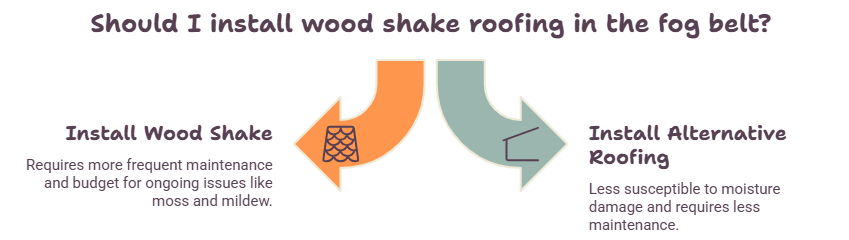
Cedar shake is genuinely more susceptible to moisture-related problems than composition shingle or metal roofing — mold, mildew, and rot risk goes up meaningfully in humid or consistently rainy conditions. That’s a direct reflection of industry installation guidance, not something I’m making up to talk you out of a sale.
San Francisco’s fog belt — the Outer Sunset, the Outer Richmond, Parkside, anywhere Karl the Fog sits heavy overnight — is exactly the kind of persistent moisture environment that guidance is warning about. It’s not the same as a torrential-rain climate, but it’s also not dry, and wood shake doesn’t get the reset period it would in a genuinely arid climate.
What This Actually Means for Your Decision
I’m not going to tell you wood shake is impossible in the fog belt, because that’s not accurate either. It means the maintenance conversation matters more here than it would in, say, Bernal Heights or Potrero Hill, which see meaningfully more direct sun and less sustained dampness.
If you’re set on wood shake specifically in a heavy-fog zip code, budget for more frequent inspection and cleaning than a manufacturer’s baseline recommendation, and go in with clear eyes about moss and mildew being an ongoing conversation, not a one-time installation decision.
Wood Shake Roofing Lifespan and Durability
Real numbers, with the honest caveats attached.
How Long It Actually Lasts
Properly installed and maintained cedar shake commonly lasts 30 to 50 years, genuinely double or even triple the 10-to-25-year range you’d typically see from composition asphalt shingle. That’s a real advantage, and it’s the core of why people pay the premium for it.
That lifespan assumes real maintenance, though — periodic cleaning and inspection to prevent moss, mold, and general degradation from taking hold. Skip that maintenance in a persistently damp climate and you’re not getting anywhere near the top of that range.
Wind and Impact Performance
Cedar shake has a genuinely strong wind resistance rating, and its impact rating against hail sits at Class 3, which is a step below the Class 4 rating available on some other roofing systems. For San Francisco specifically, hail isn’t the primary weather concern the way it might be in other parts of the country, so this tradeoff matters less here than it would somewhere with regular hailstorms.
Fire Resistance — Where Chapter 7A Comes In
Untreated wood shake is genuinely more vulnerable to fire than composition shingle, metal, or tile, and can be treated with fire-retardant coating to improve that rating, though at additional cost. This matters directly in San Francisco because of Building Code Chapter 7A, which requires fire-resistant roofing materials for properties near urban wildland interface zones — areas including parts of Twin Peaks, Diamond Heights, upper Bernal Heights, and the slopes near Glen Canyon.
If your property falls in or near one of these zones, treated, fire-rated wood shake — or a composite shake alternative built to meet the same code requirement — isn’t optional. We’ll flag this clearly during your inspection rather than after a permit gets rejected.
Installation Details That Actually Matter
This is the part where I’ll be genuinely blunt, because I’ve seen enough wood shake installation content — including from professional installers — get this specific detail wrong, and it’s worth knowing what correct actually looks like.
Underlayment Has to Be Fully Covered
Cedar shake installation requires a breathable mesh underlayment specifically, layered with roofing felt, so the shakes can breathe properly while still getting weather protection underneath. That felt paper is never supposed to be visible or exposed between the gaps in the finished shakes.
I mention this specifically because I’ve watched installation videos — genuinely well-produced, professional-looking ones — where the felt was left visibly exposed in the gaps between shakes, and viewers with real, decades-long shake installation experience called it out immediately as a mistake that leads to accelerated UV degradation of that underlayment and eventual leaks. If a contractor’s finished work shows visible black felt paper between your shakes, that’s not a stylistic choice. That’s an installation error.
Roof Deck Condition Comes First
Like any roofing project, everything above the deck depends on the deck itself being solid. On San Francisco’s older housing stock, where original board sheathing has often been carrying decades of this city’s specific moisture exposure, that deck inspection matters even more than it might on a newer structure elsewhere.