Asphalt Shingles San Francisco — Fiberglass, Composition & Architectural Options for SF Homes in 2026
Fiberglass, composition and architectural asphalt shingles for San Francisco homes. Algae resistance, wind ratings and 2026 costs for SF’s fog belt, salt air and coastal conditions.
Fiberglass, Composition & Architectural Options for SF Homes in 2026
Asphalt shingles get undersold in San Francisco roofing conversations. Most of the city’s flat rooftops dominate the discussion — TPO, modified bitumen, torch-down — and the sloped roof conversation gets comparatively little attention. Which is odd, because a significant number of SF homes have sloped or partially sloped roof sections that are genuinely well-served by the right asphalt shingle specification.
The operative word is right.
Because asphalt shingles in San Francisco are not the same product as asphalt shingles in Sacramento, Fresno, or Phoenix. The fog belt, the salt air, the biological growth conditions specific to this city’s coastal microclimate — all of it changes what specification actually makes sense here. A shingle that would give you 28 reliable years in a drier inland California market might give you 19 in the Outer Richmond if you bought the wrong product.
First — What “Asphalt Shingles” Actually Means in 2026
The term covers more variation than most people realize. When a contractor says “asphalt shingles” they could be talking about two fundamentally different products with different performance profiles for San Francisco’s environment.
Fiberglass Asphalt Shingles — The Current Standard
Modern asphalt shingles manufactured since the late 1980s are fiberglass-reinforced. The core of the shingle is a fiberglass mat — not organic felt — coated on both sides with asphalt and surfaced with ceramic granules on the weather-exposed top face.
The fiberglass mat provides several advantages over the older organic felt construction:
- Higher dimensional stability — less prone to warping, curling, and cracking under thermal cycling
- Better fire resistance — fiberglass core achieves Class A fire rating without additional treatment
- Lower moisture absorption — fiberglass does not absorb water the way organic felt does, which matters significantly in San Francisco’s persistently humid coastal environment
- Lighter weight — easier to handle and install, less structural load on older SF buildings
When someone talks about asphalt shingles in 2026, they are almost always talking about fiberglass asphalt shingles. The organic felt construction has largely disappeared from the new installation market.
Organic Composition Shingles — Legacy Product, Rarely Installed New
Organic composition shingles use a felt mat — recycled paper and wood fiber — as the core, coated with asphalt and surfaced with granules. They were the standard through most of the twentieth century and a significant portion of older SF buildings with original roofing still have them.
Organic composition shingles are heavier, more flexible, and in some ways more impact-resistant than fiberglass alternatives. The problem in San Francisco’s environment is moisture absorption. The organic felt core absorbs water over time, which accelerates deterioration, promotes biological growth, and leads to curling and cracking at a faster rate than fiberglass cores in a coastal humid climate.
If your older SF home has the original composition shingles and you are replacing them, you are replacing it with fiberglass. That is the right call for this environment.
3-Tab vs Architectural (Dimensional) Shingles — What the Difference Actually Means
Within fiberglass asphalt shingles, the most important product category distinction is between 3-tab and architectural shingles.
3-tab shingles are the flat, uniform shingles with three distinct tabs cut into the lower edge. They are thinner, lighter, and less expensive than architectural shingles. Wind resistance is lower — typically rated for 60 to 80 mph. Lifespan is shorter — 15 to 20 years in SF’s conditions. They are rarely specified for new SF residential installations in 2026 because architectural shingles have become the de facto standard at a price point that makes 3-tab’s cost savings marginal.
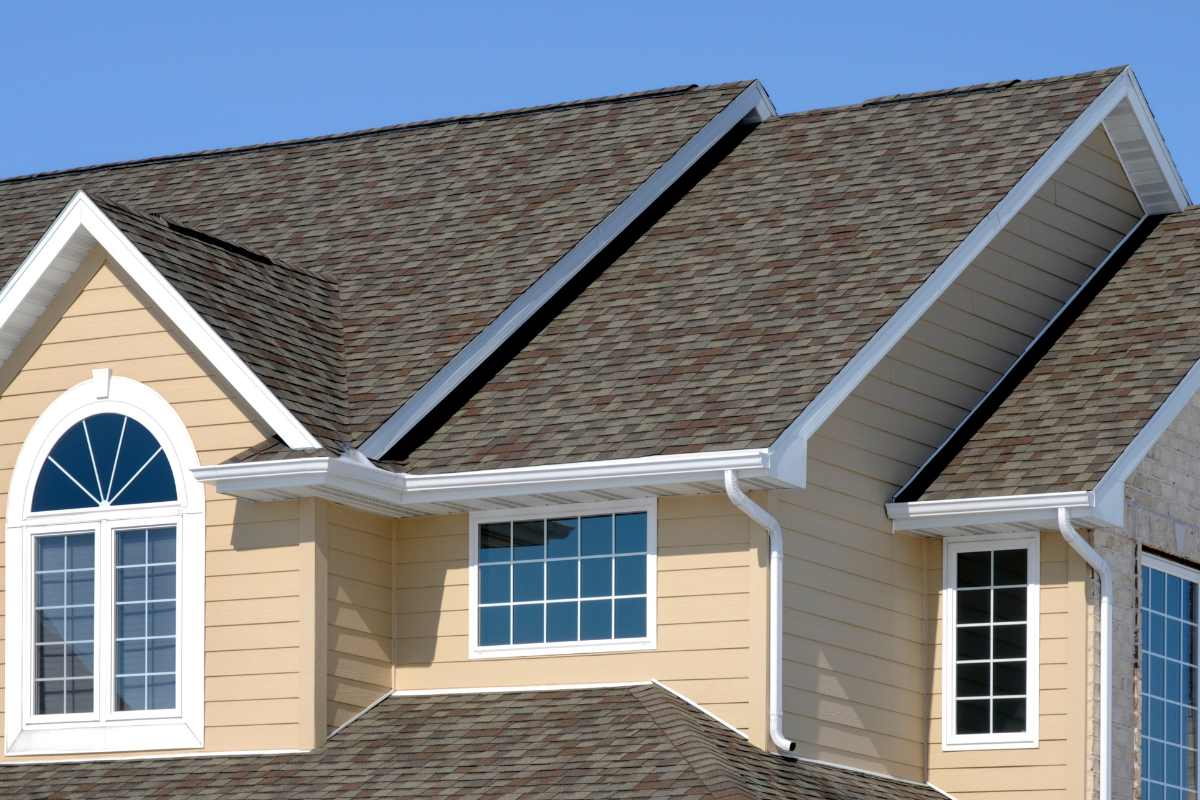
Architectural shingles — also called dimensional or laminated shingles — are constructed with two layers of fiberglass mat bonded together, creating a thicker, heavier shingle with a dimensional appearance that mimics the shadow lines of wood shake or slate. They are significantly more wind-resistant than 3-tab — typically rated for 110 to 130 mph depending on product. Lifespan in SF conditions runs 20 to 25 years with proper specification. They are the correct baseline for any San Francisco residential roof replacement in 2026.
Impact-resistant (IR) shingles are a premium architectural shingle category with modified polymer in the asphalt formulation that gives the shingle higher impact resistance ratings — Class 3 or Class 4 under UL 2218 testing. For most of San Francisco where hail is not a primary weather concern, IR shingles are less relevant than they are in hail-prone markets. The exception is rooftops with significant foot traffic for HVAC maintenance or rooftop access, where the enhanced puncture resistance has practical value.
What San Francisco Specifically Does to Asphalt Shingles
The Algae Problem in Fog-Belt Neighborhoods
This is the single most important SF-specific consideration for asphalt shingle selection and the one that most SF property owners have never had explained properly.
Gloeocapsa magma — the algae species responsible for the black streaking visible on asphalt shingle rooftops throughout the Outer Richmond, Outer Sunset, Cole Valley, and other fog-heavy SF neighborhoods — thrives in exactly the conditions San Francisco’s marine layer creates. Sustained coastal humidity, moderate temperatures, and shade from neighboring structures combine to create ideal algae colonization conditions.
The black streaks are not aesthetic only. Algae feed on the limestone filler in asphalt shingles, consuming the granule matrix that protects the asphalt from UV degradation. As algae colonies expand, granule loss accelerates. The asphalt beneath becomes exposed to UV radiation and oxidizes faster. The result is a shingle that loses years of its rated service life specifically because of biological activity — not weathering, not physical damage, just algae.
Algae-resistant shingles address this with copper or zinc granules blended into the surfacing. When rain hits the roof, trace amounts of copper or zinc ions are released, creating conditions toxic to algae growth. Products like GAF Timberline shingles with StainGuard Plus technology or CertainTeed Landmark with Streakfighter use this approach. The algae resistance is not permanent — it depletes over time — but it provides meaningful protection through the shingle’s productive service life.
For any asphalt shingle installation in San Francisco’s fog-belt neighborhoods — Outer Sunset (94122), Outer Richmond (94121), Inner Sunset (94117), Cole Valley, and fog-exposed sections of Noe Valley — algae-resistant specification is not optional. It is the specification that determines whether your 25-year warranty shingle actually performs for 25 years in this specific microclimate.
Moss Growth — The Secondary Biological Problem
Moss is the more aggressive cousin of algae on SF rooftops. Where algae creates surface staining and accelerated granule loss, established moss colonies physically lift shingle edges, compromise lap integrity, and create direct pathways for water infiltration under the shingle. Moss holds moisture against the shingle surface continuously — particularly damaging in SF’s fog-heavy environment where the shingle surface never fully dries out in foggy morning conditions.
Moss growth is most common on north-facing and shaded roof sections — interior-facing slopes on Avenues row houses, roof sections shaded by neighboring buildings in dense Mission or Castro neighborhoods, and any slope that receives limited direct sunlight during SF’s fog-heavy summer months.
Zinc strips along the ridge are a common preventive measure — rain carries zinc down the slope, inhibiting moss colonization below the strip. Moss removal from existing infested surfaces requires careful treatment — pressure washing damages granule surfaces and aggressive chemical treatment requires runoff management. The better approach is prevention through algae-resistant shingle specification from the start.
Wind Rating — Why It Matters More in SF Than Most California Markets
The Candlestick Point area (94124) is one of the windiest urban sites in California — a geographic reality created by the Bay’s funnel effect at the southern end of San Francisco. The coastal exposure along the western neighborhoods generates consistent onshore wind that the city’s topography channels and accelerates. The Marin headlands wind pattern affects northern SF neighborhoods in ways that inland California cities never experience.
For most San Francisco locations, architectural shingles rated for 110 mph wind uplift are the appropriate specification. For properties with direct coastal exposure — Ocean Beach-adjacent properties in 94121 and 94122, elevated locations in Twin Peaks or Diamond Heights with minimal wind protection — 130 mph rated shingles are worth the modest additional cost.
Wind resistance in asphalt shingles is primarily driven by adhesive strip performance — the factory-applied strip of sealant on the underside of each shingle that bonds to the shingle below it when heated by the sun after installation. In SF’s persistently cloudy and cool summer conditions, adhesive strip activation can take longer than in sunnier California markets. Installers need to account for this — hand-sealing is sometimes appropriate in coastal SF locations where solar activation of the adhesive strip cannot be relied upon in the weeks after installation.
Salt Air and Granule Adhesion
The salt air that reaches all of San Francisco from the Bay works on asphalt shingle surfaces in ways that most roofing content ignores. Salt deposits on granule surfaces over time, and in combination with moisture cycling from the marine layer, can accelerate granule loosening from the asphalt matrix.
Premium fiberglass asphalt shingles with ceramic-coated granules and advanced adhesive bond between granules and asphalt perform significantly better in coastal salt-air environments than entry-level products with mineral granules and standard asphalt formulation. The granule adhesion quality difference is not visible at installation — it shows up at year 12 versus year 22 in the granule loss rate.
California Requirements for Asphalt Shingles in San Francisco
Class A Fire Rating.
All asphalt shingles installed in San Francisco must carry a Class A fire resistance rating — the highest available. Modern fiberglass asphalt shingles from major manufacturers achieve Class A as a standard feature. Verify explicitly before specification rather than assuming.
Title 24 Cool Roof
California’s Title 24 Energy Code requires cool roof compliance on low-slope applications. For steep-slope residential roofs — the category most asphalt shingle installations fall into — Title 24 steep-slope requirements apply. Cool-roof-rated asphalt shingles with qualifying solar reflectance are available and sometimes required depending on project type and local jurisdiction amendments. Confirm with your contractor whether Title 24 cool-roof requirements apply to your specific project.
Chapter 7A WUI
San Francisco hillside neighborhoods in designated Wildland-Urban Interface zones have additional material requirements. Standard asphalt shingles meeting Class A fire rating satisfy most WUI requirements for asphalt products — but verify for your specific address if you are in a hillside SF neighborhood.
SF DBI Permit
Significant roof replacement in San Francisco requires a building permit from the Department of Building Inspection. Permit fees add $800 to $3,500 depending on project valuation. Essential for insurance validation, property sale, and future renovation permits. Verify your contractor’s C-39 California Roofing Contractor License at cslb.ca.gov before signing anything.
What Asphalt Shingles Are Not Right For in San Francisco
Flat and low-slope roof sections. San Francisco has an enormous number of flat rooftops — Victorian flats, Edwardian duplexes, commercial buildings, mixed-use mid-rises throughout SoMa and the Mission. None of these applications are appropriate for asphalt shingles. Flat and low-slope roofs require membrane systems — TPO, modified bitumen, EPDM, or PVC. Our flat roofing San Francisco page covers the full flat roof system landscape.
Roofs below a 2:12 pitch. Asphalt shingles require minimum slope for proper drainage. Below 2:12 pitch, water does not drain fast enough to prevent infiltration under shingle laps. This is a code and performance requirement, not a contractor preference.
Properties where the architectural character calls for something else. Spanish Colonial and Mediterranean Revival homes in Noe Valley and Glen Park look right with clay tile — not asphalt shingles. Historic Craftsman bungalows in Cole Valley and the Inner Sunset have architectural character that wood shake serves better. Using asphalt shingles on these buildings because they are cheaper is a decision that affects property character and potentially resale value. Our clay and concrete tile roofing and wood shake roofing San Francisco pages cover those alternatives.
2026 Asphalt Shingle Cost in San Francisco
| Shingle Type | Installed Cost Per Sq Ft | Realistic SF Lifespan | Wind Rating | Algae Resistance |
| 3-Tab Fiberglass (entry level) | $6 – $9 | 15 – 18 years | 60 – 80 mph | Varies by product |
| Architectural Dimensional (standard) | $8 – $12 | 20 – 23 years | 110 mph | Available — specify required |
| Architectural Premium (algae-resistant) | $10 – $14 | 22 – 25 years | 110 – 130 mph | ✅ Built-in |
| Impact-Resistant Class 4 | $12 – $16 | 24 – 27 years | 130 mph | ✅ Most products |
SF DBI permit fees: Add $800 – $3,500 depending on project valuation
Underlayment: Synthetic underlayment is the correct specification for SF’s moisture environment — not 30-pound felt. Add this to your proposal verification checklist.
Decking repair contingency: Older SF homes frequently have deteriorated sheathing discovered at tear-off. Budget 10 to 15 percent above base bid.
What a Proper Asphalt Shingle Installation Looks Like in SF
Synthetic underlayment — not felt. The Reddit roofing community is unambiguous on this: “Synthetic is way better than 30-pound, especially under tile” — and the same principle applies under asphalt shingles in SF’s moisture environment. Synthetic underlayment is lighter, more tear-resistant, and significantly more moisture-resistant than traditional felt. On a San Francisco rooftop that may sit exposed to morning fog for hours before the installation crew arrives, synthetic underlayment provides a margin that felt does not.
Ice and water shield at eaves and valleys. While San Francisco does not experience ice dams in the traditional sense, self-adhered ice and water shield at eave edges and valley transitions is the correct specification for coastal moisture environments. It provides a redundant waterproof layer at the most vulnerable points — eave edges and valley intersections where water flow concentrates.
Proper ventilation. Attic ventilation affects shingle lifespan directly. Inadequate ventilation traps heat under the roof deck in summer, accelerating asphalt oxidation from below. In SF’s cooler conditions, ventilation still matters — trapped moisture from the marine layer needs a path out of the attic assembly. Ridge vent with soffit intake is the standard balanced ventilation approach for most SF residential installations.
Hand-sealing in coastal locations. As discussed above, SF’s cool cloudy conditions can delay solar activation of factory adhesive strips. In coastal-exposure locations, hand-sealing shingle tabs with roofing cement at installation ensures immediate wind resistance before solar activation occurs.