Torch Down roofing Coating vs Replacement SF | 2026
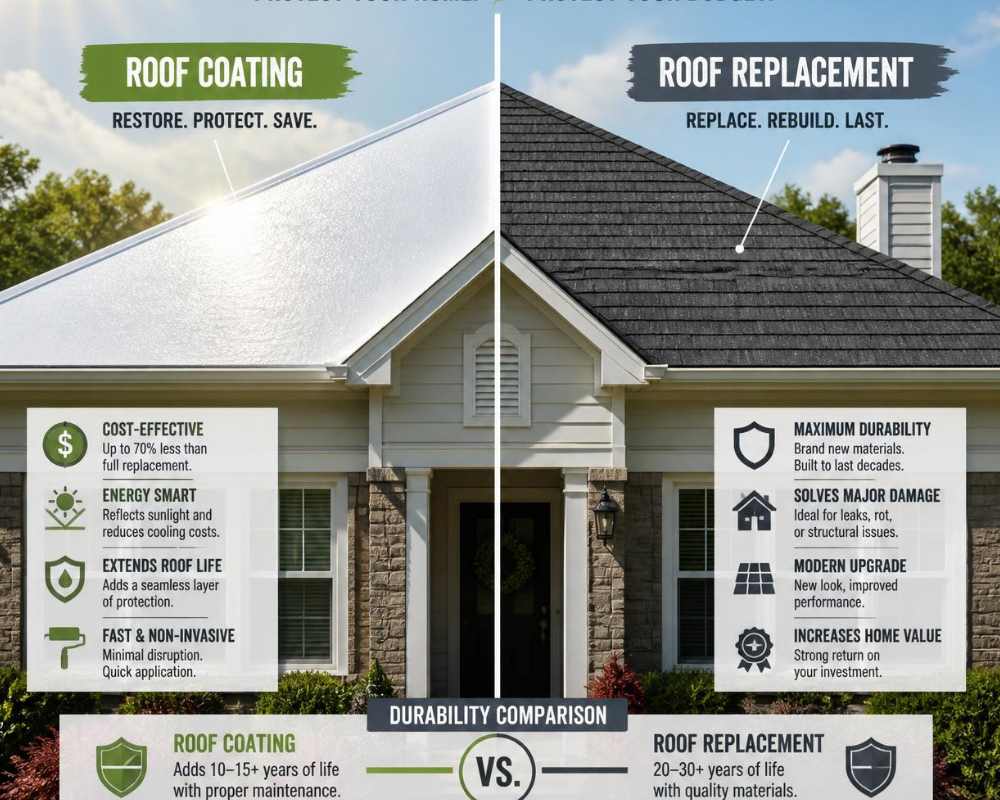
Somewhere between “my roof is fine” and “I need a full tear-off,” there’s a genuinely useful middle option that a lot of homeowners never get told about clearly, because it’s a smaller ticket than replacement and not every contractor is eager to walk you through it. Coating an aging but structurally sound torch down roof instead of replacing it entirely.
I want to be upfront about something before we go further, because it matters for how you should read the rest of this page. A silicon coating is a preservative, not a cure. It’s the roofing equivalent of resealing a deck versus rebuilding it — genuinely valuable when the structure underneath is sound, and genuinely pointless when it isn’t.
This page walks through exactly how to tell which situation you’re in, what each option actually costs in San Francisco right now, and the specific signs that mean coating isn’t going to save you money — it’s just going to delay an expense you can’t actually avoid.
What Roof Coating Actually Is
A liquid-applied coating — silicone, acrylic, or another elastomeric compound — goes on over your existing torch down membrane, essentially the same way paint goes over a wall, except it’s engineered specifically to seal, waterproof, and reflect heat rather than just add color. It’s sprayed, rolled, or brushed on, and it cures into a continuous protective layer over what’s already there.
The thickness of that coating directly determines how long it lasts and what kind of warranty backs it. Manufacturers commonly tie warranty length to mil thickness — a 20-year warranty typically requires roughly 30 mils of coating, and going thinner to save material cost genuinely shortens the real-world protection you’re getting, not just the paperwork.
Is Your Torch Down Roof a Genuine Coating Candidate?
This is the actual question that matters, and it’s worth being honest about the eligibility criteria before you spend money either direction.
What Makes a Roof a Good Candidate
Your torch down roof is a reasonable coating candidate if the membrane is structurally sound, dry underneath, has intact seams, and shows no signs of saturated insulation. Roughly 75 to 85 percent of the existing insulation needs to be dry for a coating to make sense — moisture trapped beneath the surface will cause bubbling, blistering, or outright coating failure no matter how well the top layer is applied.
Proper drainage matters just as much as the membrane condition itself. Chronic ponding water — water sitting for more than 48 hours after rain — will break down even a well-applied coating over time, so if your roof already has a standing-water problem, that needs solving before coating makes sense as an option at all.
The Honest List of When Replacement Is the Real Answer
I’m going to be direct here, because a coating company that tells you every roof can be coated isn’t being straight with you. Large, persistent water stains inside the home, multiple recurring leaks even after past repairs, soft or spongy spots on the deck itself, and roofing membrane that’s brittle, chalked, or torn beyond what patching can reasonably address — these are all signs that a coating isn’t the right call, full stop.
Add to that list: consistently sagging or drooping roof edges, deteriorated flashing at chimneys and skylights, and a deck that’s visibly struggling to support its own weight. If more than one or two of these describe your roof, coating is genuinely delaying the inevitable rather than solving it, and you’ll likely end up paying for the coating and the replacement both.
Torch Down Roofing Cost in San Francisco Right Now
Real 2026 numbers for what full replacement actually runs, since that’s the number you’re weighing coating against.
What Replacement Costs Per Square Foot
Flat and low-slope roof replacement in San Francisco commonly runs $8 to $14 per square foot installed for torch down or TPO. For a typical San Francisco rowhouse roof — somewhere in the 1,200 to 1,800 square foot range — that generally prices out between roughly $10,000 and $25,000 for a full tear-off and replacement, though the specific number moves based on several factors that genuinely change the labor involved, not just the material.
What Actually Moves That Number
Tear-off depth matters more than people expect — one old layer of roofing is normal and priced in, but two or three generations of built-up material on an older San Francisco building means significantly more labor and much heavier disposal cost.
Parapet and edge detail work is where a lot of the real cost lives. Every parapet wall needs the membrane properly turned up and capped, and a roof with a lot of walls, vents, skylights, and rooftop equipment has meaningfully more detail work than a clean, simple roof plane — and detail work is exactly where corner-cutting shows up as a leak later.
Deck condition discovered during tear-off gets priced by the sheet if soft or rotted decking turns up. And access matters: a roof you can reach with a ladder from the street costs less to work than one where every piece of material and debris has to move through the building itself or over a neighboring roof, which is a genuinely common situation on San Francisco’s shared-wall rowhouses.
Rowhouse Access — The Cost Driver Nobody Outside the City Anticipates
This deserves its own mention because it’s such a distinctly San Francisco problem. A rowhouse shares walls with its neighbors, typically has no driveway and no side yard, and often no interior route to the roof beyond a narrow stairwell. Materials and debris either get carried through the building by hand, or a crane lifts everything over the roofline instead.
For a small roof, carrying is tedious but usually the cheaper option. For a full tear-off with new insulation, a few hours of crane time can actually cost less than the crew-days it would take to carry everything by hand. When you’re comparing bids, ask specifically how materials and debris will actually move — a contractor who answers this clearly and confidently has done this exact kind of block before. One who waves the question off is about to learn on your roof, at your expense.
Coating Cost vs Replacement Cost — The Real Math
Coating a structurally sound roof typically runs meaningfully less than half the cost of full replacement — for many roofs, less than that. That’s the core financial argument for coating, and it’s a real one when your roof is a genuine candidate.
Here’s the honest caveat, though: that lower upfront cost only makes sense if the roof actually qualifies. Spending on a coating for a roof with saturated insulation or multiple active leaks doesn’t save money — it adds a coating expense on top of the replacement you’ll still need shortly after, once the underlying problems make themselves known again.
TPO vs Torch-Down — What Roofers Actually Debate When You’re Deciding Between Them
If replacement is genuinely the right call, this is the next real decision, and it’s worth understanding both sides honestly rather than just picking whichever a single contractor happens to install. We go deeper on TPO specifically and modified bitumen and torch-down on their own dedicated pages if you want the full technical picture of each system.
Lifespan and Failure Rate
Torch-down modified bitumen has a slightly better average lifespan on paper than TPO in some comparisons, but a higher real-world residential failure rate, largely because correct torch-down installation is far more dependent on installer skill — a rushed or inexperienced crew produces a genuinely worse result than the same crew would with TPO, where the installation process is more forgiving.
Temperature Performance
TPO wins on thermal expansion and contraction handling day-to-day, but modified bitumen actually performs better at temperature extremes — both very hot and very cold — which matters less in San Francisco’s relatively mild year-round climate than it would somewhere with real seasonal swings.
Cost Structure Is Genuinely Different
The primary cost driver for modified bitumen is labor. The primary cost driver for TPO is material. This is worth understanding because it means the two systems respond differently to a contractor trying to cut cost — a cheap modified bitumen bid usually means rushed labor, while a cheap TPO bid usually means lower-grade material.
Our Honest Take for San Francisco Rowhouses Specifically
On a small, cut-up rowhouse roof with a lot of penetrations — vents, skylights, HVAC equipment — a well-installed torch-down roof is still a genuinely fine product, and it’s easy for any flat roofer in this city to maintain and patch later, since it’s the traditional, well-understood system here. On a larger, cleaner roof with fewer penetrations, TPO usually wins on cool-roof compliance and long-term thermal performance.
California Title 24 and Why It Matters More Than People Expect Here
California’s Title 24 Energy Code requires cool-rated roofing on low-slope reroofs statewide, and San Francisco sits within the climate zone this applies to — meaning it affects essentially every flat roof replacement in the city, not just larger commercial projects.
In practice, this steers material choice more than it affects your budget directly. White TPO is inherently reflective and clears the requirement by its nature. Torch-down systems need a cool-rated granulated cap sheet or a compliant coating to meet the same standard. And yes, this genuinely matters even in a city famous for its fog — clear afternoons still bake dark membranes, and the daily heat cycling from expansion and contraction as the roof warms and cools is a real contributor to premature seam and material wear, fog or no fog.
Frequently Asked Questions About Torch Down Coating vs Replacement in San Francisco
Call or Text: +1 628 221-4900 best Inspection. Honest Coating-vs-Replacement Assessment. No Upsell.