Skylight Leak Repair in San Francisco | Causes, Fixes & Replacement
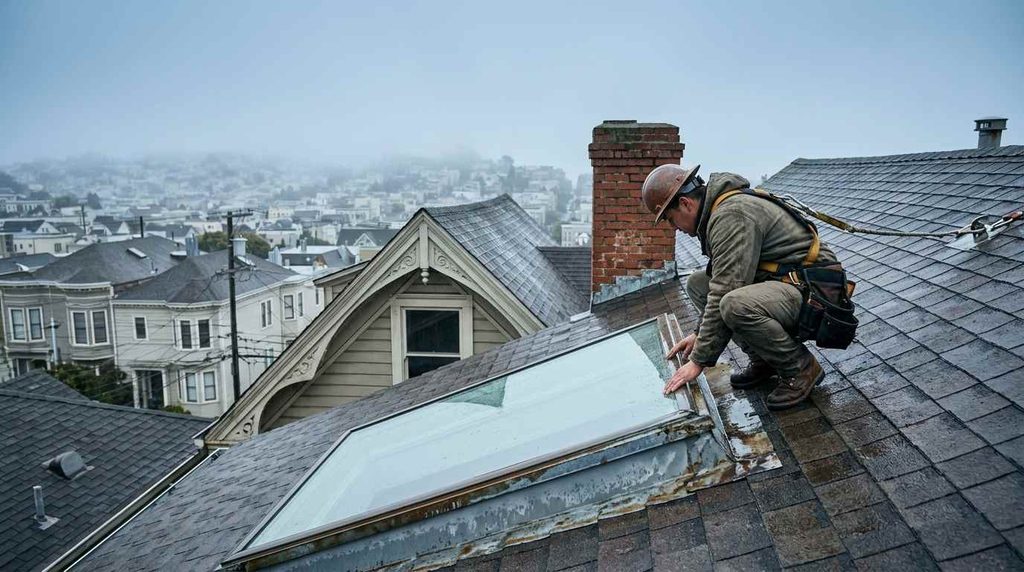
Quick Answer: Is Your Skylight Leaking, and What Should You Do First?
If water drips, stains, or pools around a skylight during or right after rain, treat it as a leak and protect the inside first. Move furniture, put a bucket under the drip, take photos of the stain and the ceiling around it, and do not go up on a wet roof to look.
If you only see fog or droplets on the inside of the glass on a cold, foggy morning, and there is no stain, no drip trail, and no wet drywall, that is usually condensation, not a roof leak. San Francisco fog makes this confusion very common, especially in bathrooms and kitchens.
A skylight can leak from the flashing around it, from the seal between glass and frame, from a cracked pane, from a blocked channel, or from roof water that enters above the skylight and travels down to it. The stain tells you where water ended up. It does not prove where water got in. That distinction is why so many skylight repairs fail the first time.
Key Facts
- A stain under a skylight is not proof the skylight itself leaks. Water can enter above it and travel along the deck or rafters.
- The most common SF skylight problems are failed flashing, a dried-out gasket or glass seal, debris and pooling on flat roofs, and a bad install or bad re-roof sequence.
- Leaks that only show in heavy rain are still leaks. They are often flashing or channel problems that only fail when water volume is high.
- A new skylight, or a skylight that starts leaking a few months after a full roof replacement, usually points to flashing, not to the glass.
- Fogged glass, a soft or rotted curb, and a leak that returns after resealing are replacement signals, not reseal signals.
- No verified San Francisco skylight price is claimed in this guide. See the cost section for why quotes differ and what a quote must list.
Is Your Skylight Leaking or Is It Condensation?
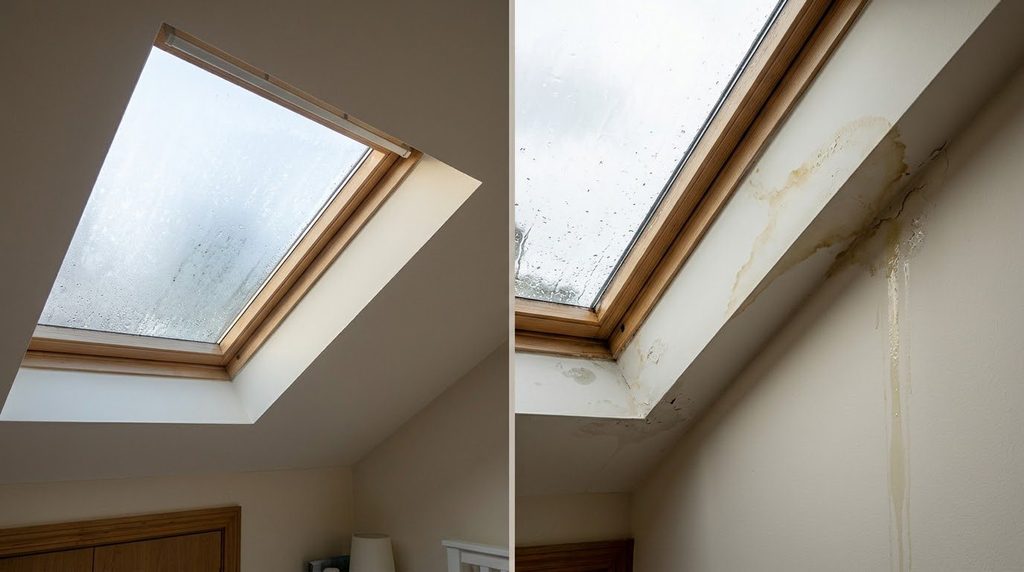
This is the first question to answer, because the fix is completely different. In San Francisco, marine-layer fog, cool nights, and warm, humid air inside bathrooms and kitchens create condensation on skylight glass on mornings when there is no rain at all. Homes on the foggy west side, in the Sunset (94122) and Richmond (94118), and on higher, foggy ground around Twin Peaks, see this more than homes in drier, sunnier parts of the city.
| Sign | Condensation | True leak |
| Timing | Cold or foggy morning, no rain | During or right after rain |
| Look | Even fog or beads on inside glass | Drip, drip trail, or growing stain |
| Ceiling | Dry drywall around skylight | Stain, peeling paint, soft drywall |
| Frame | Damp glass and frame only | Wet curb, wet attic wood, wet insulation |
| Test | Clears with ventilation and warmth | Returns with the next rain |
Check it this way: ventilate the room, run the bathroom or kitchen fan, and see if the moisture clears and stays clear on a dry day. If it does, and there is no stain, start with ventilation and humidity, not roof work. If you see a stain, a drip trail after rain, wet wood in the attic, or peeling paint around the shaft, that is a leak, even if it only happens in heavy rain. For a wider check on how roof water moves and hides, see our guide on roof leak repair in San Francisco.
Do not seal a condensation problem with roof sealant. You will hide the symptom, trap moisture, and still have the same fog problem the next cold morning.
Where Is the Water Actually Coming From?
People search for corner leaks, bottom leaks, and leaks between two skylights because that is where they see water. In practice, water enters in a few places and shows up somewhere else:
- Lower corner or bottom edge: often flashing at the sill, a failed corner seam, or water that pooled and backed up under the lower flashing.
- Top edge or uphill side: often debris trapped behind the head flashing, or roof water entering above the skylight and running down to it.
- Between two skylights: often the flashing and drainage between the units, not both skylights at once. One creator example in the research was a leak dead center between two skylights where the copper flashing between them was the problem.
- Far corners, away from the skylight: often water travelling along a rafter, a wall, or a brick joint, then dripping far from the entry point. One homeowner report in the research described two years of patching around skylights and a brick wall with no fix. That pattern means the entry point was never found.
- After a storm, not during it: often water held in insulation, a shaft, or a blocked channel that drains slowly after rain stops.
If you cannot find the entry point from inside, the next step is a proper roof leak detection check in San Francisco, from the attic and the roof, not another bead of sealant on the spot where the stain is.
Types of Skylights in San Francisco Homes, and How Each One Leaks
San Francisco stock mixes older Victorian and Edwardian homes, mid-century homes, and flat-roof homes in SoMa (94103) and the Mission (94110). The skylight type changes the weak point.
| Type | How it is built | Most common leak point |
| Fixed skylight | Does not open, glass or dome set in a frame | Glass-to-frame seal and perimeter flashing |
| Venting skylight | Opens for air, with hinges and seals | Opening seals, hinges, and frame joints |
| Tubular skylight | Small tube from roof to ceiling | Roof flashing at the tube and tube joints |
| Curb-mounted | Sits on a raised wood curb | Curb flashing, curb rot, and membrane at curb base |
| Deck-mounted | Sits low on the roof deck | Step flashing and underlayment at the frame |
| Glass skylight | Glass pane in metal frame | Gasket failure and fogging between panes |
| Acrylic dome skylight | Plastic dome, often older | Dome cracking, yellowing, and frame seal failure |
A Velux-type opening skylight adds another weak point: side channels that must stay clear. If those channels block with debris, rain spills over the sides and into the roof. An acrylic dome adds a different one: the dome itself can crack with age and sun, and replacing the dome is not the same job as resealing a frame.
Top Causes of Skylight Leaks in San Francisco
1. Failed flashing
Flashing is the metal kit that moves water around the skylight and down the roof slope: step flashing on the sides, sill flashing at the bottom, head flashing at the top. When flashing rusts, shifts, lifts, or was never woven in properly with underlayment, water gets under the shingles or membrane and into the curb. This is the cause behind many “new skylight leaks” and “leak after roof replacement” reports. If a roofer re-roofs around an old skylight without removing it and re-flashing it, the weep and condensation channel can end up trapped behind new roofing, and water that should drain out ends up inside. For the flashing itself, see roof flashing repair in San Francisco.
2. Dried-out gasket and glass-to-frame seal
Double-pane and dome skylights rely on a rubber gasket or silicone glazing seal to hold glass to frame. Years of sun bake that seal dry. It shrinks, cracks, and pulls away. Water then slips straight between frame and glass, even when the roof flashing is sound. Signs are a visible gap at the glass edge, a seal that feels hard and brittle, dirt and algae growing under the frame where water has sat, and fogging between panes when the inner seal has also failed.
3. Debris, pooling, and flat-roof drainage
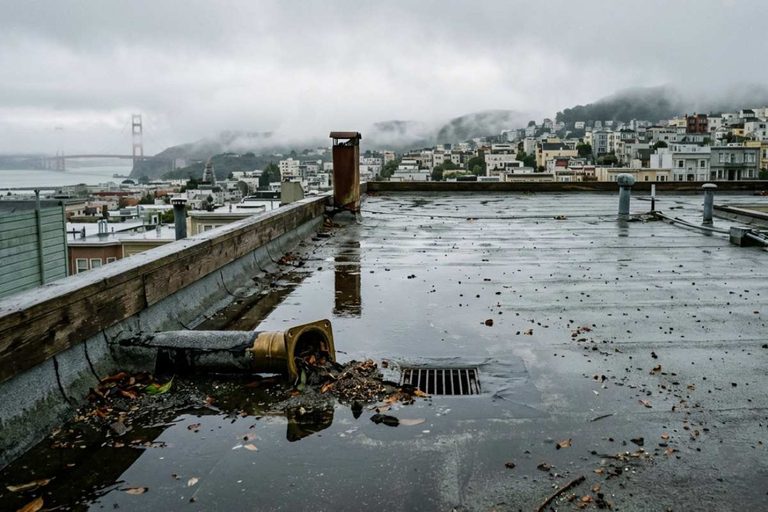
Leaves, pine needles, and moss collect behind the head flashing and in side channels. That dam backs water up under shingles instead of letting it flow around the skylight. On flat roofs, pooling near a skylight curb does the same job more slowly: water sits, finds a seam, and works in. This is why flat-roof skylights in San Francisco keep coming up as a repeat problem. See flat roofing in San Francisco for how flat-roof drainage and skylight curbs work together.
4. Poor installation and bad re-roof sequence
A skylight sealed mainly with caulk instead of woven step flashing and self-adhering membrane will fail early. Caulk dries, cracks, and shrinks in sun. The same happens when a new roof is laid over an old skylight frame without a proper re-flash. Reports of leaks one week after replacement, three months after a roof replacement, and again three years after a replacement all point to this category more than to bad glass.
5. Cracked, fogged, or aged glass
A hairline crack, a cracked acrylic dome, or permanent fogging between double panes means the unit itself has failed. Resealing the outside will not restore a failed inner seal or a cracked pane. If the glass is fogged and will not clear, or the dome is cracked, that is a replacement discussion, not a sealant discussion.
6. Blocked weep and condensation channel
Skylights are built with a small channel to collect water that gets past the glass seal and condensation that runs down the inside glass, so it can drain or evaporate. When that channel blocks with dirt, or gets covered during a re-roof, water has nowhere to go except inside. Clearing channels is a small job that prevents a large misdiagnosis.
A note on climate: freeze and thaw, ice dams, and snow melt show up a lot in national skylight content. They are not the main San Francisco cause. In San Francisco, the equivalent is winter rain from November to March, fog condensation, and flat-roof ponding. Do not let a national ice-dam section distract from a flashing or drainage problem here.
What to Do Tonight If Your Skylight Is Leaking in Rain
You do not need a permanent fix tonight. You need to limit damage and gather proof:
- Move furniture, electronics, and anything that stains easily away from the drip line.
- Put a bucket under the drip and a towel on the floor. Note the time rain started and when dripping started.
- Take photos of the stain, the drip, the skylight from inside, and any peeling paint or ceiling damage. Photos help a roofer and help any warranty or insurance conversation later.
- Do not go on a wet roof, do not step on skylight glass or the frame, and do not try to seal from the outside in rain. Wet sealant will not bond, and a wet roof is a fall risk.
- If the ceiling is sagging, soft, or bulging with water, stay clear of that spot and get a professional check promptly. Do not poke a hole in a bulging ceiling to drain it unless a professional tells you to.
- If the leak is small and the ceiling is solid, a temporary inside cover and a bucket will buy time until a dry-day inspection. That is the honest version of “buy a couple months”: buy time safely, do not pretend a bucket is a repair.
For rain-specific roof behavior, see roof leak after rain in San Francisco.
How to Diagnose a Skylight Leak Without Guessing
Guessing wastes sealant and hides the real entry point. Work in this order:
- Inside: note exactly where the stain or drip is, which corner, whether it happens in light rain or only heavy rain, and whether it happens on foggy dry mornings too. That last answer separates condensation from a leak.
- Attic, if you have safe access: look for wet wood, stained insulation, daylight around the curb, and water trails on rafters. Water trails often lead uphill from the stain.
- Roof, only in dry daylight and only if safe: check for debris behind the head flashing, lifted or rusted step flashing, cracked sealant at the glass edge, cracked dome or glass, and soft wood at the curb. Do not walk on the skylight.
- Hose test, low to high: with one person inside watching, spray gently at the lowest suspect area first, wait, then move up in small sections. If you start at the top, you will wet everything and learn nothing.
- Patch-test one area at a time: this is the Velux creator method that works well here. Temporarily cover or tape one suspect seam, wait for rain or a hose test, and see if the leak changes. Seal everywhere at once and you will never know what fixed it, or what did not.
- Document: photos of flashing, seals, channels, and any rot or mold. A roofer needs those photos to quote flashing work, membrane work, or replacement honestly.
If the leak returns after a reseal, if the deck or curb is soft, if glass is cracked or fogged, or if the roof is steep or high, stop and get a professional diagnosis. A second bead of sealant over a flashing or rot problem will not hold.
Skylight Leak Repair: What Actually Fixes Each Problem
Clear debris and channels
Remove leaves, needles, and moss from behind the head flashing and from side channels with a soft brush, not a metal scraper that tears flashing. Clear gutters and valleys that back water up toward the skylight. This alone fixes some heavy-rain-only leaks, and it is part of every other fix too.
Reseal the glass-to-frame joint properly
Old sealant must come off first. New sealant does not bond to old, dirty, or cracked sealant. Clean the joint, let it dry, and apply a continuous bead of exterior-grade silicone or elastomeric glazing sealant made for glass, metal, and roofing. One YouTube creator method uses a fleece-reinforced silicone seal across the glass-to-frame transition, with the surface sanded lightly and masked about three-quarters of an inch from the frame, then two coats. Treat that as one creator method, not as the only method and not as a guarantee. The principle that transfers is sound: clean, remove old material, bond to clean surfaces, and do not seal over dirt and old tar.
Do not block the weep or condensation channel with sealant, and do not seal an entire shingle or flashing run shut. Water needs a path out.
Replace a failed gasket
If the rubber gasket is hard, cracked, or disintegrating, order the correct gasket for that skylight model where possible, remove the old gasket, clean the seat, and fit the new one. If the model is old or custom and no gasket is available, that pushes the decision toward unit replacement, not toward more sealant.
Replace flashing and membrane
When flashing is rusted, bent, missing fasteners, or was never woven in correctly, resealing the surface will not fix it. The surrounding shingles or membrane must be lifted, damaged step flashing replaced, loose flange edges secured, and self-adhering ice and water shield wrapped up the curb and out over the deck. This is roof work, not a caulk job, and it is the fix behind most post-reroof leaks. For wet-weather timing on flat roofs, see flat roof repair in wet weather.
Repair curb and deck rot, or replace the unit
Soft, rotted, or mold-affected wood at the curb or deck must be repaired before any new flashing or skylight goes on. Sealing over rot hides it and lets it spread. If the deck is solid and the glass is clear, a flashing and seal repair can last. If the deck is soft, the frame is rotted, or the glass is fogged or cracked, replacement is the honest fix.
Repair vs Replace vs Remove: How to Decide in San Francisco
| Situation | Best move | Why |
| Isolated seal crack, glass clear, deck solid | Repair seal or gasket | Problem is local and fixable |
| Debris or blocked channel only | Clear and test | No part has failed yet |
| Flashing rusted, bent, or badly installed | Replace flashing and membrane | Sealant cannot replace flashing |
| Glass fogged between panes or cracked | Replace unit | Inner seal or pane has failed |
| Curb or deck soft, rotted, or moldy | Repair wood, then replace unit if needed | New flashing on rot will fail |
| Already re-roofing | Replace old skylight at same time | Re-flashing later costs similar labor again |
| Flat-roof skylight keeps leaking, shaft unwanted | Consider close-off and roof repair | Removes a chronic leak point |
| Bathroom skylight with no other window | Repair or replace, do not just close off | Closing it removes light and air |
Age alone does not decide this. Competitor guides disagree: one says repair under 10 years and replace over 15 to 20 years, another says replace over 20 years. Use condition instead: clear glass plus solid deck plus an isolated seal or flashing fault points to repair. Fogged glass, cracked dome, rotted curb, or a leak that returns after a proper flashing repair points to replacement. If you are already replacing shingles, replace an old skylight at the same time. Removing and re-flashing an old unit later takes nearly the same labor as fitting a new one, and it aligns the roof and skylight work.
For new skylight work, see skylight installation in San Francisco.
Flat Roof Skylights in San Francisco: Why They Keep Leaking
Flat-roof skylights fail differently from pitched-roof skylights. Water does not run off quickly. It pools, sits against the curb, and works at seams for hours after rain stops. A low curb, a membrane that stops short of the curb top, debris at the curb base, and a drain that backs up all make it worse.
If a flat-roof skylight has leaked more than once, ask three questions before another reseal: is the curb high enough and properly flashed with membrane, is drainage around the curb clear, and is the deck under the curb solid? If any answer is no, resealing the glass edge will not hold. In that case the choice is a proper curb and membrane rebuild with a new unit, or closing the skylight off and repairing the roof as a continuous surface. Closing off is a valid choice for a skylight nobody uses for light, and a poor choice for a bathroom or kitchen skylight that is the only source of daylight. See flat roof leaking in San Francisco for the flat-roof side of this problem.
Skylight Leak Repair Cost in San Francisco: Why Quotes Differ So Much
People ask about cost, then get three wildly different quotes and wonder if they are being scammed. The quotes differ because the jobs differ, even when the stain looks the same.
| What changes the price | How it changes the job |
| Leak source | Seal repair vs flashing replacement vs full unit |
| Skylight type and size | Fixed vs venting vs tubular vs custom size |
| Roof type | Pitched shingle vs flat membrane vs metal |
| Curb and deck condition | Sound wood vs rot repair before new work |
| Access and height | Easy low roof vs steep, high, or tight access |
| Scope in the quote | Flashing and membrane included or left out |
What a quote must list, in plain words: what is being repaired or replaced, whether flashing and membrane are included, whether deck or curb wood repair is included, whether the old unit and debris are removed, and what warranty applies to the work and to the unit, separately. A quote that only says “seal skylight” for a flashing failure is not cheaper. It is incomplete.
No verified San Francisco skylight price table is published here, because none was verified from the sources checked for this guide. The ranges below are general ranges published by national competitors, not San Francisco quotes, and they are included only so you can see why a national article number does not settle an SF price:
| Service level, national competitor ranges only | General range published nationally |
| Minor sealant and gasket repair | $250 to $450 |
| Flashing replacement kit | $500 to $950 |
| Complete skylight replacement | $1,200 to $2,500 |
| New skylight cut-in, no existing opening | $2,500 to $4,500 and up |
Do not treat those numbers as San Francisco prices. Size, type, roof, deck condition, and access move an SF quote, and a detailed inspection is how a real SF number is produced. If a quote is far higher or lower than the others, ask what is different in scope, not just in price. That question alone resolves most “am I being scammed” worries.
Precautions Before You Touch a Skylight
- Work only in dry daylight, on a dry roof, with a stable ladder and fall protection where needed. Never work on a wet roof.
- Never step on skylight glass, an acrylic dome, or the frame. Stay on roof decking.
- Never seal over old, dirty, or cracked sealant and expect it to hold. Remove old material and clean first.
- Never block weep channels, condensation channels, or drainage paths with sealant.
- Check the attic for wet insulation, stained wood, and mold smell before you decide a leak is small. A small stain can hide a larger wet area.
- If you see mold, peeling paint over a large area, soft drywall, or a sagging ceiling, do not just repaint. Find and fix the water entry first, then deal with the interior.
- If glass is cracked, if the roof is steep or high, if the deck feels soft underfoot, or if you are unsure about flashing, do not climb up to improvise. That is the point where a professional diagnosis saves money.
- Keep a record: date of leak, rain conditions, photos inside and in the attic, and what was repaired. That record matters for warranty and for any future leak in the same spot.
For a full roof-level check, a detailed roof inspection in San Francisco will look at the skylight in the context of flashing, shingles or membrane, and drainage, not as an isolated window.
How to Prevent the Next Skylight Leak
Prevention is mostly calendar work, not products:
- Before the November to March rain season, clear debris from behind head flashing, side channels, gutters, and valleys.
- In spring, check seals and flashing for cracks, lifting, and rust, and check the attic after the first heavy rain.
- After any roof work, check that the skylight was re-flashed, not just sealed around, and that channels were left clear.
- In bathrooms and kitchens, run exhaust fans and keep humidity down. That prevents condensation that looks like a leak and keeps seals and frames drier.
- Watch for early signs and act on them: a small stain, a musty smell near the shaft, fogging between panes, or a seal that has gone hard. Small skylight problems are cheap when they are flashing or seal problems. They get expensive when they become rot problems.
Fog is part of San Francisco life. A skylight that fogs on a foggy morning is not automatically failing. A skylight that stains a ceiling after rain is. Learn that difference once, and you will stop paying for the wrong fix. For the fog side of roof life here, see marine layer roof lifespan in Marin and San Francisco.
What About Warranty and Insurance?
These are the two questions people ask most after “how much,” and they have no single answer in the sources checked.
Warranty: a skylight usually has a manufacturer warranty for the unit and a separate installation warranty for the flashing and fitting work. Those are different documents, with different terms. Check both documents for your exact model and installer before assuming a leak is covered. A leak caused by failed flashing is not automatically a manufacturer defect, and a fogged pane is not automatically an installation fault.
Insurance: document the leak with dated photos, note when it started and what rain it followed, and check your own policy for what it covers and what it excludes. Coverage depends on cause, policy wording, and maintenance history. No article can promise coverage, and one online anecdote about a denied claim in another state does not set California rules. If you are unsure, ask your insurer what documentation they need before interior repair work covers up the evidence.
How We Checked This Guide
This guide was built for San Francisco, not copied from a national template. It uses four competitor articles, about 118 Reddit titles with votes and comments, seven YouTube transcripts, and a keyword table with no volume figures. Reddit titles were treated as questions and demand only, because no comment bodies arrived. YouTube material was treated as creator method, especially the fleece-reinforced silicone method from one creator, not as a guaranteed permanent fix. National competitor prices were labelled as national, not San Francisco, because no verified San Francisco skylight price was found in the sources checked. No online reviews were copied as our reviews. No Semrush volume or difficulty figure is claimed for this topic, because no Semrush table arrived for it. San Francisco local factors used here are marine-layer fog, November to March rain, flat-roof stock in SoMa and the Mission, Victorian and Edwardian older stock, and foggy west-side and Twin Peaks conditions. Area ZIP codes given are area examples only, not a business address.
Should I replace or close off a flat-roof skylight that keeps leaking?
If the curb, membrane, and drainage are rebuilt properly and the skylight is wanted for light, replacement can work. If the skylight is unused, the curb is low, drainage is poor, and it has leaked more than once, closing it off and repairing the roof as a continuous surface removes a chronic leak point. Do not close off a bathroom or kitchen skylight that is the only source of daylight without a light and ventilation plan.
Frequently Asked Questions
Bottom line
In San Francisco, most skylight leaks are flashing, seal, drainage, or re-roof sequence problems, not bad glass alone. Find the entry point with an inside, attic, and roof check, fix flashing and membrane when flashing has failed, replace the unit when glass is fogged or cracked or wood is rotted, and do not let a national price, a single-brand sealant claim, or a bead of caulk over old material stand in for a proper diagnosis. If your skylight is dripping, staining, or leaking only in heavy rain, get a detailed inspection before the next winter storm turns a seal problem into a ceiling problem.
For a detailed inspection from a licensed and insured C-39 contractor, call +1 833-804-6249.
NAICS Code 238160 – Roofing Contractors