
Flat Roof Leaking SF? Emergency Repair & What to Do Now
So your flat roof is leaking.
Maybe you noticed it during last week’s atmospheric river. Maybe you’ve got a water stain spreading across your ceiling right now. Maybe your tenant just texted you a photo of a bucket in the living room catching drips.
Welcome to the club. I’ve gotten about 40 calls in the past two weeks—all flat roofs, all leaking after the recent rains.
Here’s the thing about flat roofs in San Francisco: they’re not actually flat. They shouldn’t be, anyway. They’re supposed to have a slight slope (we call it “low slope”) so water drains off. But even when they’re installed right, they leak. Sometimes because they’re old. Sometimes because the fog never lets them fully dry out. Sometimes because… honestly, I still don’t know why some of them leak.
I’ve been fixing flat roofs in SF since 2009. Worked on everything from Victorian flats in the Mission to newer construction in SOMA to old warehouses in Dogpatch. I’ve seen every kind of flat roof leak you can imagine, and I’m going to walk you through this the way I’d explain it if you called me right now.
No fluff. No sales pitch. Just what you actually need to know.
Why Flat Roofs Leak in San Francisco (Spoiler: The Fog Doesn’t Help)
Let’s start with the obvious: San Francisco’s weather is weird.
We don’t get those big dramatic thunderstorms that other cities get. What we get is:
- Constant fog in the summer (especially if you’re in the Sunset or Richmond)
- Steady drizzle in the winter that just… doesn’t stop
- Atmospheric rivers that dump inches of rain in 48 hours
- Salt air if you’re anywhere near the coast
- Microclimates where it’s 65° and sunny in the Mission and 55° and foggy in the Outer Sunset
All of this moisture—and I mean constant moisture—takes a toll on flat roofing materials.
The Main Culprits
1. Ponding Water
This is the #1 cause of flat roof leaks. Period.
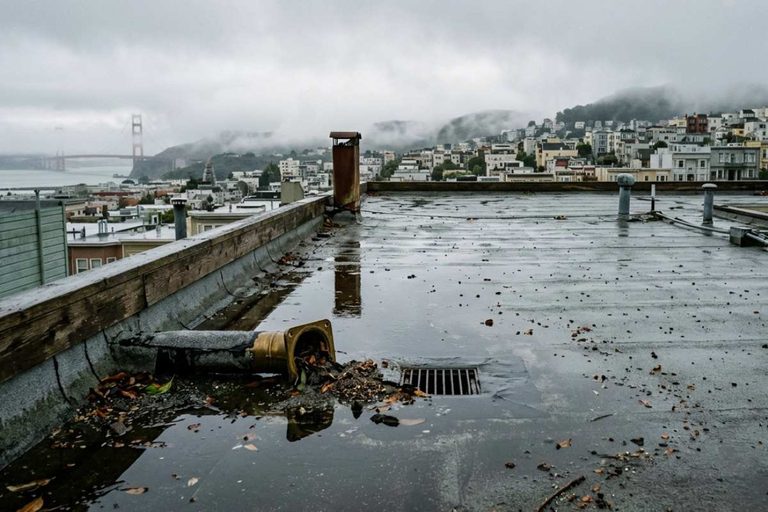
Water sits in low spots on your roof (we call them “bird baths” in the industry). It just… sits there. For days. Sometimes weeks if you’re in the fog belt and it never fully evaporates.
Over time, that standing water breaks down the roofing membrane. It doesn’t matter if it’s EPDM rubber, TPO, modified bitumen, built-up tar and gravel—water sitting on any of these materials will eventually find a way through.
I was on a roof in Bernal Heights last month—a beautiful installation, only 8 years old, but there was a low spot near the back corner where water pooled. The membrane had basically dissolved in that spot. The owner had no idea. Water was getting into the wall cavity and traveling 15 feet before it showed up as a ceiling stain in the kitchen.
2. Clogged Drains and Scuppers
Your flat roof needs to drain somewhere. Usually that’s through roof drains (the round grates you see) or scuppers (the openings in the parapet walls).
In San Francisco, especially in neighborhoods with lots of trees (like Cole Valley, Forest Hill, Twin Peaks), leaves and debris clog these drains constantly.
Clogged drain = water backs up = water finds the path of least resistance = water comes into your building.
I’ve pulled out everything from leaves to tennis balls to—no joke—a full bird’s nest from roof drains.
3. Failed Flashing
Flashing is the metal (or sometimes rubber) that seals the edges where your roof meets walls, chimneys, vent pipes, skylights, HVAC units.
This is where 90% of leaks actually start.
Not the main roof surface. The transitions. The edges. The penetrations.
I cannot stress this enough: 99% of leaks are flashing or transitions.
In San Francisco’s salt air (if you’re coastal) or constant moisture (if you’re in the fog belt), metal flashing corrodes. Sealant dries out and cracks. Rubber boot flashings around vent pipes get brittle from UV exposure.
I was just on a roof in the Marina—you could literally see daylight where the flashing had pulled away from the parapet wall. The owner kept thinking the leak was from the roof membrane. Nope. It was flashing the whole time.
4. Age and UV Damage
Most flat roofing materials last 15-25 years in San Francisco’s climate. Some newer systems (like TPO or PVC) might go 20-30 years if they’re maintained.
But here’s what happens: the sun beats down (yes, even through the fog—UV rays still get through), the material gets brittle, cracks form, and eventually water gets in.
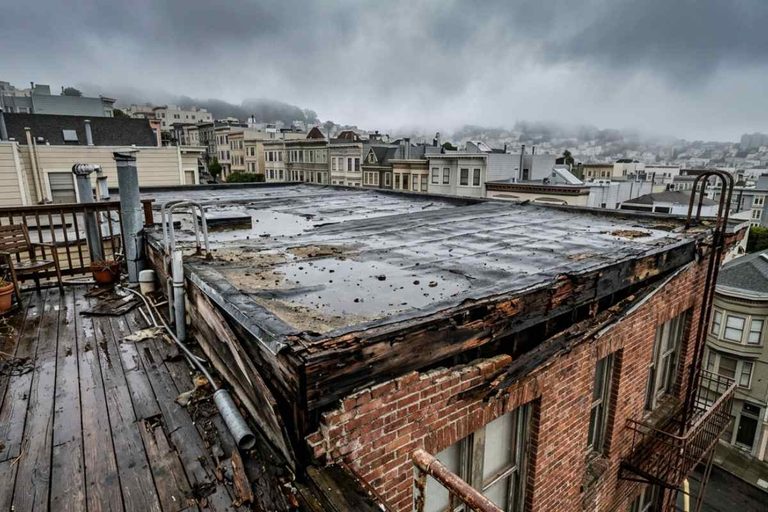
If your roof is over 20 years old and starting to leak, you’re probably looking at replacement, not repair.
5. Poor Installation
I hate saying this, but… a lot of flat roofs in San Francisco were installed by the lowest bidder.
Seams not fully welded. Underlayment skipped to save money. Drainage not thought through. Flashing done with caulk instead of proper metal work.
I re-do a lot of “repairs” that other roofers did. And by “repairs” I mean they gooped some tar over the leak and called it good.
How to Tell If Your Flat Roof Is Leaking (Even Before You See Water)
Sometimes leaks are obvious—water dripping from the ceiling, stains spreading across the drywall.
But sometimes they’re sneaky.
Signs to Watch For
Water stains on ceilings or walls
Brown or yellowish rings. They might be small at first. They grow over time.
Pro tip: if you see a stain, the actual leak is probably not directly above it. Water travels. On a flat roof, it can travel 10, 15, even 20 feet from where it’s getting in to where it shows up inside.
Musty smell
If it smells like wet socks or mildew, you’ve got moisture somewhere. Could be in the walls, could be in the ceiling cavity, could be insulation that’s soaked.
I’ve been in buildings where the smell hits you the second you walk in. That’s advanced water damage.
Bubbling or blistering on the roof surface
Go up on your roof (if it’s safe—don’t do this if it’s wet or you’re not comfortable). If you see bubbles or blisters in the roofing membrane, that’s trapped moisture. It’s trying to escape but can’t, so it lifts the membrane up.
Those blisters will eventually crack open. Then you’ve got a leak.
Sagging ceiling tiles or drywall
In commercial buildings, this is common. The ceiling tiles get waterlogged and sag. In residential, drywall might bulge or feel soft to the touch.
Mold or mildew growth
Especially in San Francisco’s damp climate, mold shows up fast. If you’re seeing black spots on walls or ceilings near where the roof is, you’ve got a moisture problem.
Finding the Leak (This Is Where It Gets Tricky)
Here’s the uncomfortable truth: finding a leak on a flat roof is hard.
Like, really hard. Sometimes frustratingly hard.
I’ve been doing this for 15 years and I still spend an hour or more on some roofs trying to track down where water’s actually getting in.
The Process
Step 1: Find where the leak is showing up inside
Go inside. Find the water stain or drip. Measure from two walls to that spot. Write it down.
Example: “12 feet from the north wall, 8 feet from the east wall.”
Step 2: Go up on the roof and measure the same distances
From the outside, measure from those same walls. Mark that spot on the roof.
That’s your starting point.
But—and this is important—the actual leak might be 10-20 feet away from that spot.
Why? Because flat roofs have layers. Water can get in at one spot, travel between the membrane and the deck (especially if you have a corrugated metal deck, which is common in older SF buildings), and show up somewhere else entirely.
I did a roof in Potrero Hill where water was coming into the office on the south side of the building. Spent an hour checking that area. Nothing obvious. Finally found the leak on the north side of the building, 25 feet away. Water was traveling through the channels in the metal deck.
Step 3: Check the usual suspects
Don’t just stare at the roof surface. Check:
- Roof drains (are they clogged? is the flashing around them cracked?)
- Parapet walls (where the roof meets the wall—is the flashing intact? can you see gaps?)
- Penetrations (vent pipes, HVAC units, skylights—anything that punches through the roof)
- Seams (if you have EPDM rubber or TPO, check where the seams are—are they lifting? peeling?)
- Low spots (where is water ponding? that’s probably where it’s getting in)
Step 4: The water test (if you’re desperate)
Some roofers will flood a section of the roof to find the leak. You basically dam up an area, fill it with water from a hose, and then go inside to see where water shows up.
I don’t love this method because you’re intentionally making the leak worse to find it. But sometimes it’s the only way.
Common Leak Spots on SF Flat Roofs
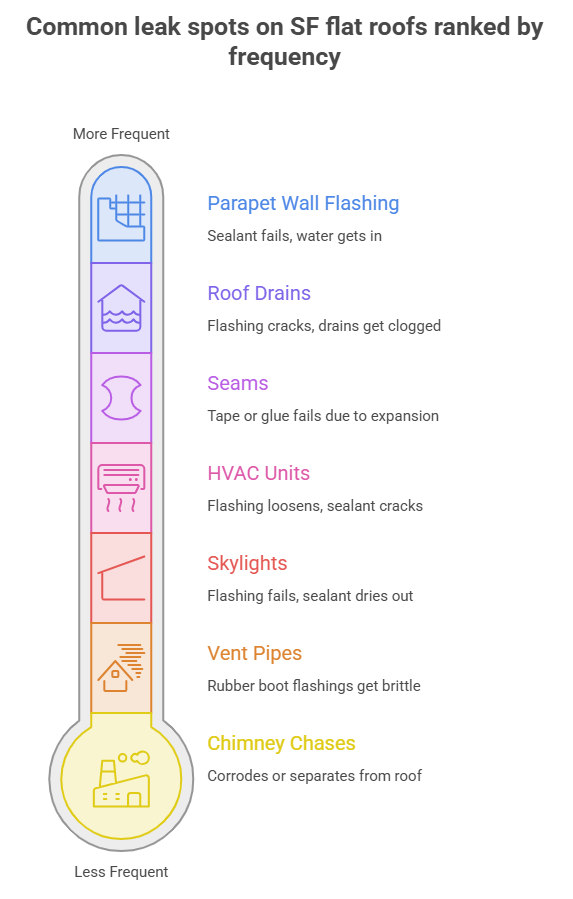
Based on 15 years of doing this, here are the spots where I find leaks most often:
1. Parapet Wall Flashing
The parapet is the short wall that goes around the edge of your roof. There’s supposed to be metal flashing (called a cap or coping) that covers the top of that wall and extends down both sides.
Over time, the sealant between the cap and the wall fails. Water gets in. Runs down the inside of the wall. Shows up in your building.
I see this constantly in older SF buildings. The Richmond, the Sunset, SOMA—everywhere.
2. Roof Drains
The flashing around the drain (the metal collar that seals the drain to the roof) cracks or separates. Water pours right in.
Also, drains get clogged. Then water backs up and finds any weak spot.
3. HVAC Units
Air conditioning units sit on curbs (raised platforms) on the roof. The curb is supposed to be flashed and sealed properly.
But what happens over time? The unit vibrates. The flashing loosens. Sealant cracks. Water gets in.
Also, if the HVAC installer didn’t coordinate with the roofer (which happens a lot), the installation might not be done right.
I’ve seen AC units just sitting on wooden blocks on top of the membrane with no proper flashing at all. Nightmare.
4. Seams (Especially on EPDM Rubber Roofs)
EPDM rubber roofs come in big sheets. Those sheets get glued or taped together at the seams.
In San Francisco’s temperature swings (hot days, cool foggy mornings), those seams expand and contract. Over time, the tape or glue fails. The seam opens up.
I see this a lot in the Sunset and Richmond where the fog keeps things damp and the seams never fully cure.
5. Skylights
Skylights are beautiful. They’re also leak-prone.
The flashing around the skylight frame fails. The sealant dries out. Cracks form.
If you have an old metal-framed skylight (common in older SF buildings), the metal corrodes in the salt air.
6. Vent Pipes and Chimney Chases
Anywhere something sticks up through the roof, you’ve got a potential leak point.
Vent pipes use rubber boot flashings. Those get brittle and crack after 10-15 years.
Chimney chases (the structure around the chimney) have metal flashing that corrodes or separates from the roof membrane.
DIY Repair vs. Calling a Pro (And When to Do Which)
Look, I make my living fixing roofs. But I’m not going to tell you to call a roofer for every little thing.
When You Can DIY (Maybe)
Small, obvious hole or crack
If you can clearly see where water’s getting in—like a nail popped through the membrane, or a small split in the rubber—you might be able to patch it yourself.
Products that work:
- Silicone roof sealant (the stuff in the caulking tube—good for small cracks around flashing)
- EPDM patch kits (if you have a rubber roof—Home Depot sells these)
- Roof cement/mastic (the black goop in a bucket—works for quick patches, but it’s not pretty)
I’ve seen Reddit posts where people say they fixed small leaks themselves with these products and it held for a few years.
But here’s the thing: a DIY patch is temporary. It’s a Band-Aid. It might buy you a year or two, but eventually you’ll need a real repair.
Clearing a clogged drain
You can do this. Go up on the roof (when it’s dry), pull the debris out of the drain, flush it with a hose.
Just be careful. Flat roofs can be slippery, especially in SF where there’s often moisture or moss.
When to Call a Pro
You can’t find the leak
If you’ve been up on the roof and you have no idea where water’s getting in, call someone. We have tools (moisture meters, infrared cameras) and experience that make finding leaks easier.
The leak is at a flashing or transition
Flashing repairs need to be done right. You need the right materials (metal, not just caulk), the right techniques (proper overlaps, fastening), and the right sealants.
A bad flashing repair will fail within a year. I re-do these all the time.
You’ve got ponding water
If water’s sitting on your roof and not draining, you’ve got a drainage problem. That might mean adding drains, re-sloping the roof, or installing tapered insulation.
That’s not DIY. That’s a professional job.
Your roof is old (15+ years) and leaking in multiple spots
At that point, you’re chasing leaks. You fix one, another pops up. You fix that, another one shows up.
That’s a sign the roof is done. You need a replacement, not more patches.
You’re not comfortable being on the roof
Flat roofs in SF often have parapet walls, which is good—it means you’re less likely to fall off.
But they can still be dangerous, especially when wet. If you’re not comfortable up there, don’t risk it.
What It Actually Costs to Fix a Flat Roof Leak in San Francisco (Real Numbers)
Let’s talk money. Because that’s what everyone wants to know but nobody wants to ask.
Repair Costs (Based on What I’ve Seen and Reddit Data)
Small patch (under 10 sq ft):
- DIY: $20-$50 in materials
- Professional: $400-$800 (minimum service call)
Medium repair (flashing, small section replacement, drain repair):
- $800-$2,500
Most roofers have a minimum charge just to show up. In SF, that’s usually $400-$600. Then labor and materials on top of that.
From Reddit (r/AskSF, 6 months ago): “Roofing company caused leak, mattress damaged”—the issue was they had to call the roofer’s insurance. Point being, even small repairs can turn into bigger headaches if not done right.
Major repair (multiple leaks, significant membrane damage, structural issues):
- $3,000-$8,000
At this point, you’re getting close to replacement territory. You need to weigh whether it makes sense to keep repairing or just replace the whole thing.
Replacement Costs
From the Reddit data:
- r/bayarea (2 years ago): “Redid a flat roof of ~1700 sq ft in Hayward for $16k 3 years ago”
- r/AskSF (1 month ago): “Average estimate for roof installation is around $29k for 3k sq ft”
So ballpark: $10-$15 per square foot for a flat roof replacement in the Bay Area in 2025.
For a typical San Francisco flat (let’s say 1,200-2,000 sq ft of roof area):
- $12,000-$30,000
Factors that affect price:
- Type of material (EPDM rubber is cheapest, TPO/PVC is mid-range, modified bitumen is mid-range, foam or fancy stuff is expensive)
- Accessibility (is the roof easy to get to? or are we hauling materials up three flights of stairs?)
- Condition of the deck (if we find rot when we tear off the old roof, that’s extra $$)
- Permits (SF requires permits for roof replacement—that’s $500-$1,500 depending on the scope)
- Neighborhood (SOMA commercial building? Different pricing than a residential flat in the Sunset)
The “San Francisco Premium”
Yeah, it’s real. Everything costs more here.
From Reddit (r/AskSF, 3 years ago): “Reroofing Costs in SF… The ‘415’ surcharge is ~15% more.”
Why?
- Higher labor costs (SF roofers make more than roofers in, say, Sacramento)
- Parking/access challenges (try getting a crane or material delivery truck onto a narrow street in North Beach)
- Permits and inspections (SF DBI is thorough)
- Cost of doing business in SF (insurance, licensing, overhead)
San Francisco Neighborhood Breakdown: Where Flat Roof Leaks Are Most Common
Not all SF neighborhoods are created equal when it comes to flat roof problems.
Sunset District / Outer Richmond (Fog Belt)
The Problem: Constant fog = constant moisture. Roofs never fully dry out.
I see more moss, algae, and membrane deterioration here than anywhere else in the city.
EPDM rubber roofs seem to have the most problems in these neighborhoods because the seams stay damp and fail faster.
What to watch for:
- Seam failure
- Moss growth around drains and edges
- Ponding water (because the fog keeps everything wet)
ZIP codes: 94116, 94122 (Sunset); 94121 (Richmond)
Mission District / Bernal Heights / Potrero Hill (Sunny, Less Fog)
The Problem: More sun = more UV damage. Roofing materials get brittle faster.
Also, these neighborhoods have a lot of older buildings with tar-and-gravel roofs that are way past their lifespan.
What to watch for:
- Cracking and splitting from UV exposure
- Blistering (bubbles forming in the membrane)
- Aged flashing that’s corroded or separated
ZIP codes: 94110 (Mission), 94107 (Potrero Hill), 94110 (Bernal Heights)
SOMA / Downtown (Commercial Buildings)
The Problem: Bigger roofs, more complex drainage, more HVAC equipment.
I work on a lot of commercial flat roofs in SOMA. The leaks are usually related to:
- HVAC equipment installations (curbs not flashed properly)
- Roof drains clogged or undersized for the roof area
- Parapet wall flashing on tall buildings (wind-driven rain gets in)
What to watch for:
- Leaks around rooftop equipment
- Drainage issues (because these roofs are BIG and need multiple drains)
ZIP codes: 94103, 94105, 94107
Marina / Presidio / Coastal Areas (Salt Air)
The Problem: Salt air corrodes metal flashing faster.
If you’re near the water, your metal flashing, screws, and fasteners are deteriorating faster than they would inland.
I’ve pulled up flashing on Marina roofs that looks fine from the top but is completely corroded underneath.
What to watch for:
- Corroded metal flashing
- Rusty fasteners
- Deteriorated sealant (salt air breaks it down)
ZIP codes: 94123 (Marina), 94129 (Presidio)
The Insurance Nightmare (Because Of Course There Is One)
Here’s something nobody tells you until it’s too late: San Francisco homeowner’s insurance companies are dropping policies because of flat roofs.
From Reddit (r/sanfrancisco, 4 months ago): “San Francisco homeowner dropped by insurer due to flat roof”
The comments: “Homeowners usually aren’t performing the maintenance required to prevent leaks in a flat roof.”
Another comment: “Very few companies accept Flat Roof’s. It’s been that way for over a decade at least.”
Why Insurers Hate Flat Roofs
- They leak more often than pitched roofs
- Water damage claims are expensive
- Maintenance is required (and most people don’t do it)
- They’re harder to inspect (can’t see them from the street)
What You Can Do
1. Document maintenance
Keep records of every inspection, every repair, every time you’ve had someone up there.
Some insurers will cover flat roofs if you can prove you’re maintaining them.
2. Get a roof certification
Some roofers (including us) can provide a roof certification that says “this roof is in good condition and should last X more years.”
That can help when you’re trying to get or keep insurance.
3. Consider replacement if your roof is old
If your flat roof is 20+ years old, you might not be able to insure it at all.
Replacing it with a newer system (TPO, PVC, or coated system) can make it insurable again.
4. Shop around
Some insurers still cover flat roofs. You might pay more, but they’re out there.
CSAA, Nationwide, sometimes Farmers (depending on the underwriter).
Products That Actually Work (And One That Doesn’t)
I’ve used pretty much every flat roofing product on the market. Here’s what holds up in San Francisco’s climate.
What Works
Silicone Roof Coating
This stuff is amazing. You can coat an existing flat roof (EPDM, modified bitumen, built-up) with silicone and it:
- Seals leaks
- Reflects UV (keeps the roof cooler)
- Is flexible (expands and contracts with temperature changes)
- Lasts 10-15 years
I’ve used it on roofs in the Sunset where the EPDM was failing but the deck was still good. Cleaned the roof, applied silicone coating, and the leaks stopped.
From the research: “Super Silicone Seal” is mentioned repeatedly as a product that bonds well to EPDM, asphalt, metal—basically anything.
TPO (Thermoplastic Polyolefin)
If you’re replacing your flat roof, TPO is solid.
It’s heat-welded at the seams (so no glue or tape to fail), it’s UV-resistant, it’s white (reflects heat), and it lasts 20-25 years in SF’s climate.
Cost: mid-range. More than EPDM, less than PVC.
Modified Bitumen (Torch-Down)
This is basically a modern version of tar-and-gravel roofs.
It’s durable, it’s proven, it handles ponding water well.
The seams are heat-welded with a torch, so they’re solid.
Downside: it’s black, so it absorbs heat. In SF’s cool climate, that’s not as big a deal as it would be in, say, Phoenix.
EPDM Rubber (If Installed Right)
EPDM gets a bad rap, but it works if:
- The seams are done correctly (either glued or taped properly)
- It’s not in a super-foggy area where seams stay wet
- It’s maintained
It’s the cheapest option for flat roofs, which is why it’s popular. Just know that in SF’s fog belt, seams can fail.
What Doesn’t Work
Cheap Tar Patches
Every DIY homeowner buys a bucket of roof cement from Home Depot, globs it on the leak, and thinks they’re done.
It doesn’t last. The tar cracks, peels up, and you’re back to leaking within a year.
If you’re going to use tar/mastic, you need to:
- Clean the area thoroughly
- Prime it
- Apply a thin layer
- Embed reinforcing fabric
- Apply another thin layer
- Feather the edges
Nobody does that. They just glob it on. It fails.
When to Repair vs. When to Replace
This is the question I get asked the most.
Repair If:
- Your roof is under 15 years old and the leak is localized
- The deck is still solid (no rot, no sagging)
- It’s one or two leaks, not multiple
- You’re on a tight budget and just need to buy a few more years
Replace If:
- Your roof is over 20 years old (it’s lived its life)
- You’re chasing leaks—you fix one, another shows up
- There’s rot or structural damage to the deck
- Your insurance company is threatening to drop you because of the roof
- You’re planning to sell (a new roof adds value and makes the sale easier)
From Reddit (r/BayAreaRealEstate, 2 months ago): Someone asked about roof replacement costs for insurance requirements. The reality is, if your insurer says “replace it or we’re canceling your policy,” you don’t have much choice.
Emergency Leak Response: What to Do Right Now If Your Roof Is Leaking
It’s 10 PM. It’s raining. Water’s coming through your ceiling. What do you do?
Immediate Steps
1. Contain the water inside
- Put buckets, pots, towels under the drip
- Move furniture, electronics, anything valuable away from the wet area
- If water’s pooling on the ceiling and the drywall is bulging, carefully poke a small hole to let it drain (I know this sounds crazy, but a controlled drip is better than the ceiling collapsing)
2. Document everything
- Take photos and videos
- Note the time, date, weather conditions
- This is for your insurance claim
3. Try to stop more water from getting in (if safe)
If you can safely get on the roof:
- Put a tarp over the area where you think water’s coming in
- Weight it down with something (boards, sandbags—NOT loose bricks that can slide off)
DO NOT go on the roof if:
- It’s dark
- It’s wet/raining
- You’re not comfortable up there
- The roof is steep or has no parapet walls
4. Call for emergency service
Most roofing companies have emergency numbers. We do. Many others do too.
Emergency repairs usually cost more (you’re paying for after-hours service), but stopping water damage now is cheaper than fixing mold and rot later.
Next Morning
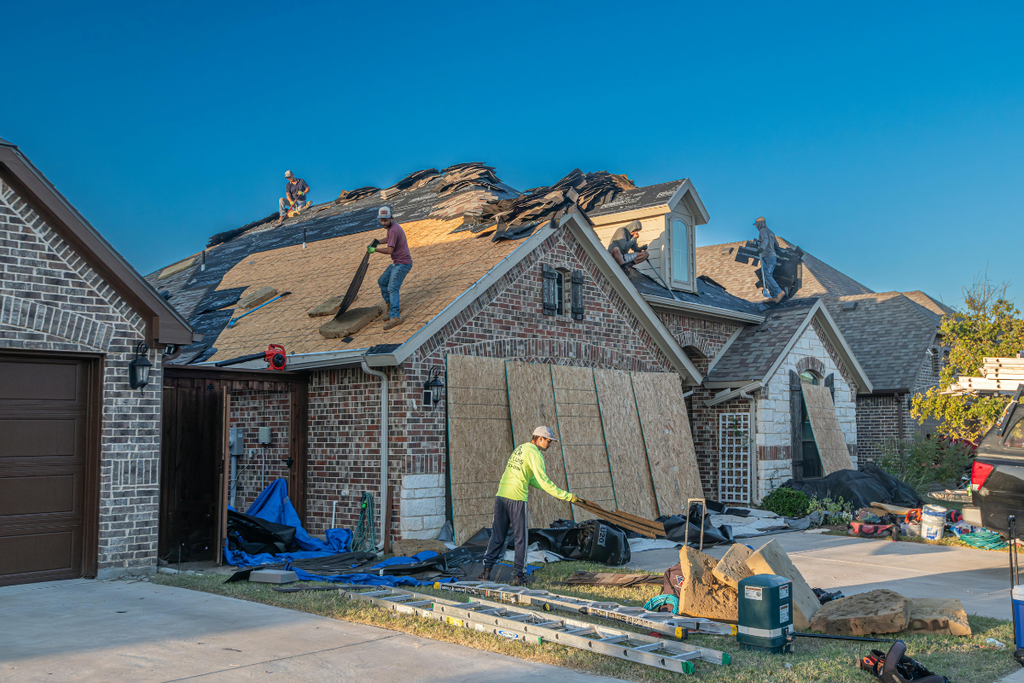
5. Get a tarp installed properly (if needed)
A professional can install a tarp that’ll keep you dry until the weather clears and we can do a permanent repair.
Cost: usually $300-$800 depending on size and access.
6. Get an inspection
Don’t just patch the leak and move on. Find out why it leaked so you can prevent it from happening again.
7. Call your insurance
If there’s interior damage (ceiling, walls, flooring), your homeowner’s insurance should cover it.
But here’s the thing: insurance usually covers the damage, not the roof repair itself (unless the leak was caused by a specific covered event like a storm).
Read your policy. Call your agent. Document everything.