Roof Repair vs Replacement in San Francisco (2026): Costs, Tests & When to Replace
Key Facts
- Repair in San Francisco: 450–1,800 for most repairs; flat-roof repair 350–2,500.
- Replacement in San Francisco: 17,000–42,000 for most homes in the site’s canonical range.
- Silicone coating: 3.50–6 per sq ft. TPO: 7–11 per sq ft. Torch-down / modified bitumen: 8–13 per sq ft.
- Decision rule: repair when the roof is young, damage is local, the deck is dry, and the repair buys real years. Replace when age, area, deck, layers, or cost per year point the other way.
- San Francisco is Climate Zone 3. Title 24 low-slope cool-roof rules for other zones do not apply the same way here.
- Phone: +1 833-804-6249. NAICS Code 238160 – Roofing Contractors.
Quick Answer: repair or replace your San Francisco roof?
Repair it if the leak has one clear source, the roof is in the first half of its life, less than a quarter of the field is affected, and the deck is solid. Replace it if the roof is within five years of end of life, repairs keep returning, the deck is soft, shingles are brittle, or a second layer sits on a slope roof.
A $450 repair lasting eight years costs about $56 a year. A $1,800 repair lasting two years costs $900 a year. A $17,000 replacement lasting 25 years costs $680 a year.
The 5-test decision: repair, restore, or replace
If a roof fails two or more, replacement moves from possible to likely.
1. Age test. Use age bands: under 15 years, repair first; 15 to 20, decide on condition; over 20, replace is likely. Asphalt lasts 20 to 30 years, three-tab 15 to 25 and architectural 25 to 40 in one creator source. Metal lasts 40 to 70 years, tile or slate 50 years or more. Within about five years of end of life, a large repair is money spent on a roof already ending.
2. Area test. One flashing leak, cracked pipe boot, or ponding patch is a repair. Widespread granule loss, curling, blistering, or leaks in three rooms is a system problem.
3. Deck test. The deck is the wood under the roofing. A roofer should walk it, probe soft spots, and check the attic for staining, sagging, and daylight. Soft, delaminating, or saturated decking means a surface patch will not hold. Moisture in the assembly is different from moisture on it, and a moisture reading or core cut can prove which one it is.
4. Layer test. Two layers on a slope roof usually mean the next job is a tear-off. Code does not allow a third layer, and a second layer hides the deck. Get the layer count in writing.
5. Cost-per-year test. Divide price by the years it should buy. A replacement is only a good deal if the full scope is included: tear-off, decking, underlayment, flashing, ventilation, permits, and cleanup.
For the full checklist, read how to read a roofing quote in San Francisco before you sign.
Why the percentage rules contradict each other
Search this question and you will find five different rules, measuring different things, which is why homeowners get opposite advice on the same roof.
Some guides use an area rule: replace when 25 to 30 percent is damaged, or above 30 percent, or up to 50 percent. One contractor source says there is no fixed percentage. Other guides use a cost rule: 25 to 30 percent of replacement, roughly a third, or up to 50 percent. Area and cost are not the same test. A small valley repair can be expensive; a large flat field can be cheap. If a contractor cites a percentage without saying area or cost, ask which one he means.
How repairs, re-roofing, and replacement differ
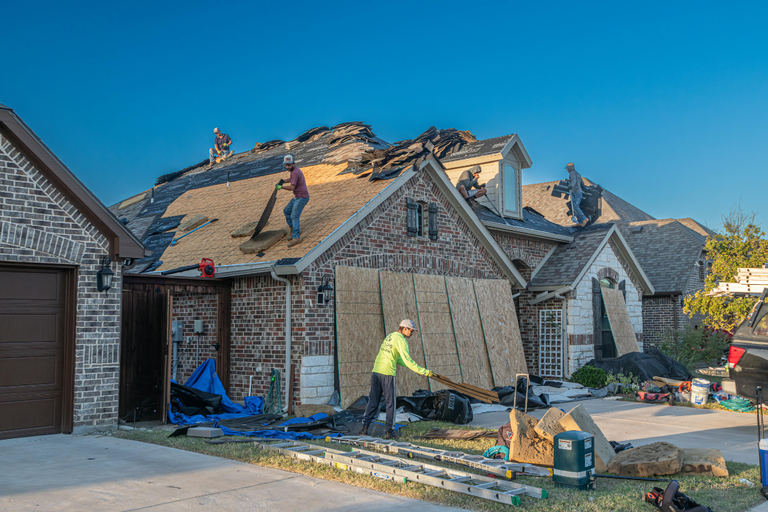
A repair fixes one local problem: a flashing, pipe boot, seam, or valley. A re-roof, or overlay, adds a new layer without removing the old roof down to the deck. A replacement, or tear-off, removes every layer down to the deck under R908.3, then rebuilds with underlayment, flashing, and ventilation. Re-roofing costs less and is faster, but it hides the deck and adds weight, and is not possible with two layers already present. Do not let a quote call an overlay a full replacement. Ask which one it is, in writing.
DIY vs professional. A homeowner can clear a gutter or patch one shingle on a low, safe slope. Hire a professional for a chimney, skylight, valley, or parapet leak, or for a brittle, wet, or two-layer roof.
Roof repair vs replacement cost in San Francisco
San Francisco costs are higher than national averages because access is tight and many homes are attached.
| Job | San Francisco range | What changes the price |
| Targeted slope repair | 450–1,800 | Flashing, valley, pipe boot, access |
| Flat-roof repair | 350–2,500 | Membrane type, ponding, deck condition |
| Silicone coating | 3.50–6 per sq ft | Prep, ponding |
| TPO replacement | 7–11 per sq ft | Insulation, seams |
| Torch-down replacement | 8–13 per sq ft | Layers, deck, access |
| Full replacement | 17,000–42,000 | Size, material, tear-off |
Other sources report wider ranges. HomeYou lists repair at $462 to $6,486 and replacement at $12,725 to $25,759. Recommended.app lists repair at $325 to $7,250, replacement at an average of $14,500, and premium work at $48,000 or more.
Labour is part of the spread. HomeYou reports $96 to $225 per hour, average $157. Another source reports a $38 per hour wage figure, a wage, not a rate charged, so do not compare them as the same number. Permits conflict too: Apollo reports $256.62 and $386.22, HomeCostLens reports $400 to $1,000, and an earlier site draft reported $514 or more and $714 or more. Verify the live Department of Building Inspection fee before you budget. A $4,200 repair quote is a common pain point. It can be fair for a complex valley, chimney, or skylight rebuild, and high for a single pipe boot. The test is scope.
Cost per year: the maths that settles most arguments
Cost per year turns a quote into a decision. Divide price by expected life. Use the same method for repair and replacement.
| Option | Price | Expected life | Cost per year |
| Small repair | $450 | 8 years | $56 per year |
| Large repair | $1,800 | 2 years | $900 per year |
| Replacement | $17,000 | 25 years | $680 per year |
| Replacement | $42,000 | 25 years | $1,680 per year |
Creator material shows the same point: $1,500 for two years is $750 a year, $14,000 for 28 years is $500 a year, and $1,500 for 12 years is $125 a year. A repair life is an estimate, not a warranty. Ask for the expected life in writing. Add up cumulative repairs: if they already total 25 to 30 percent of a replacement without buying long life, replacement is usually better. If solar panels sit on the roof, check detach and reset, reported at $200 to $300 per panel by EnergySage in May 2026. Restoration life is reported as 10 to 20 years in some sources and 5 to 10 years in others, depending on prep, ponding, and candidate quality. For commercial roofs, read commercial roof restoration vs replacement in San Francisco.
What changes the answer by material
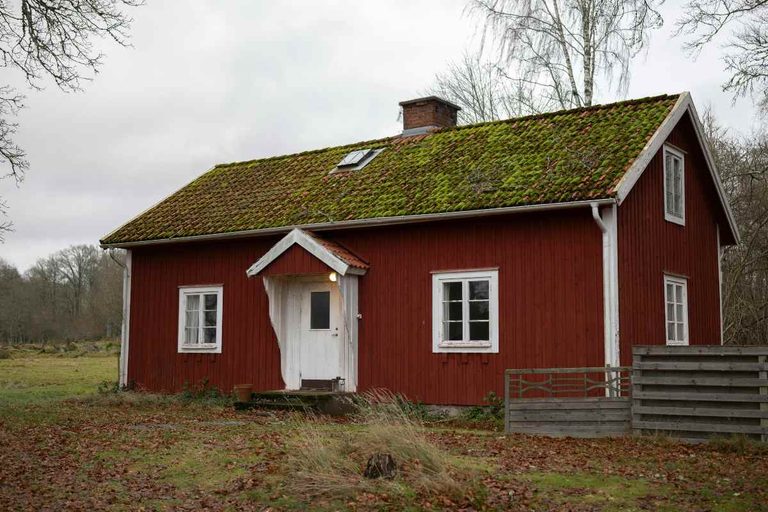
Asphalt shingles. Repair when granules are present, shingles are flexible, and the leak is at a flashing, boot, or valley. Replace when shingles are brittle, curling, or losing granules across a slope. In the brittle test, a lifted tab that cracks instead of bending means the roof is near the end of its repair life.
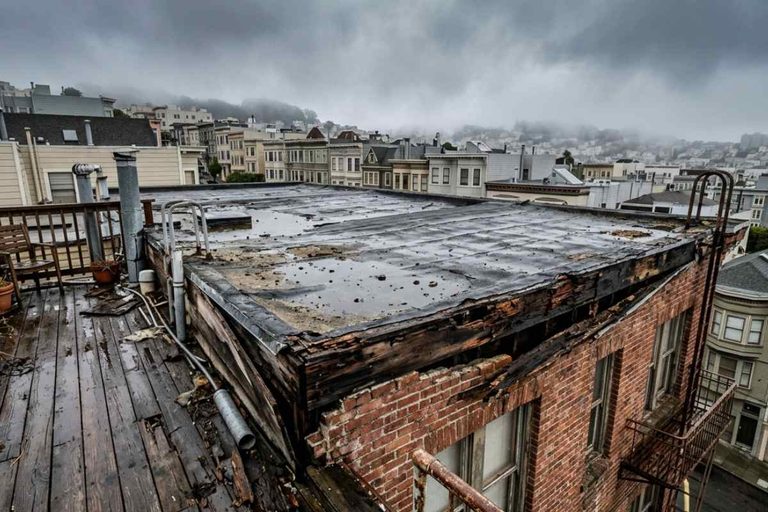
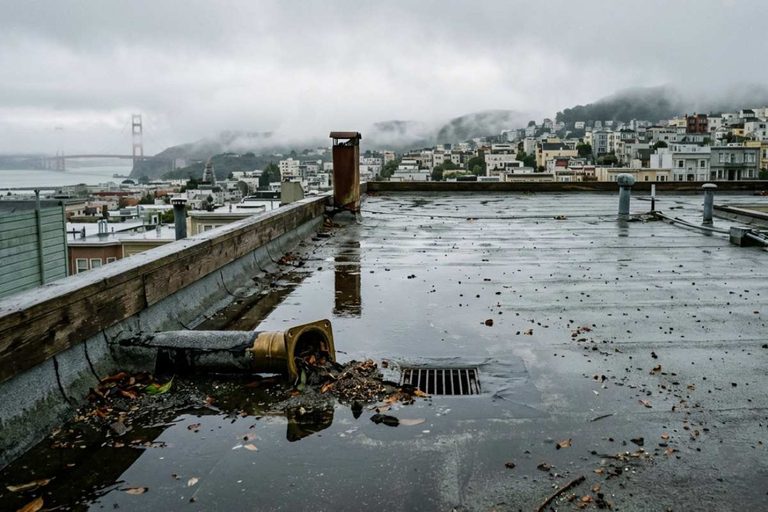
Flat roofs: TPO, torch-down, and modified bitumen. Many homes in the Richmond, Sunset, Mission, and Excelsior have flat sections. Repair a local seam, single blister, or small ponding patch. Replace when seams fail in several places, the membrane is brittle, ponding lasts more than 48 hours, or moisture is trapped under the membrane. See flat roof repair in wet weather in San Francisco.
Tile. Tile fails at underlayment, flashing, and broken pieces, not as a tile. Repointing, rebedding, and flashing repair can buy years. Replace when underlayment fails across a slope or battens are rotted.
Slate. Slate is usually a repair roof. Replace only for fastener failure, widespread delamination, or deck failure. User posts consistently favour repair for slate.
Metal. Repair a failed seam, loose fastener, or flashing detail. Replace when rust is widespread, panels are thin, or the deck is failing. A quote should name the profile, standing-seam or corrugated.
EPDM, PVC, and wood shake. EPDM and PVC follow the TPO rule: repair a local seam, replace when seams fail widely or the membrane is brittle. Wood shake follows the asphalt rule: repair when sound and local, replace when split, curled, or rotted across a slope. Pipe boots commonly need replacement every 10 to 15 years in creator material, especially in salt air and UV.
New roof leaking: install errors. A 5 to 6 year old roof that looks fine usually does not need replacing for a chimney flashing leak. A 6 year old roof said to need replacement may have an installation error, and a 5 year old roof with a 30 year warranty should not be replaced on age alone. If errors are found in one area, they likely exist throughout. Check the workmanship warranty and get the error in writing with photos.
San Francisco local factors: fog, salt air, and old houses
San Francisco weather is marine layer, fog, wind-driven rain, salt air, and long damp periods. That mix changes how roofs fail.
Fog keeps roofs damp after sunrise in the Richmond District (94121), Sunset District (94122 and 94116), and near Ocean Beach and Golden Gate Park. Salt air corrodes flashings near the Great Highway, the Marina District (94123), and the Embarcadero.
Victorians and Edwardians in Pacific Heights (94115), Noe Valley (94114), the Haight (94117), and the Mission (94110) have steep slopes, valleys, dormers, and chimneys that leak first. Eichlers in the Sunset and Diamond Heights have low-slope sections that pond. ZIP codes name the exposure, not a price: a flat roof in Bayview (94124) faces a different risk than a Victorian in Bernal Heights (94110 and 94112), and a tile roof in St. Francis Wood (94127) faces different moss pressure than a torch-down roof in SoMa (94103 and 94107).
Insurance: RCV vs ACV, storm vs wear, and the 51% problem
Insurance is the second most common pain point, after conflicting quotes. The freshest example is a homeowner whose insurer approved a full replacement but paid only 51 percent. The gap is usually depreciation.
RCV vs ACV. Replacement Cost Value is the cost to replace now. Actual Cash Value is replacement cost minus depreciation. A 15-year-old roof with a 25-year life is 60 percent depreciated, so on $12,000 the insurer may pay $4,800 before the deductible.
Storm vs wear. Insurance usually covers sudden storm damage, not wear, age, or poor maintenance. Wind damage is often local, while hail can damage a whole roof. Photos, dates, and a written inspection help. A denied claim still needs a written record, and some insurers have dropped flat roofs in San Francisco.
Documentation before the contractor arrives. Photograph the roof, attic, and interior stain. Note the storm date. Check whether the policy pays RCV or ACV, and get the scope in writing before work starts.
Permits, Title 24, and code: what San Francisco actually requires
A replacement usually needs a Department of Building Inspection permit. A small repair may not. Check the scope with the department or a licensed C-39 contractor before work starts.
Title 24, Climate Zone 3. San Francisco is Climate Zone 3. The 2025 standards govern permits filed on or after January 1, 2026. For low-slope nonresidential roofs, the prescriptive cool-roof rule applies in Zones 2, 4, and 6 to 15, not the same way in Zone 3. A guide that says all low-slope roofs must be cool roofs is wrong for San Francisco.
For steep-slope nonresidential roofs in Zones 1 and 3, aged solar reflectance is 0.20 or higher. The alteration trigger is more than 50 percent of area or more than 2,000 square feet, whichever is less. Insulation is R-23, U-0.037, with at least R-10 above deck.
R908.3 and the two-layer rule. Replacement means removal down to the deck, the point of R908.3. With two layers already present, the next job is a tear-off.
The third option: restoration, not just repair or replace
Restoration is a coating or membrane system over a sound roof to extend life. It works when the deck is dry and ponding can be fixed. It does not work when the deck is rotted or moisture is trapped. For homes, silicone at $3.50 to $6 per sq ft is the closest equivalent on many flat roofs. See best roof coating for a leaking flat roof in San Francisco.
When two roofers disagree: quotes, upselling, and the independent check
The most common pain point is not price. It is trust. Three roofers say replace. One says repair. One quote is $35,000. Another is $42,000. A third is $200,000 for the same roof.
Ask each roofer for the same scope in writing: tear-off or overlay, decking allowance, underlayment, flashing, ventilation, permits, cleanup, and warranty registration. Upselling red flags are age alone as the reason, no photos or attic check, no written scope, pressure to sign today, and a full replacement for one flashing leak on a young roof.
An independent condition report from someone not bidding the job is a useful check. It is a paid, detailed inspection with a written report, not a sales visit. Use it when quotes conflict by a large amount.
What to expect during a roof replacement
Expect noise and debris, and a period when the roof is open, so the contractor should stage work in dry weather and cover the roof each day. The order is tear-off, deck check, underlayment, flashing, new roofing, ventilation, and inspection.
Selling, buying, and the repair-now plan
If you are selling, a repair can be right when the roof has life left and the buyer wants a dry home. If you are buying, two layers, brittle shingles, or a soft deck is a negotiation point. A seller can offer a price reduction or credit, and an appraiser or lender can require replacement before closing. Get a detailed inspection before you close.
The middle ground is repair now, replace planned. Fix the active leak, the failed flashing, and the drain, then plan replacement for a dry season with a permit and a full scope. Two repairs in 36 months in different places is a warning. One leak is an event. Two leaks in different places is a system aging out.
FAQs
Is it better to repair or replace a roof in San Francisco?
Repair when the roof is young, damage is local, the deck is dry, and the repair buys real years. Replace when it is within about five years of end of life, damage is widespread, the deck is soft, or a second layer sits on a slope roof.
What is the 25% rule for roof repair vs replacement?
It is usually an area rule: replace when about a quarter to a third of the field is damaged. Other guides use a cost rule of 25 to 50 percent of replacement cost. Use both.
How much does roof repair cost in San Francisco in 2026?
Most targeted repairs are $450 to $1,800. Flat-roof repairs are $350 to $2,500. The wider market spread is $325 to $7,250.
How much does roof replacement cost in San Francisco in 2026?
The site’s canonical range is $17,000 to $42,000. HomeYou reports $12,725 to $25,759. Recommended.app reports an average of $14,500 and premium work at $48,000 or more.
How long does a roof repair last?
A small flashing repair on a young roof can last eight years or more. A large repair on an old, brittle roof can last two years. Creator material reports a couple of months to a couple of years for a repair on a failing roof. Ask for the expected life in writing.
Does insurance pay for roof replacement in San Francisco?
Insurance usually pays for sudden storm damage, not wear or age. If the policy pays Actual Cash Value, a 15-year-old roof with a 25-year life is 60 percent depreciated, so a $12,000 replacement cost may pay $4,800 before the deductible.
How do I know if a contractor is upselling me a replacement?
Age alone, no photos, no attic check, no written scope, and pressure to sign today are red flags. Get a second scope in writing, and an independent condition report if quotes conflict by a large amount.
Can I repair my roof myself, or should I hire a professional?
Clear a gutter or patch one shingle on a low, safe slope yourself. Hire a professional for a chimney, skylight, valley, or parapet leak, or for a brittle, wet, or two-layer roof.
What should I expect during a roof replacement?
Tear-off, deck check and repair, underlayment, flashing, new roofing, ventilation, and inspection. Expect noise and debris, and ask how the crew covers the roof each day.
What should a San Francisco roof replacement quote include?
Removal of every existing layer, hauling and disposal, a decking allowance with a unit price per sheet, underlayment, flashing, pipe boots, ventilation, permits, inspections, cleanup, and warranty registration.
Do I need a permit to replace a roof in San Francisco?
A full replacement usually needs a Department of Building Inspection permit. Reported fees conflict, from $256.62 and $386.22 in one source to $400 to $1,000 in another and $514 or more in an earlier site draft.
When should I repair now and replace later?
Repair now when one leak has a clear source and the roof has life left. Plan replacement when repairs return in different places, or cost per year favours replacement. Two repairs in 36 months in different places is a sign the system is aging out.
Bottom line
In San Francisco, repair when age, area, deck, layers, and cost per year all point to repair. Replace when two or more of those tests point to replacement. Get the scope in writing, check the permit and Title 24 zone, and do not let a single percentage rule decide a $17,000 to $42,000 job.
NAICS Code 238160 – Roofing Contractors. For a detailed inspection and a written scope, call +1 833-804-6249.