
Torch Down Roofing Cost SF 2026: Why Quotes Vary So Much
If you’ve gotten three torch down roofing quotes for the same flat roof and they came back $35,000, $42,000, and $200,000, you’re not imagining things — and you’re not alone. That’s a real spread local homeowners have reported for identical jobs, and it’s exactly why so many San Francisco residents end up posting their quotes online just to ask “did I get ripped off?”
We walk SF’s flat roofs for a living — Sunset District rowhouses, Bayview warehouses, Noe Valley Edwardians with flat additions off the back. Here’s what we tell people standing next to us on the roof, not a generic national number pulled from a cost calculator.
Torch Down Roofing Cost in San Francisco: Quick Answer
Based on real SF-area jobs homeowners have reported, torch down roofing in San Francisco typically runs $9,000 to $35,000+ for a full residential reroof, depending on roof size, number of layers, material grade, and what’s found underneath once the old roof comes off. Smaller roofs (800–1,400 sq ft) tend to land between $13,000 and $19,000. Larger roofs (2,500–3,000+ sq ft) commonly run $26,000 to $35,000. Jobs that uncover rotted decking, rotted roof beams, or require a full multi-layer tear-off push well past that range.
That’s a wide bracket on purpose — because in this city, it genuinely is one.
Get Your Roofing Project Quote Today
Why Torch Down Roofing Quotes Vary So Wildly in SF
This is the question we get asked more than any other, and it deserves a real answer instead of a reassuring brush-off.
Local homeowners have publicly compared quotes for the same roof that ranged from roughly $35,000 to $200,000 — a gap too large to explain by material choice alone. A few forces specific to San Francisco drive that spread:
- Scaffolding and access costs get left out of some quotes entirely. Rowhouses with shared walls and narrow lots often require scaffolding rental just to safely access the roof, and that’s an easy line item for a lower bidder to quietly omit — then add back in later.
- What’s under the old roofing isn’t known until tear-off. Rotted roof beams, soft decking, and water-damaged structural wood are common in SF’s older housing stock, and a quote that doesn’t account for this risk at all is often either incomplete or padded to cover an unknown.
- Scope changes mid-project are common. One SF homeowner was quoted for a bitumen torch down reroof, but the city inspector required a switch to shingles partway through — changing both the material and the labor scope, and the final price along with it.
- Labor availability is genuinely tight here. Multiple SF homeowners have described real difficulty just getting a second or third contractor to show up and quote the job at all, which lets the contractors who do show up charge a premium.
The fix isn’t finding the “right” number — it’s getting an itemized quote. A bid that separates tear-off, decking contingency, material, labor, scaffolding/access, and disposal lets you actually compare two contractors instead of comparing two mystery totals.
Learn More, Foam Roof Problems in San Francisco
Torch Down Roofing Cost by Roof Size in San Francisco
Roofers price by the roofing square — one square equals 100 square feet. Here’s what homeowners have actually reported paying for torch down and modified bitumen reroofs around the Bay Area, broken down by approximate size:
| Roof Size | Reported Cost Range | Notes |
| 800 sq ft | ~$19,000 | Smaller roofs often carry a per-square premium — contractors don’t like small jobs, and mobilization costs don’t shrink with the roof |
| 1,000–1,125 sq ft | 10,000–13,000+ | Base price can climb fast if beam or deck rot is found mid-project |
| 1,400 sq ft | 13,000–30,000 | Wide range depends heavily on whether material stays bitumen or switches to shingle per inspector requirement |
| 2,100 sq ft | ~$14,500 | Reported for a straightforward job with no major structural surprises |
| 3,000 sq ft | ~$29,000 avg | Larger roofs generally land closer to this average when no hidden damage is found |
| Full home incl. solar removal/reinstall | 35,000–40,000 | Solar portion alone has run roughly $5,000 of the total in reported cases |
Why smaller roofs sometimes cost more per square foot than larger ones: mobilization, scaffolding, and crew setup cost close to the same whether the roof is 800 square feet or 2,000. On a small roof, that fixed cost gets spread across less material, which is why an 800 sq ft job can land at a higher effective rate than a 3,000 sq ft one.
What Actually Drives Your Torch Down Roofing Price in SF
1. Number of Plies (2-Ply vs. 3-Ply)
Torch down roofs are built in layers — most commonly a 2-ply or 3-ply modified bitumen system.
- 2-ply systems cost less upfront but have a shorter realistic service life.
- 3-ply systems cost more in material and labor but are reported by installers to last significantly longer when properly maintained — some roofers report 2-ply systems commonly lasting around 35 years, and well-maintained 3-ply systems reaching 50 years or more. These are field-reported lifespans, not manufacturer guarantees, so ask your contractor what warranty actually backs the number they quote you.
2. Material Type — SBS vs. APP Modified Bitumen
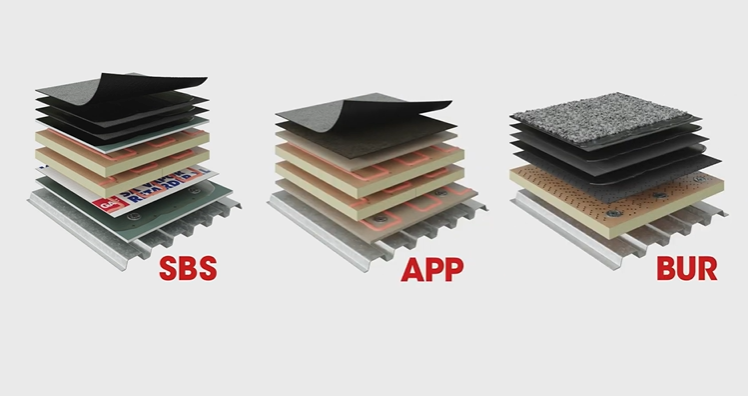
- SBS modified bitumen is more flexible and handles San Francisco’s thermal swings — foggy mornings followed by sun-exposed afternoons — without becoming brittle.
- APP modified bitumen is more rigid and UV-resistant but performs worse in sustained cold, which is less relevant here than in snow climates, but still worth discussing with your contractor if your roof sits in a wind-exposed or fog-heavy microclimate.
Ask which system your contractor is proposing and why — not just “torch down,” since that’s an installation method, not a material spec on its own.
3. Tear-Off and Existing Layers
If your roof already has multiple layers of old roofing material stacked up, all of it has to come off before new torch down goes on. More layers means more labor, more disposal cost, and more chance of finding damage once everything’s stripped back — this is one of the most common reasons an initial quote grows mid-project.
4. Decking and Structural Condition
This is the single biggest wildcard in SF reroofing. Real SF homeowners have reported rotted main roof beams and redwood roof beams discovered only after tear-off began, adding thousands to a project that looked straightforward on paper. A contractor who doesn’t mention a decking/structural contingency in writing before work starts isn’t giving you a complete picture — ask for a per-sheet or per-linear-foot rate for replacement decking or framing before you sign anything.
5. Roof Complexity and Access
Flat roofs with parapet walls, multiple penetrations (vents, skylights, HVAC curbs), or limited truck/dumpster access cost more to work on. Narrow SF lots and shared-wall rowhouses frequently require scaffolding just to get crews and materials safely to the roofline — budget for this explicitly rather than assuming it’s bundled in.
6. Permits
Most roof replacement work in San Francisco requires a building permit through the Department of Building Inspection. Permit fees and requirements vary by project scope — confirm the current fee schedule directly with SF DBI, and make sure your contractor’s quote clearly states whether the permit cost is included or billed separately.
San Francisco’s Climate and Housing Stock Make This More Complicated Than a National Average
A generic “roofing cost calculator” doesn’t account for what actually happens to a flat roof in this city:
- The fog belt vs. the sun belt. A flat roof in the Outer Richmond (94121) or Inner Sunset (94122) sits under marine fog moisture for much of the year, while a roof in Noe Valley (94114) or Bernal Heights bakes under direct sun with far less fog cover. The same torch down system ages at different rates depending on which side of the city it’s on.
- Salt air near the waterfront. Properties in Dogpatch (94107) and Bayview–Hunters Point (94124) sit close enough to the Bay that airborne salt accelerates wear on flashing and membrane seams faster than inland neighborhoods.
- Wind exposure. Areas like Visitacion Valley (94134) and hillside properties near Twin Peaks see sharper wind loading, which stresses membrane edges and parapet details over time.
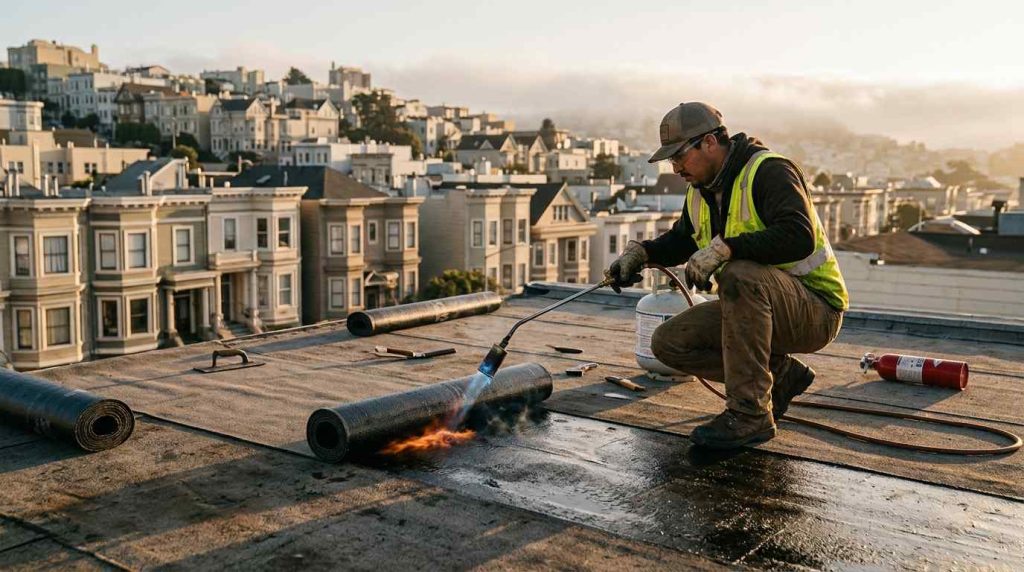
- Shared-wall rowhouse construction. Torch down installation uses an open propane torch applied directly to the roof deck. On attached rowhouses common across the Mission, Sunset, and Richmond districts, that open-flame risk is a real consideration — some roofers will recommend a cold-applied (peel-and-stick) system specifically for shared-wall properties for this reason.
- Flat and low-slope housing stock. Many SF homes — including classic Eichler-influenced flat-roof designs and rear additions over light wells — were built with minimal slope to begin with, which makes proper drainage and ponding prevention a bigger factor here than in a typical suburban reroof.
Hidden Costs Homeowners Keep Getting Surprised By
Based on what we consistently see come up after a quote is accepted, not before:
- Scaffolding rental — confirm whether this is in your quote, not assumed
- Rotted or soft decking — ask for a per-sheet replacement rate upfront
- Rotted structural beams — a real, reported cost-driver on SF jobs specifically
- Chimney and skylight flashing repair — often only discovered once the old roofing is stripped back
- Scope changes required by the city inspector — occasionally a material switch is mandated mid-project
- Permit fees — confirm with SF DBI and your contractor whether this is itemized or bundled
A detailed, itemized written estimate should address every one of these before work starts. If your quote is a single number with no breakdown, you don’t actually know what you’re paying for — or what might get added later.
How to Tell If You’re Being Quoted Fairly
- Get at least three written, itemized quotes for the same scope of work — material, layer count, tear-off, and decking contingency should be specified identically so you’re comparing apples to apples.
- Ask what happens if they find rotted decking or beams. A contractor who has a clear, pre-agreed per-unit rate for this has done this before. One who shrugs and says “we’ll figure it out” is leaving the door open for a number that grows significantly mid-project.
- Confirm the actual installation method in writing. Some SF homeowners have reported being quoted for torch-applied work and later discovering the material was mechanically nailed down instead — a different (and generally lower-cost, lower-durability) method.
- Ask about ply count and material brand specifically, not just “torch down roofing” as a catch-all term.
- Verify licensing and insurance directly — don’t take a business card’s word for it. Confirm any contractor’s license status yourself through the California Contractors State License Board.
- Be wary of a bid that’s dramatically lower than the others with no explanation — and equally wary of one dramatically higher with no itemization to justify it.
Repair or Full Replacement? A Quick Gut-Check
- Repair likely makes sense if the roof is under roughly 15 years old, the damage is isolated (a single blistered or lifted seam, one flashing failure), and the rest of the membrane is in otherwise sound condition.
- Replacement is the better call if you’re seeing widespread cracking or blistering across the roof, repeated leak calls to the same general area despite prior patches, or ponding water that doesn’t drain within a day or two of rain.