

Commercial Solar Reroofing San Francisco: Costs & Detach Guide
Key Facts
- 2026 commercial solar cost: 1.10–2.55 per watt installed, before incentives (national benchmark)
- Detach and reset: 200–300 per panel (national benchmark, EnergySage May 2026)
- Federal tax credit deadline: begin construction by July 4, 2026, or placed in service by December 31, 2027
- Panel life: 25–30 years; roof rule: replace the roof before solar if it has about 5 years of life left
- San Francisco roof costs: TPO 7–11, torch-down/modified bitumen 8–13, silicone coating 3.50–6 per sq ft
- Recycling: We Recycle Solar is the only EPA-permitted dedicated solar panel recycler in the United States, up to 99% recovery
Quick Answer
Put the roof first. A commercial solar array lasts 25 to 30 years, and most of the roofs it gets bolted to do not. If your roof has about five years of life left, replace it before the panels go on. Taking an array off and putting it back on costs $200 to $300 per panel, and a large commercial array can run past $30,000 just for the detach and reset. In 2026, commercial solar runs $1.10 to $2.55 per watt installed before incentives, and most well-sited systems pay back in 6 to 10 years. The federal tax credit has a hard deadline now: begin construction by July 4, 2026, or be placed in service by December 31, 2027. In San Francisco, add the marine layer, Title 24, the California 50% rule, and PG&E’s net billing tariff to the math before you sign anything.
The One Rule: The Roof Comes First
Every solar problem on a commercial building starts where the array meets the roof. The panels will outlast the roof. That decides everything else: when to install, what mounting to use, and whether to reroof first.
One roofing company puts it as a rule: if the roof is within about five years of the end of its service life, replace it before you install solar, not after. Owners in contractor forums say the same thing in plainer words: time the solar with the roof replacement, or you pay extra to move the array a few years down the road.
Solar crews find hidden roof damage on the job: rotten decking, bad flashing, missing underlayment. It is common enough that roofers talk about it as a routine find. Every one of those turns into roof work before a single panel goes on, which is why the roof gets assessed first. A detailed inspection before any solar proposal tells you the roof’s age, its condition, and how many years it has left.
The trap is the remove-and-reinstall bill. A roofer in Utah reports about $250 per panel for detach and reset on an insurance job, so a 30-panel system put on two years before a roof replacement cost an extra $7,500. That sits inside the national benchmark of $200 to $300 per panel. On a commercial array with hundreds of panels, the bill is five figures. If the roof is tired, the choice is restoration vs replacement, and the answer decides the solar timeline.
What Commercial Solar Costs in San Francisco in 2026
Solar is priced per watt of DC capacity. In 2026, installed commercial solar in the United States runs $1.10 to $2.55 per watt before incentives, and bigger systems cost less per watt. The benchmark is $1.77 per watt installed (Wood Mackenzie/SEIA, second quarter 2026).
| System size | Cost per watt | Gross cost | Best fit |
| 25–100 kW | 1.80–2.55 | 45,000–255,000 | Small office, retail, restaurant |
| 100–500 kW | 1.40–1.90 | 140,000–950,000 | Warehouse, light manufacturing, school |
| 500 kW–2 MW | 1.10–1.50 | 550,000–3,000,000 | Distribution centre, large plant, campus |
A 500 kW system at the benchmark rate runs about $885,000 before incentives and about $460,000 after the federal tax credit and depreciation. The credit and depreciation together typically cut the net cost by 45 to 55%. One contractor’s rate card puts it as $2.00 per watt for large systems, $2.20 for mid-size, and $2.40 for small systems.
Payback is where the numbers spread out, so take the range. Published 2026 guides put most well-sited systems at 6 to 10 years, with aggressive incentive stacking pulling the best projects into the 4 to 7 year range. A second 2026 source puts it at 4 to 8 years. One warehouse owner reports payback pencilling around 6 to 7 years. A competitor guide claims 3 to 4 years in high-cost states like California, which is the optimistic end. Against a 25 to 30 year panel life, even a 10-year payback leaves 15-plus years of low-cost electricity.
Keep two things straight. Rooftop solar costs more per watt than utility-scale solar, and always will. The value is power used on site, on your own roof. And the solar prices above are 2026 national benchmarks, while the roof prices are San Francisco figures from our own cost guides: TPO $7 to $11 per sq ft, torch-down and modified bitumen $8 to $13, silicone coating $3.50 to $6, and a full commercial replacement $17,000 to $42,000. Your written quote is what counts, and how to read a roofing quote shows what a real quote should contain.
Is Your Roof Ready for Solar?
Four questions decide it: can the roof hold the weight, how much life does it have left, does water drain off it, and is there room for the array around everything already on the roof.
Weight comes first. A flat membrane roof needs to hold about 5 pounds per square foot extra for the array, according to contractor reports, and the National Renewable Energy Laboratory puts the added load at up to 6 pounds per square foot. Ballasted systems run heavier, 4.0 to 8.0 pounds per square foot. Structural engineers warn that most modern flat roofs are “limit load” engineered, which means they were designed to just meet the code load and not much more. A 72-cell commercial panel weighs over 60 pounds on its own.
| Roof type | How solar mounts | Watch out |
| TPO membrane | Ballasted or penetrating | White surface suits bifacial panels |
| PVC membrane | Ballasted or penetrating | Chemical-resistant, weldable seams |
| EPDM membrane | Ballasted preferred | Black surface runs hotter |
| Torch-down / modified bitumen | Ballasted preferred | Torch work needs fire safety |
| Standing seam metal | Clamp, no penetrations | Needs the right clamp for the seam |
| Built-up roof | Ballasted preferred | Gravel must be cleared first |
Flat roofs are about 80% of commercial roof area in the United States, which is why most commercial solar goes on flat roofs. TPO is about 40% of commercial roofing and PVC about 14%, according to a contractor forum estimate. In San Francisco, TPO runs $7 to $11 per sq ft installed and torch-down or modified bitumen $8 to $13. Standing seam metal roofs last 40 to 50 years, which makes them the best long-term partner for a 25 to 30 year array, because the roof outlives the panels instead of the other way round.
Age is the second question, and it kills the most projects. If the roof has 5 years left, the array will need to come off for a reroof while it still has 20 years of life in it. That is the detach and reset bill, and it is the reason for the five-year rule.
Drainage is the third. Ponding water under an array is a leak waiting to happen, and panels hide it until the damage is done. Check drainage and ponding water before panels go on, not after the first winter rain. Our flat-roofing guide covers what a sound flat roof looks like in this city.
Room is the fourth. HVAC units, skylights, vents, and parapets eat the usable area, and every one needs a setback around it. Owners always overestimate the usable roof, and the design always comes back smaller than the first guess. A commercial roof also rarely holds enough array to cover the building’s full load, so size the system to the roof you have and the daytime load you actually use.
Ballasted vs Penetrating: The Mounting Decision
This decision decides whether the roof leaks, whether the warranty survives, and whether the array stays put in a storm. There are four ways to hold panels on a commercial roof, and the right one depends on the roof type, the load capacity, and the wind.
| System | How it holds | Penetrations | Best for |
| Ballasted | Concrete blocks or trays | None | Membrane roofs where the warranty matters |
| Penetrating | Flashing and sealant | Yes, flashed | High-wind zones, low load capacity, seismic zones |
| Hybrid | Ballast plus some penetrations | Few | Roofs with mixed load capacity |
| Standing seam clamp | Clips grip the seam | None | Standing seam metal roofs |
Ballasted systems are the most common choice on flat membrane roofs because they make no holes, so the membrane stays intact and the roof warranty usually survives. The cost is weight: 4.0 to 8.0 pounds per square foot of ballast, which many older roofs cannot carry, and ballasted arrays need wind design and seismic restraints in this city. Published 2025 guide pricing puts ballasted at $2.50 to $3.20 per watt installed.
Penetrating systems bolt through the membrane into the deck, with flashing and sealant at every point. They weigh less, hold better in high wind, work on roofs that cannot carry ballast, and perform better in seismic zones. The risk is obvious: every penetration is a future leak point, and the flashing quality decides whether it leaks in year two or year twenty. Published 2025 guide pricing puts penetrating at $2.80 to $3.50 per watt, and hybrid systems at $2.70 to $3.40. Standing seam metal takes a clamp with no penetrations at all, and metal roof solar runs $2.60 to $3.30 per watt in the same guide.
The warranty question matters more than the price difference. Ask it in writing before you sign: does this mounting void my roof warranty? Get the answer from the roofing manufacturer, not the solar salesperson. A ballasted system usually preserves the warranty. A penetrating system needs warranty-compliant flashing, and only the manufacturer decides what counts.
How a Commercial Solar Design Actually Happens
A commercial design is not a residential design with more panels. It starts with a site visit: the team walks the property, checks the electrical system, works out how to get on the roof, and looks at the structural load, the roof age, and how much space the panels will actually take.
Tilt decides how much of the roof you can use. Panels laid flat pack tight together. Panels tilted up for better production cast a shadow behind them, so the next row has to sit further back. The tilt that makes the most power is not the tilt that fits the most panels.
Access pathways and the electrical route come next. Large commercial systems need walkways at intervals so crews can reach the array, and the codes require them. The inverters go on the roof or on the wall, and thick conduits run from the array down to the electrical system. On a flat, unshaded roof, installers lean toward a commercial string-inverter setup rather than microinverters, as one installer thread puts it.
Then come the codes. Local building codes, the National Electrical Code, and fire code setbacks all apply, and different jurisdictions adopt different versions of the NEC. On a house, the fire code typically wants a 3-foot setback from the ridge and the sides. On a commercial roof, the setbacks also wrap around every obstruction: HVAC units, skylights, vents.
The last gate is the utility. PG&E sets interconnection standards and looks at grid stability and the transformers in the area before it approves a system. If the project needs a transformer upgrade, the customer can end up paying for it. Installers report transformer upgrades adding thousands of dollars. That cost belongs in the proposal, not as a surprise after the contract is signed. Commercial arrays typically use larger 72-cell panels, while residential systems typically use 60-cell panels, as installers describe it. One small gain worth knowing: a white TPO membrane reflects light onto the back of bifacial panels, which adds a little production.
Reroofing Under an Existing Array: Detach and Reset
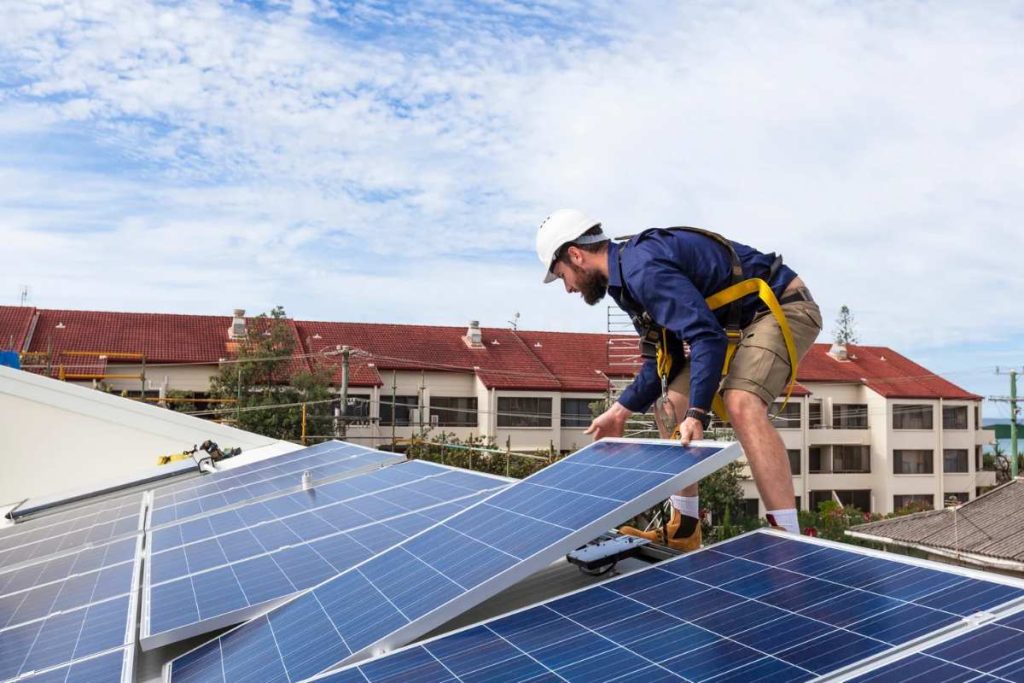
Yes, the array has to come off. There is no way to reroof underneath panels. The process is called detach and reset, and it is the line item that solar owners never see coming.
| Scope | Range | Source |
| Per panel, national benchmark | 200–300 | EnergySage, May 2026 |
| Per panel, Florida | 150–400 | Florida contractor guide |
| Per panel, San Antonio | 250–350 | Texas roofing company |
| Per panel, Utah (user report) | About $250 | Roofer report, insurance job |
| 20-panel array | 4,000–6,000 | EnergySage benchmark |
| 30-panel array | 6,000–9,000 | EnergySage benchmark |
| Large commercial array | $30,000+ | Insurance estimating guide |
| Storage during roof work | 300–1,500 | Published guides |
| Reinstall permit | 150–500 | Florida contractor guide |
The sequence is six steps: shut the system down and disconnect it, label and remove the panels, store them safely, do the roof work, reset the array with new flashing and penetrations, then recommission and inspect. The array is typically off the roof for one to three weeks on a standard job, and three to seven days on a straightforward one.
Two trades are involved, and they stay in their own lanes. In California, the electrical disconnect is licensed solar or electrical work, not roofing work, so the solar contractor or electrician handles the disconnect while the roofer handles the roof. The cleanest setup is one contract and one workmanship warranty covering the detach, the reroof, and the reset. Ask for that in writing.
Three traps to check first. If the system is leased or under a power purchase agreement, the original installer may have to handle the removal, and unauthorised handling can void the warranty. If the roof replacement is part of an insurance claim for storm damage, the detach and reset is generally part of the covered loss, according to insurance estimating guides. And a partial reroof over the array usually still needs removal, while work on a roof section clear of the array usually does not. The cheapest detach and reset is still the one you never pay. Time the solar with the reroof, and the problem disappears. Our commercial roofing hub covers the reroofing options for Bay Area buildings, and wet-weather repair covers what to do when the roof cannot wait for the solar schedule.
Retiring an Aging Array: Removal and Certified Recycling
The first big wave of commercial arrays, installed in the late 1990s and early 2000s, is now reaching the end of its 25 to 30 year design life. Those roofs need decisions, and the decision has two halves: what happens to the panels, and what happens to the roof underneath.
Nations Roof and We Recycle Solar partnered in October 2025 to offer one national path for exactly this. We Recycle Solar is the only EPA-permitted dedicated solar panel recycler in the United States, according to the company, and it recovers up to 99% of glass, metals, and rare materials from the panels it processes, with zero landfill. Every project produces chain-of-custody documentation, which is what ESG reporting and corporate sustainability benchmarks ask for. Nations Roof brings 40-plus branch locations, more than 1,100 people on its self-performing team, and 30,000-plus projects nationwide.
Their process runs in five steps: assess the array and the roof together, take the array down with certified crews, send the panels for certified recycling, replace the roof while it is exposed, and hand over the full record with photographs and warranties. The point is simple: the array is off and the roof is open, so the replacement happens inside the same window, and you pay for access and disruption once instead of twice. For a San Francisco building owner, the questions are three: where do the panels go when they come off your roof, who handles the roof underneath, and what goes back on. Get the recycling destination and the chain-of-custody record in writing. A new array on a new roof puts both assets on the same clock, which is the only way the next 25 years pencil out.
The 2026 Tax Credit Deadline
The federal Investment Tax Credit is 30% of the eligible project cost when prevailing-wage and apprenticeship requirements are met, and the credit plus accelerated depreciation together typically recover 45 to 55% of the gross system cost.
The deadline is hard. Under the One Big Beautiful Bill Act, signed July 4, 2025, solar projects that began construction after July 4, 2026 must be placed in service by December 31, 2027 to claim the credit. That is Public Law 119-21, confirmed by three independent 2026 sources. Two published guides still say the 30% credit is locked in through 2032. That is out of date. Do not plan a project around it.
Commercial solar also qualifies for accelerated depreciation on a five-year MACRS schedule. The bonus depreciation percentage has changed with the 2025 tax law, so confirm the current figure with your tax professional rather than taking it from a guide, including this one.
One more money question. Can roof costs be included in the tax credit basis? Roof work that is only needed to carry the array can sometimes count. A full reroof generally does not. One contractor thread describes installers splitting a quote into a $50,000 solar system and $25,000 of roof repair to make the numbers work. That is a sales tactic, not a tax rule. Get the treatment in writing from your tax professional before you sign, not from a sales proposal.
San Francisco Local Factors
National guides get the technology right and the location wrong. San Francisco changes the math in five ways, and none of them appear in the competitor guides.
Fog and the marine layer. The marine layer rolls in off the Pacific and sits over the western neighbourhoods, and it cuts direct sun. Panels still make power from diffuse light, but at a lower rate than the same panels inland. Any production estimate built on Central Valley sun numbers will overstate what a San Francisco roof makes. Use San Francisco production figures, and read our marine layer guide for what the fog does to a roof over time. The fog is heaviest on the west side and lightest in the southeast, and the southeast is where the big flat warehouse roofs are.
PG&E and net billing. California’s net billing tariff, known as NEM 3.0, has been in effect since April 2023. Exported power is credited at a much lower rate than the retail price you pay, so the math now favours using the power on site or storing it in a battery. Installers report that NEM 3.0 and high interest rates have hurt solar in the short term. A battery runs $800 to $1,200 per kilowatt-hour installed, and it cuts demand charges, which run $10 to $20 per kilowatt-month. One more thing people learn the hard way: a grid-tied array without a battery stops producing during a power cut, because the inverter shuts down for safety.
Title 24 and the California 50% rule. Title 24 is California’s energy code, and it governs what happens when you reroof and what “solar-ready” means for a commercial building. The exact requirements depend on the building type and the scope of work, so they belong in the written assessment, not in a general claim. The 50% rule is simpler: if more than 50% of the roof is replaced, the work has to meet current code. Both rules push in the same direction: do the roof and the solar as one planned project instead of two separate ones.
Permits, seismic, wind, and salt air. San Francisco permits and PG&E interconnection both take time, and the utility can cap how much solar the local grid supports. The city sits in a high seismic zone, so ballasted systems need seismic restraints and penetrating systems handle seismic loads better. The wind off the Bay means ballasted arrays need proper wind design, not just weight. Salt air corrodes hardware, so mounting components should be stainless steel or coated, not bare metal. Some older commercial buildings fall under historic review, which can restrict what goes on the roof. Check before you design, not after.
The neighbourhoods. The warehouse roofs that suit solar best sit in the city’s industrial southeast: Bayview-Hunters Point (94124), Dogpatch (94107) around Pier 70 and the Port of San Francisco waterfront, and the warehouse blocks off the Bay. SoMa (94103) and Mission Bay (94158) hold the newer commercial buildings. Visitacion Valley (94134) and the Excelsior (94112) hold the smaller commercial stock. The environment case is straightforward: power made on the roof is power used in the building, and when the array retires, the panels are recycled, not landfilled. The financial case still has to pencil on its own.
Warranties, Risks, and How to Vet an Installer
Warranties are where solar projects quietly go wrong, because there are three of them and they belong to three different parties. Typical published terms are 25 years on panel power output and 10 to 12 years on the panel product, 10 to 25 years on the inverter, 10 to 20 years on the mounting system, and 5 to 10 years on installation workmanship. The inverter is the part that fails first: it typically needs replacing after 10 to 15 years, while the panels keep going.
The roof warranty is the one to protect. Ask in writing whether the mounting voids it, and get the answer from the roofing manufacturer. A ballasted system usually preserves it. A penetrating system needs warranty-compliant flashing, and only the manufacturer decides what counts. Never put a second layer on a roof under an array: it shortens the new roof’s life, and some manufacturers will not honour the warranty on a layover.
Vetting the installer matters more than vetting the panels. The biggest mistake in commercial solar, according to installer advice, is talking with residential installers about a commercial roof. The best sign is a solar contractor with a full roofing division, so one company owns both the roof and the array. Ask for a line-item proposal that separates solar, battery storage, roof work, and electrical upgrades. And get leak detection done before the array goes on, so a leak under the panels is found while it is still cheap to fix.
Two red flags. First, “free solar” programs. There is no free roof. Free solar is a lease or a power purchase agreement, or a sales pitch. Read the contract: who owns the panels, who pays for the detach and reset, and what happens when you sell the building. Second, any contractor asking for payment for work never done, or threatening a lien without a signed contract. No written contract, no work, no payment.
When the Roof Isn’t Right: Ground Mounts and Carports
Sometimes the roof is not the right home for the array. The load capacity is too low, the shading is too heavy, or the roof is too cut up with equipment. Then the choice is a ground mount or a carport, and both cost more than a roof mount, because you have to build the structure the roof was giving you for free.
A ground mount pounds posts about seven feet into the ground, or uses ground screws or a ballasted base where the ground will not take posts. The advantage is freedom: face true south, tilt how you want, put it close to the point of interconnection, move it out of shade, and go as big as the ground allows. The cost driver is the trench back to the interconnection point. The difference between a hundred feet and five hundred feet is large, and between five hundred and fifteen hundred feet it grows sharply.
A carport runs about twice the cost of a ground mount. The posts go deep into the ground on massive concrete piers, which today sit underground so you never see them. The benefit is dual use: the parking spaces produce power and shelter the cars and the people parking under them from rain. The roof mount is typically the cheapest option with the best return, according to installer reports. That holds when the roof can take it. When it cannot, the ground or the carport is the honest answer, and a good installer will say so.
The Solar-Ready Roof Checklist
- Roof age and remaining life: five-year rule, replace before solar if the roof is near the end
- Structural load check: about 5 to 6 pounds per square foot extra, plus ballast if used
- Roof type and membrane condition: TPO, PVC, EPDM, torch-down, metal, or built-up, and its real condition
- Drainage and ponding check: no standing water under the future array
- Obstructions mapped: HVAC, skylights, vents, parapets, and the setbacks around each one
- Electrical capacity and interconnection: PG&E approval and transformer capacity confirmed
- Warranty letters in writing: roof warranty and solar warranty, from the manufacturers
- Detach-and-reset quote in writing: per-panel price, storage, permit, and offline time
- Tax treatment in writing: from your tax professional, before you sign
- End-of-life plan: where the panels go, and the chain-of-custody record
How We Checked
This guide is written from the roofing side, for building owners in San Francisco and the Bay Area. The solar prices are 2026 national benchmarks: Wood Mackenzie and SEIA second quarter 2026 pricing, the EnergySage detach-and-reset benchmark updated May 2026, and published October 2026 cost guides. The roof prices are San Francisco figures from our own cost guides. The detach-and-reset figures are national benchmarks plus contractor reports from Utah, Florida, and Texas, labelled by place. The tax deadline is Public Law 119-21, confirmed by three independent 2026 sources. The recycling figures belong to Nations Roof and We Recycle Solar and are attributed to them. Figures from a single location or a single contractor are labelled as such, and no San Francisco price in this guide was invented. No Semrush data was available for this guide. Get a written quote for your building. Planning ranges are not quotes.
How much does commercial solar cost in 2026?
Installed commercial solar runs $1.10 to $2.55 per watt before incentives in 2026, with bigger systems costing less per watt. The benchmark is $1.77 per watt (Wood Mackenzie/SEIA, second quarter 2026). A 500 kW system runs about $885,000 before incentives and about $460,000 after the tax credit and depreciation. Roof work is priced separately: in San Francisco, TPO runs $7 to $11 per sq ft and torch-down or modified bitumen $8 to $13.
How long does commercial solar take to pay back?
Most well-sited systems pay back in 6 to 10 years, with aggressive incentive stacking pulling the best projects into the 4 to 7 year range. A second 2026 source puts it at 4 to 8 years, and one warehouse owner reports payback pencilling around 6 to 7 years for his building. In San Francisco, fog lowers production compared with inland sites.
Do solar panels have to be removed to replace a roof?
Yes. There is no way to reroof underneath panels. The array comes off, the roof gets replaced, and the array goes back on. The process is called detach and reset, and the array is typically off the roof for one to three weeks.
How much does detach and reset cost?
The national benchmark is $200 to $300 per panel (EnergySage, May 2026). A 20-panel array runs $4,000 to $6,000 and a 30-panel array $6,000 to $9,000. Large commercial arrays can exceed $30,000. Storage during the roof work adds $300 to $1,500, and a reinstall permit adds $150 to $500.
Does my roof need to be replaced before solar?
If the roof has about five years of life left, yes. Panels last 25 to 30 years, so an array put on a tired roof will need to come off for a reroof while it still has 20 years of life in it, and that detach and reset bill is five figures on a commercial array. Replace the roof first.
Can you put solar panels on a flat commercial roof?
Yes. Flat roofs are about 80% of commercial roof area in the United States, and most commercial solar goes on them. Ballasted systems use concrete blocks and make no penetrations, while penetrating systems bolt through the membrane with flashing. The roof needs to hold about 5 to 6 pounds per square foot extra, which a structural engineer has to confirm.
How much weight can a commercial roof hold for solar?
Plan on about 5 to 6 pounds per square foot of added load, and 4.0 to 8.0 pounds per square foot for a ballasted system, because the concrete blocks are part of the load. Many modern flat roofs are “limit load” engineered, meaning they were designed to just meet the code load, so a structural check is not optional.
Will solar panels damage my commercial roof?
Not if they are mounted right. The risk is the penetrations: every bolt through the membrane is a future leak point, and the flashing quality decides whether it leaks. Ballasted mounting avoids penetrations entirely. The more common find is hidden damage the solar crew uncovers, like rotten decking, bad flashing, or missing underlayment.
Do solar panels void a roof warranty?
They can. Ask in writing before you sign, and get the answer from the roofing manufacturer, not the solar salesperson. A ballasted system usually preserves the warranty. A penetrating system needs warranty-compliant flashing, and only the manufacturer decides what counts.
Are there tax incentives for commercial solar in 2026?
Yes. The federal Investment Tax Credit is 30% of the eligible project cost when prevailing-wage and apprenticeship requirements are met, and commercial solar also qualifies for accelerated depreciation on a five-year MACRS schedule. The deadline is hard: begin construction by July 4, 2026, or be placed in service by December 31, 2027. Confirm the details with your tax professional.
Can a tenant install solar on a leased commercial building?
Tenants almost never buy solar on leased property, because it only makes sense with 20-plus years of control over the building. The lease has to cover who owns the array, who pays for the detach and reset, and who removes the panels and repairs the roof when the lease ends. Get that in the lease before anyone drills a hole.
Is commercial solar worth it in San Francisco?
It can be, when three things line up: the roof is new or has decades left, the building uses most of its power during the day, and the system is sized to the roof. The fog lowers output compared with inland sites, and California’s net billing tariff pays much less for exported power than the retail rate, so on-site use and a battery matter more here. Get a written assessment for your building before you decide.
Bottom line: The roof comes first. If the roof is sound and has decades left, solar is a good investment on a San Francisco commercial building: sized to the roof, mounted to protect the warranty, and timed with the tax credit deadline. If the roof is near the end of its life, reroof first and put the array on the new roof. Either way, get the roof assessment, the detach-and-reset quote, and the tax treatment in writing before you sign.
NAICS Code 238160 – Roofing Contractors. Call +1 833-804-6249 for a detailed inspection.


