

Retail Building Roof Repair in San Francisco | Costs, Leaks & Staying Open
Key Facts
- A leak over a sales floor is a business problem first: inventory, slip hazards, closed hours, and tenant disputes.
- The 5 most common retail leak sources: HVAC curbs, tenant build-out penetrations, parapet and coping, interior drains, and tie-in seams.
- SF repair ranges: repairs 450–1,800, flat roof repair 350–2,500, full replacement 17,000–42,000.
- Repair vs restoration vs replacement follows moisture evidence, not the size of the ceiling stain.
- Most retail roofs can be repaired or replaced with the store open, in controlled work zones with a daily dry-in.
- California deposit cap: 10% or $1,000, whichever is less, with a 3-day cancellation right.
Quick Answer
A retail roof in San Francisco is usually repaired without closing the store. The crew works in controlled zones, opens only what it can make watertight the same day, and schedules the noisy work around your hours. The leak is almost always at one of five places: an HVAC curb, a penetration added during a tenant build-out, a parapet or coping joint above the storefront, an interior drain that stopped draining, or the seam where an old section was tied into a new one. Repairs run 450–1,800, flat roof repairs 350–2,500, and a full replacement 17,000–42,000. Whether you repair, restore, or replace depends on how much of the roof is wet — measured with a moisture scan and core cuts, not guessed from the ceiling stain. If water is coming in over merchandise right now, protect the stock, mark the leak, photograph everything, and get a temporary dry-in first.
What Makes a Retail Roof Different
A retail roof is not a house roof and it is not a warehouse roof. The difference is what sits underneath it: a sales floor full of inventory, customers walking under the leak, and usually more than one tenant sharing one membrane. One roofer put the question plainly in a forum thread — “Any strictly retail guys out there?” — and the thread exists because retail roofing is its own trade. The roof has to be fixed while the business underneath it keeps trading, and a leak over a sales floor costs inventory, hours, and customers while it is argued about.
Retail roofs carry more penetrations than any other commercial roof. HVAC units, vents, grease exhausts, signs, skylights, and drains all punch through the membrane, and tenants add more with every build-out — conduit, piping, equipment — while the roofer who comes after finds out whether the flashing was done right. Contractor access does the rest: an HVAC tech with a screw gun, a sign installer, a delivery crew on the roof. In San Francisco the building makes it harder still: storefronts sit on narrow sidewalks with shared walls, no staging area, and no parking for a dumpster or a crane. The work has to fit the building, the tenants, and the street.
The 5 Places Retail Roofs Leak
On the retail centers inspected across the country, the leak is usually traced to one of five places. San Francisco adds fog and a November-to-March rain season to the same five.
| Leak source | What fails | What it looks like inside |
| HVAC curb | Flashing splits, sealant ages, or the curb is too low for the insulation height | Stain near a rooftop unit, worse after rain |
| Tenant build-out penetration | A new pipe or conduit is cut through the membrane, and the flashing is poorly installed | Leak appears after a fit-out, far from the old leak |
| Parapet and coping | Joints open, coping lifts, or water runs down the storefront wall | Staining above the shopfront, damp at the ceiling edge |
| Interior drain | The drain clogs, ponding water sits, or seams fail under standing water | Puddle on the roof, stain in the middle of the sales floor |
| Tie-in seam | The seam between old and new sections opens with movement | Leak along a straight line, often where the building was extended |
HVAC curbs are the single most common source. The flashing around a cycling unit flexes, the sealant ages, and water follows the curb down into the ceiling. If the curb is too low for the new insulation height — common on a reroof — the flashing can never be right until the curb is raised. That is a curb problem, not a membrane problem, and patching the membrane will not fix it.
Tenant build-out penetrations are the second. A restaurant adds a grease exhaust, a grocer adds refrigeration lines, a sign company adds supports — each hole needs flashing, and its quality decides whether the roof leaks next winter. One property owner posted about a 3-year-old Starbucks roof already needing a repair-or-replace decision: a young roof can fail early when the penetrations, not the membrane, are the problem.
Parapet and coping leaks show up on the storefront wall. When joints open, water runs down behind the shopfront and appears as staining above it or damp at the ceiling edge. It looks like a wall problem. It is a roof problem. Interior drains and ponding are the quiet ones: a clogged drain leaves water sitting, and the seams under it fail first. Ponding is water that stays 48 hours after rain, and in the fog belt a roof that never fully dries between storms ponds longer than the same roof inland — our flat roof repair in wet weather page covers what to do when it rains on an already-wet roof. Tie-in seams fail where the building changed — an extension, a partial replacement — and the leak runs along a straight line. Water travels along insulation and decking before it appears indoors, so the stain can sit feet from the entry point.
What To Do Tonight When the Roof Leaks
Do this in order. It takes an hour, it protects the business, and it creates the record everything else depends on.
1. Protect the merchandise and the floor. Move stock out from under the drip and cover what cannot move. Put a bucket under the drip, a wet-floor sign at the edge of the wet area, and keep customers out of it. A slip is a bigger claim than a roof repair.
2. Mark the leak. This is the single most useful thing a store can do, and it comes from the most-voted answer in the research: place a marker where the water is coming in. When the crew arrives, the marker tells them where to look — and the ceiling stain is not always where the roof is actually leaking.
3. Photograph everything. The drip, the stain, the damaged stock, the floor, the ceiling. Photographs settle a lease dispute and are what an insurer asks for first. Date them.
4. Get a temporary dry-in. A tarp and a temporary seal stop the water tonight. It is not the repair — it buys time for the repair to be done right. Roofers who do emergency work note that insurers pay for emergency tarping, because a tarp is mitigation. Do not let a temporary fix become the permanent fix by default: a tarp buys days, not a winter.
5. Call a commercial roofer and say four things: where the water is coming in, what is underneath it, whether the store can stay open, and what the roof is made of if you know it. Keep one contact person for the job so the roofer is not chasing five people while water comes in.
What a Professional Assessment Covers
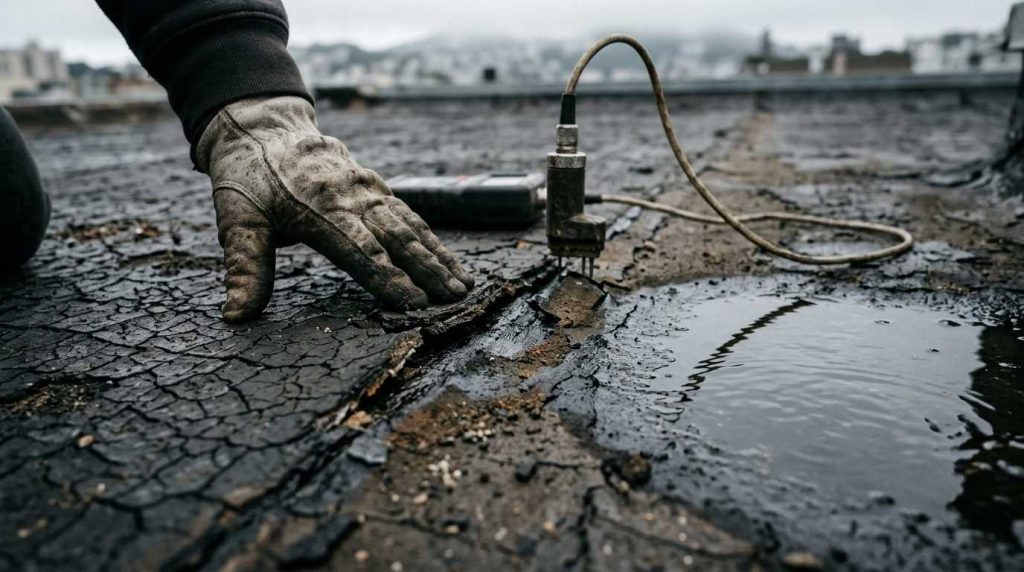
A sound assessment looks beyond the visible drip. It covers the membrane surface, every seam, the flashing at every penetration, the drainage and whether it actually drains, the coping and edge metal, and the signs of trapped moisture underneath. That last part is what separates an assessment from a look: a moisture scan (infrared or electronic) maps where the insulation is wet, and core cuts confirm it — a small plug cut through the assembly to see the layers and take a moisture reading. Without that, any repair-vs-replace recommendation is a guess. Our roof leak detection page explains the methods in detail.
The findings should come back as a clear scope with photographs, options, and pricing — not a verbal estimate. The documentation supports maintenance planning, warranty conversations, and budgeting, and in a multi-tenant building it is the document that settles who owes what. One roofer’s rule from the research is worth keeping: document your recommendations and the outcome if the work is not done, in writing, and give it to the owner. The assessment also has to answer the warranty question before any work starts: if the roof has an active manufacturer warranty, the repair has to follow the manufacturer’s requirements or the warranty can be lost. One contractor’s claim from the research is worth knowing, even though it is a claim and not a warranty fact: a master service agreement that says anyone other than the roofer on the roof — an HVAC tech, a sign installer — voids the warranty. Whether or not your agreement says that, control who gets on the roof, and write it down.
Repair, Restoration, or Replacement?
Not every leak calls for a new roof. The decision follows inspection evidence, not the size of the interior stain. Roof age, wet insulation, repair history, warranty terms, and ownership plans all shape it — and the moisture scan is the evidence that turns a guess into a plan. The full comparison lives on our commercial roof restoration vs replacement page.
| Approach | When it fits | Key limitation |
| Targeted repair | Damage is limited, and the surrounding assembly is dry and serviceable | Cannot fix broad moisture or recurring assembly-wide failure |
| Restoration / coating | The roof is aged but dry, stable, and compatible, and passes testing | Cannot correct hidden saturation or deficient attachment |
| Recover (new layer over old) | The existing system supports an approved new assembly | May trap problems; weight, height, moisture, and code factors matter |
| Full replacement | Damage is widespread, large sections are wet, or the deck has deteriorated | Requires more demolition and coordination, but provides maximum access to underlying conditions |
Targeted repair is right when the problem is isolated — a failed flashing at one curb, a split seam, a puncture from foot traffic — and the membrane around it is sound and the insulation underneath is dry. Most retail service calls end here. A repair that fixes the actual failure, with the failed detail replaced rather than smeared over with sealant, is the cheapest reliable work a roof can get. Silicone sealant on its own is not a repair: as one user put it, there are dedicated roofing sealants for the job, and a tube of silicone over a split seam is a delay, not a fix.
Restoration or a coating fits an aging system that needs broader protection but is still dry and stable. A silicone coating is the usual answer on a flat retail roof in the fog belt because it stands up to ponding water, at 3.50–6 per square foot installed. The honest conflict: restoration life is quoted at 5–10 years by one source and 10–20 years by others, so ask what the warranty actually covers. A coating cannot fix wet insulation, a failing deck, or poor attachment — if the scan shows saturation, coating over it traps the water.
Recover — a new layer over the old — draws the strongest warning in the research. One thread asked whether an $8,000 layover was ever acceptable when every other quote was $14,000 for a tear-off, and the most-voted answer was blunt: never put a second layer on, because it shortens the new roof’s life and some manufacturers will not honour the warranty over it. A recover can work when the existing system is dry, sound, and approved for it — but the weight, the height at curbs and parapets, and the trapped moisture all have to be checked first.
Full replacement becomes the better investment when leaks appear in multiple areas or return after repair, when the insulation is broadly saturated, when the membrane is cracking, shrinking, or blistering across large areas, when ponding cannot be fixed by the existing slope or drainage, or when the roof is at the end of its expected life. A 3-year-old roof can still reach this decision if the assembly was badly installed — age alone does not settle it. Two numbers frame the call: contractors often use a 25–30% rule, where roughly a quarter to a third of the roof wet or failing makes repair uneconomical, and California’s 50% rule, where replacing more than half the roof in a year triggers a full reroof under the code. A reroof in California also has to meet Title 24 cool-roof rules.
Retail Roof Repair Costs in San Francisco
Nobody in the competitor set publishes San Francisco prices. One Indiana contractor publishes real ranges — 350–650 for a pipe boot repair, 800–1,800 for a seam repair, 1,500–4,500 for a membrane patch that needs wet insulation cut out, 3,500–8,500 for multi-area repairs with flashing rework, 600–2,500 for an emergency tarp. Those are Indiana numbers, and they prove the point one roofer made in the research: “roofing repair pricing varies wildly because it’s not standardized.” San Francisco figures are in the table below — the site’s canonical costs, not the Indiana ones, not a Columbus, Ohio $1,200 repair from a forum thread, and not a Florida contractor’s $750 truck-roll cost, which is his number from his market and is only useful as a reminder that the crew, the truck, and the diagnosis are part of what a repair costs.
| Work | San Francisco range |
| Targeted repair (seam, flashing, puncture) | 450–1,800 |
| Flat roof repair | 350–2,500 |
| Silicone coating, installed | 3.50–6 per sq ft |
| TPO membrane, installed | 7–11 per sq ft |
| Torch-down / modified bitumen, installed | 8–13 per sq ft |
| Full replacement | 17,000–42,000 |
What moves a repair inside those ranges is access, damage location, affected area, materials, and what is underneath the surface. A single-storey strip center with a rear ladder is faster than a four-storey building with a locked roof hatch. HVAC equipment, parapet walls, signage, crowded penetrations, emergency response, and work scheduled outside business hours all add cost. Compare proposals on the same scope — the assembly, the quantities, the details, the exclusions, the allowances for wet insulation and deck replacement, and the warranty — not on the total alone. Our how to read a roofing quote page shows how to compare them line by line. California law caps the deposit at 10% or $1,000, whichever is less, with a 3-day right to cancel and a written contract required over $500 — check the proposal against that before signing.
How a Retail Roof Gets Repaired Without Closing the Store
The answer is planning, not speed. Roofing produces noise, vibration, odours, traffic, debris, and temporary access changes, and pretending otherwise is how a project loses its tenants. The work is divided into controlled zones so that no tenant is exposed overnight and no customer walks under an open work area.
Work in zones, and make each zone watertight daily. The crew removes only the amount of roof it can inspect, repair, insulate, cover, flash, and make watertight before the end of the shift. Every workday needs a defined stopping point with a temporary seal compatible with the existing and new assemblies — and the superintendent documents the completed zone and verifies the drains, edges, penetrations, and transitions before leaving. In the fog belt a roof left open overnight will be wet by morning.
Sequence around the most sensitive tenants. A grocery, a restaurant, a pharmacy, and a clothing store do not have the same tolerance for noise, dust, odour, or blocked access. High-impact work — demolition, mechanical fastening, cutting — goes before opening, after closing, or on a tenant’s slowest day. That does not mean all roofing should happen at night: night work brings lighting, supervision, and quality-control concerns of its own.
Protect entrances, parking, and deliveries. Keep at least one agreed entrance open for every operating tenant unless a short closure has been approved and communicated. When work happens above an entrance, use overhead protection, relocate the route, or schedule the work outside hours — never rely on caution tape where a customer could walk into an overhead work zone. Do not assume deliveries can use another door: grocery, restaurant, and medical deliveries have fixed equipment, security, temperature, or timing needs, and the phasing plan has to include their schedules.
Coordinate the rooftop equipment. Before the roofing reaches a unit, someone has to answer who disconnects it, raises it, removes it, or replaces it. Temporary HVAC shutdowns get scheduled with the tenants they serve, with a maximum shutdown period and a restart check. If a curb is too low for the new insulation and flashing height, that gets resolved before installation reaches the unit.
Communicate in writing, early, and often. Name one construction decision-maker, one operations contact, and one authorised contact per tenant, with emergency numbers and after-hours procedures. Send an overall project notice first, then a zone-specific notice before work reaches each suite, with dates, hours, likely noise, odour, parking, and delivery effects, and a way to report a leak, dust, or access conflict the same day. Do not promise “no disruption.” Promise planning, communication, controlled access, and a prompt response — and deliver them.
Who Pays: Leases, CAM, and Documentation
This is the section no competitor writes, and it is the section that decides whether a retail roof leak becomes a lawsuit. In a multi-tenant center, the roof is usually the landlord’s responsibility and the interior is usually the tenant’s — but “usually” is not a lease. Read the lease before the work starts, not after the invoice arrives. Three questions settle it: who is responsible for the roof structure and membrane, who pays for repairs versus capital replacement, and what the common area maintenance (CAM) charges cover. A repair is often a landlord cost recovered through CAM; a full replacement is often a capital cost with a different treatment. The lease decides, and leases differ by suite in the same building.
Documentation is what makes the answer stick. The assessment photographs, the moisture scan, the scope, the tenant leak reports, the maintenance history, and the invoices all go into one roof file. When a tenant claims the leak damaged their stock, the file shows when it started, what was done, and how fast. When an owner claims a tenant’s contractor caused the damage — an HVAC tech who punctured the membrane, a sign installer who drilled through it — the file shows who was on the roof and when. Without that file, every dispute is one person’s word against another’s. With it, most disputes never start.
Which System Does Your Building Have?
The repair depends on the system, and the system depends on what is already up there. A patch that works on TPO will not work on EPDM, and a coating that works on a sound membrane will not save a saturated one. Our flat roofing page covers the systems in more detail.
| System | Repair approach | Watch out for |
| TPO single-ply | Heat-welded seams and patches | Weld quality, perimeter securement, ponding |
| EPDM rubber | Glued patches and seam tape on a clean, dry surface | Seam adhesion, shrinkage, ponding |
| PVC single-ply | Heat-welded repairs; suitable where grease or chemicals are present | Confirm manufacturer suitability for the exposure |
| Modified bitumen / torch-down | Torch- or cold-applied patches; assess cap-sheet condition | Heat and odour during work; flashing at walls and curbs |
| Built-up roofing (BUR) | Cut out blisters and splits, then patch in kind | Gravel can hide damage and trapped moisture |
| Metal | Replace fasteners and seams, reseal penetrations | Corrosion, fastener back-out, thermal movement |
| Coatings (silicone / acrylic) | Recoat over a sound, dry, compatible roof | Silicone stands up to ponding; acrylic needs a dry surface |
One open question from the research is worth naming honestly: a building owner asked whether ParaPro resin was the right application for a sloped burgundy metal roof, and the thread never settled it. Resin choice depends on the metal, the slope, and the manufacturer — this page does not invent an answer. And on an aging gravel-surfaced built-up roof, the gravel itself is the problem for diagnosis: it conceals membrane deterioration, trapped moisture, cracks, blisters, and failed repairs, and a seemingly small leak can travel through multiple plies before it appears inside. Investigate what the gravel is hiding before deciding the roof is repairable.
Restaurants and Groceries: Special Cases
A restaurant roof carries a grease exhaust, and grease degrades most membranes — PVC is the usual answer where grease exposure is relevant, but the manufacturer has to confirm suitability for the specific exposure. The exhaust fan sits close to the leak more often than anyone expects: one field note in the research is a restaurant leak traced to the grease exhaust fan, and the fix was at the fan, not at the stain. A grocery roof carries refrigeration lines, and refrigeration cannot be down for long — temporary shutdowns need a maximum period, monitoring, and a restart check, and the work around refrigeration penetrations has to be sequenced so the store never loses cooling.
How To Tell a Good Repair From a Bad One
The research is blunt about this. “Roofers say their repairs are good. I’m unconvinced,” runs one thread at 39 votes and 65 comments. “Is roof repair a scam?” runs another. And one store owner posted a photograph of a roof repair that failed on the first rain, three days after the work was done. The distrust is earned, and the answer to it is evidence, not reassurance.
A good repair comes with photographs of the failed detail before the work and after it, a written scope that names what was corrected and why, and a warranty in writing — manufacturer and workmanship separately, with the terms stated. A good repair fixes the failed detail: the flashing is replaced, the seam is welded, the wet insulation is cut out and replaced before the new membrane goes down. A bad repair smears sealant over a split seam, patches over wet insulation, or covers a failed curb without touching the curb. Ask for the moisture scan. Ask what was cut out. Ask what the warranty covers and for how long, in writing. A contractor who cannot answer those three questions is not the contractor for a retail roof.
Preventing the Next Emergency
Schedule professional reviews in spring and fall, after severe weather, and after any other contractor works near rooftop equipment. Keep drains and gutters clear, control roof access, and record every service visit so new damage can be traced to the visit that caused it. A maintenance agreement is the commercial version of that discipline: scheduled inspections, minor repairs, drain clearing, and documentation, usually twice a year, with one contractor who knows the roof. For a retail owner it means one phone number, one file, and one contractor who already knows the roof when the leak starts.
In San Francisco
San Francisco’s retail roofs live in the fog belt. The marine layer keeps roofs damp, the November-to-March rain season tests every seam and drain, and a roof that never fully dries between storms ponds longer than the same roof would inland. Fog does not just wet the membrane — it hides the damage, because a roof that looks intact from the parapet can be saturated underneath. That is why the moisture scan matters more here than in a dry climate.
The buildings are the second local factor. Storefronts in Union Square (94108), the Westfield San Francisco Centre (94103), and Fillmore (94115) share walls, sit on narrow sidewalks, and have no lot to stage in. A grocery-anchored center near Stonestown Galleria (94132) has parking to work with; a storefront in the Mission (94110) or Hayes Valley (94102) does not. Permits run through the San Francisco Department of Building Inspection, and a reroof is a permit job, not a handshake job. The third local factor is the tenant mix: small suites and short leases as often as anchor stores, each with different hours and different sensitivity to noise and odour. The tenant matrix is the difference between a project that keeps every store open and one that loses a tenant over a week of unannounced noise above a kitchen.
How We Checked
This page is built from the five competitor sources received for this topic plus the live top ten found by search, ~91 Reddit titles with votes and comments, four YouTube transcripts, and ~10 Quora questions with top answers. No Facebook content arrived in the dump, and no Semrush file arrived, so neither is claimed as a source. Prices are the site’s canonical San Francisco costs. Indiana, Ohio, and Florida figures are labelled by place and never presented as San Francisco prices. Florida’s 25% rule is a Florida rule, not California law — California’s figures here are the 50% rule and B&P §7159. Where sources disagree, this page shows the disagreement instead of picking a winner.
Frequently Asked Questions
Bottom line
A retail roof leak is a business problem, not just a roofing problem. Find the source with a moisture scan and core cuts, fix the failed detail rather than the stain, and plan the work around the tenants so the store stays open. In San Francisco that means 450–1,800 for a targeted repair, 350–2,500 for a flat roof repair, and 17,000–42,000 for a full replacement — and a decision made on evidence, in writing, before the work starts.
NAICS Code 238160 – Roofing Contractors
For a detailed inspection of your retail roof, call +1 833-804-6249. A licensed and insured C-39 contractor will assess the roof, document the condition with photographs and a moisture scan, and recommend a practical path forward for your building and your tenants.


