
How Marin’s Marine Layer Shortens Roof Life | Fog Belt Roof Lifespans
Quick Answer
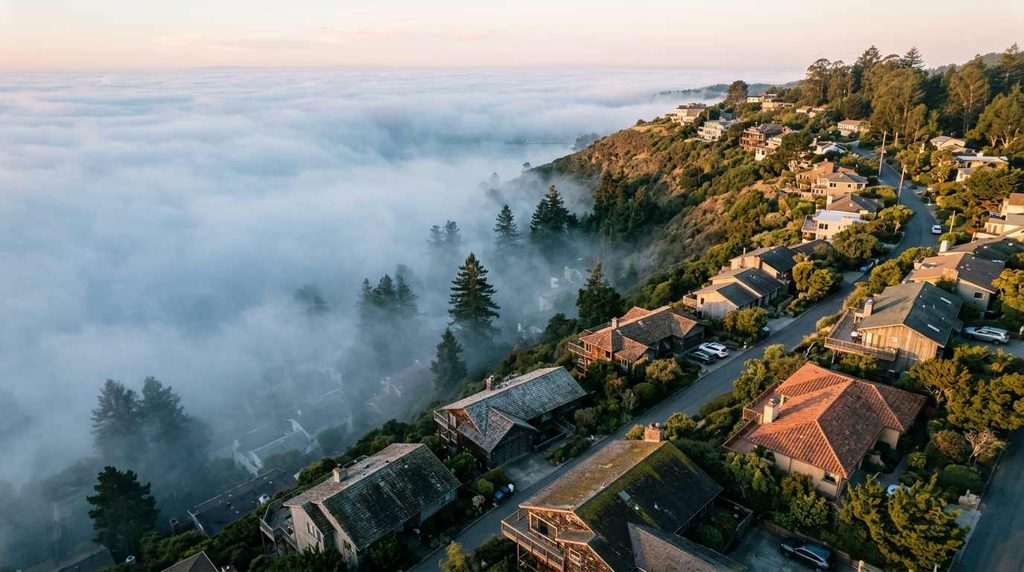
Yes, Marin’s marine layer shortens roof life. The fog that rolls in off the Pacific most mornings settles on roofs and keeps shingles damp for hours, day after day, all year. That dampness loosens granules, feeds algae and moss, corrodes metal flashing and fasteners, and works against shingles from above while trapped attic moisture works against them from below. The result is granule loss, curling edges, and algae streaking years before a roof’s rated life is up, worst on west-facing slopes, north-facing slopes, and tree-shaded sections. Coastal fog-belt homes wear fastest. Inland Marin homes, where fog burns off earlier, last noticeably longer.
What Is Marin’s Marine Layer, and Why Does It Matter for Roofs?
The marine layer is the low coastal fog and moist air that rolls in off the Pacific and settles over Marin County and San Francisco’s west side, usually overnight and in the early morning. Locals call it Karl the Fog. It is not a storm. It is a daily event, and that distinction matters.
A rainstorm soaks a roof and passes, and the roof dries. Marine layer moisture sits on a roof for hours nearly every day, keeping shingles damp long after an inland roof has dried out. Asphalt shingles are built to handle rain. They are not built for sustained, repeated dampness day after day, year-round.
The fog is thickest along the coast and the bay shore: Sausalito and the Richardson Bay waterfront, Mill Valley down by the bay, Stinson Beach, the Marin Headlands, and across the bridge in San Francisco’s Outer Sunset, Outer Richmond, and the Lands End and Ocean Beach corridor. It thins as you move inland. By Novato and the warmer valleys of central Marin, the fog burns off earlier and roofs dry faster. Same county, different roof life. That split is the single most important fact in this guide, and it is the one most roofing articles skip.
How Marine Layer Moisture Actually Shortens Roof Life
Five mechanisms work at the same time.
Wet-dry cycles loosen granules. Granules are a shingle’s sunblock. They protect the asphalt underneath from UV. Repeated wetting and drying loosens them faster than a dry climate does. The evidence lands in your gutters: black grit washing out during rain is shingle granules leaving the roof. Once granule loss gets serious, the exposed asphalt degrades much faster, and the whole roof ages faster with it.
Salt air corrodes the metal parts. Ocean air carries fine salt particles that settle on flashing, vents, gutters, and fasteners. Salt draws and holds moisture, so metal stays damp longer and corrodes sooner. One coastal guide reports rust on metal components in as little as 18 months for homes within three miles of the coast. The practical point: shingles can still look fine while the metal around them is already failing. Galvanised steel is the wrong choice here. Stainless fasteners, marine-grade aluminium, and coated metal are what last.
Moss and algae trap more moisture. Algae shows as dark streaking, mostly on north-facing slopes and tree-shaded sections. Moss grows thicker and holds water against the shingle like a sponge. Both thrive in marine layer dampness and keep the roof wetter than it would be on its own. Algae-resistant shingles, made with copper-bearing granules, exist specifically for this climate.
Ventilation works from below while fog works from above. A poorly ventilated attic traps heat and humidity under the roof deck. That moisture condenses under the deck and attacks shingles from below while fog attacks them from above. Two identical shingle roofs on the same street can age years apart, and ventilation is often the reason.
Pitch and shade decide where damage lands first. Low-pitch and flat areas drain slowly, so moisture pools instead of running off, and granule loss concentrates exactly where the roof stays wet longest. Tree-shaded sections stay damp after sunny sections have dried. North-facing slopes grow algae first. On a fog-belt roof, damage is never even. It clusters on the wettest, shadiest, flattest parts.
Fog Belt vs Inland Marin: Two Different Roofs
This is the comparison no competitor article builds, and it matters most for a Marin homeowner judging their own roof.
| Area | Fog Exposure | What It Means for Your Roof |
| Coastal fog belt: Sausalito 94965, Mill Valley 94941, Tiburon 94920, Stinson Beach 94970, Bolinas 94924 | Daily fog, often into late morning, plus salt air off the bay and ocean | Fastest wear. Granule loss, algae, and flashing corrosion show up earliest. Stainless fasteners and algae-resistant shingles matter most here. |
| Mid-county: Corte Madera 94925, Larkspur 94939, Kentfield 94904, Ross 94957, San Anselmo 94960, Fairfax 94930 | Regular morning fog that usually burns off earlier than the coast | Moderate wear. Fog still shortens life versus inland California, but roofs dry out more days per year than the coast. |
| Inland Marin: San Rafael 94901, Novato 94947 | Fog is lighter and shorter-lived, summers are warmer and drier | Slowest wear in the county. Roofs here last closest to their rated life. Summer heat becomes a factor instead of dampness. |
The pattern is simple: the longer your roof stays damp each day, the shorter its life. If you live in Sausalito or Stinson Beach and your neighbour in Novato has the same shingle, expect different lifespans. That is not a defect. That is climate.
The San Francisco Side of the Fog
The same fog rolls straight across the Golden Gate into San Francisco’s west side, and the same rules apply. The hardest-hit neighbourhoods face the ocean and the park: Outer Sunset (94122), Outer Richmond (94121), the Lands End and Ocean Beach corridor, Inner Sunset (94122), Forest Hill (94131), and West Portal (94127). One San Francisco roofer publishes an asphalt lifespan of around 20 years on the coast, dropping to 15 to 18 years in the western neighbourhoods. That is a competitor’s claim, not a verified measurement, but it matches the direction of all the other evidence: the west side wears fastest.
Move east and uphill and the picture improves. Pacific Heights (94115), Twin Peaks (94131), Noe Valley (94114), and the Mission (94110) sit above the fog more often or dry out earlier in the day. Hillside homes add a second factor: wind pressure differentials across ridges lift curled shingles faster than the same damage would progress on flat terrain. A curled shingle on a Twin Peaks ridge acts like a sail. The same curled shingle on a sheltered street might sit quietly for another year.
Landmarks tell the story. Roofs facing Ocean Beach, Lake Merced, Golden Gate Park, the Presidio, Richardson Bay, and the Sausalito waterfront take the worst of it. Roofs tucked behind Mount Tamalpais or above the fog line on a ridge dry out sooner. When you judge your own roof, start with which side of the fog you live on.
How Long Does Each Roofing Material Last in the Fog Belt?
There is no published Marin-specific lifespan study, so every number below is labelled. Manufacturer ratings are what the product is rated for. Coastal estimates are what third-party guides and competitors publish for fog and salt-air climates. Do not let anyone hand you a single Marin number without a source, because that source does not exist.
| Material | Manufacturer Rating | What Coastal Evidence Says | System Rate per sq ft |
|---|---|---|---|
| Three-tab asphalt shingles | Around 20 years | California-wide guides put three-tab at 15–20 years in coastal conditions. Thinnest shingle, least resistance to moisture and salt. | See shingle rate below |
| Architectural asphalt shingles | 25–30 years | A third-party Bay Area cost guide estimates 18–24 years in the coastal fog belt. A San Francisco competitor claims 15–18 years for asphalt in western neighbourhoods. Both sit below the rating. | $6.50 – $10 |
| Standing seam metal | 40–70 years | Works in salt air only with the right metal: aluminium, zinc, or factory-coated panels. Bare steel rusts. Concealed clips beat exposed screws because washers crack and screws back out over time. | $12 – $20 |
| Clay tile | 50+ years for the tile itself | The tile outlasts the roof system. The underlayment underneath typically needs replacement at 20–25 years, even when the tile above looks fine. That job is called a lift-and-relay. | $15 – $25 |
| Concrete tile | 40–50 years for the tile itself | Same underlayment clock as clay: plan on 20–25 years before the underlayment needs attention. | $12 – $20 |
| TPO flat membrane | Varies by thickness and installation | Flat membranes in coastal guides commonly land at 15–25 years. Drainage and UV exposure decide where in that range a given roof falls. | $7 – $11 |
| Torch-down and modified bitumen | Varies by system | Lifespan depends on seams, flashing, and drainage more than on the membrane itself. Ponding water is the deciding factor on any flat roof. | $8 – $13 |
| Silicone roof coating | A coating, not a new roof | A coating buys years on a sound flat roof. It does not fix failed seams, wet insulation, or a rotted deck. Price it as maintenance, not replacement. | $3.50 – $6 |
Two things stand out. First, the gap between rating and coastal reality is widest for asphalt shingles, which is why shingle homeowners feel it most. Second, tile and metal win on lifespan but lose on upfront cost, and tile carries the hidden underlayment clock that surprises owners who think “50-year tile” means 50 years without work. It does not. It means 50 years for the tile and roughly half that for what sits underneath it.
The Parts That Fail First
Ask any roofer who works the fog belt what they replace most, and the answer is never “the middle of the roof.” It is always the same list.
- Pipe boots and plumbing boots. The rubber boot around a vent pipe dries, cracks, and splits years before the shingles around it wear out. A 25-year shingle roof with a failed boot at year 12 is normal, not a contradiction. First leaks usually show up at boots and valleys, not in the open field.
- Valleys. Where two roof planes meet, water concentrates. Valleys collect debris, hold moisture, and wear faster than the rest of the roof. A valley that has never been cleaned out is a leak waiting for a winter storm.
- Flashing. Chimney, wall, skylight, and vent flashing corrode in salt air before the shingles do. Rusted, lifted, or separated flashing is the most common leak source on an otherwise sound fog-belt roof. Flashing is a maintenance item, not a fit-and-forget item, and our roof flashing repair guide covers it in detail.
- Fasteners and screws. Nails and screws rust, and on exposed-fastener metal roofs the rubber washers around screws crack, shrink, and harden after 10 to 15 years. Water then enters around every failed washer. Stainless or coated fasteners cost more and last far longer in salt air.
- Ridge and hip caps. Caps take the most sun and wind, so they wear first. Curling, cracking, or missing cap shingles are often the earliest visible sign that a roof is aging.
- Underlayment. Under tile especially, the underlayment is the real clock. When it fails, the tile above can look perfect while water is already reaching the deck. Soft spots when walking a tile roof usually mean failed underlayment, not failed tile.
An inspection that finds good shingles and a failed boot is not a roofer inventing work. It is the normal pattern of how roofs age, and it is why a roof can need repair years before it needs replacement.
How Much Life Is Left in YOUR Roof?
This is the question behind the most-discussed roofing threads online, and averages cannot answer it. Only your roof can. Here is how to read it.
- Check the gutters first. Heavy granule loss in gutters or around downspouts means the shingle’s protective layer is going. A few granules after a storm is normal. Handfuls, year after year, are not.
- Look at the edges. Curling, cupping, or buckling edges mean the shingle is no longer lying flat and sealed. Wind catches a curled edge like a sail, and each storm makes it worse. A few curled shingles can be repaired. Widespread curling means the system is near the end.
- Look for bald patches. Where granules have worn away completely, the asphalt shows through dark and smooth. Bald patches mean UV is now attacking the asphalt directly, and deterioration speeds up from there.
- Check the metal. Rust on flashing, vents, or fasteners, and dark streaking down from metal parts, means salt corrosion is already underway. Remember: shingles can look fine while the metal around them fails.
- Look inside. Water stains on ceilings or walls, damp rafters in the attic, and daylight visible through the attic after a storm all mean water is already getting past the roof system. Sagging areas mean trapped moisture has rotted boards underneath, and that is a replacement conversation, not a repair conversation.
- Know the age bands. Under 15 years with isolated damage, repair usually makes sense. Between 15 and 25 years, the stakes of skipping an inspection go up sharply, and recurring leaks in different places point toward replacement. Beyond 25 years on a shingle roof, a professional assessment every year is the sensible baseline, because the window where targeted repairs buy meaningful life closes once water reaches the decking or insulation.
- Check the layers. If your roof has multiple layers of shingles stacked on top of each other, that matters. Extra layers add dead weight, hide deck damage, and make proper inspection impossible without tear-off. A house bought with a “7-year-old roof” that turns out to be a fourth layer over three old ones is one of the most common nasty surprises in roofing, and it changes the replacement conversation completely.
If more than one of these signs is present, get a detailed inspection before the next winter storm season. Guessing from the ground is how small repairs become full replacements.
Flat and Low-Slope Roofs in Fog
Flat roofs in the fog belt have their own version of this problem. They do not shed water the way a pitched roof does, so fog moisture and rain sit longer, and ponding water accelerates membrane breakdown. A flat roof that holds standing water after 48 hours has a drainage problem, not just a weather problem, and no membrane survives permanent ponding gracefully. Silicone coatings help on a sound flat roof, torch-down and TPO systems handle the job when seams and flashing are right, and the deciding factor is almost always drainage and detailing, not the membrane brand. For the full picture on standing water, see the ponding water guide. If your flat roof is leaking, the roof leak repair guide covers the response steps.
Attic Ventilation: The Half Nobody Sees
Ventilation is the most underrated factor in fog-belt roof life, because it is invisible from the street and it works from the opposite side of the fog. A working system has balanced intake and exhaust: air enters low, usually at the eaves or soffits, travels under the deck, and exits high at the ridge or roof vents. That airflow carries trapped humidity out instead of letting it condense under the deck. When intake is blocked by insulation, when exhaust is undersized, or when a roof has exhaust vents but no intake at all, humid air sits under the deck and degrades shingles from below while fog degrades them from above.
Signs of a ventilation problem include condensation or dampness in the attic, mould on the underside of the deck, rusted nails poking through the deck, and shingles that curl or age faster than their neighbours on identical exposure. Confirming ventilation is adequate should be part of any roof maintenance visit, not an afterthought. On a replacement, ventilation is specified with the system, not added later, because fixing it after the fact means opening up a finished roof.
Algae vs Moss vs Mould: Three Different Problems
Homeowners use these words interchangeably. Roofers should not, because the fixes differ. Algae shows as dark streaking, usually on north-facing and shaded slopes. It is mostly cosmetic at first, but sustained growth traps additional moisture against the shingle surface and contributes to long-term damage. Algae-resistant shingles with copper-bearing granules slow it down. Moss grows thicker, lifts shingle edges, and holds water against the roof like a sponge. Moss does real damage if left alone, because it keeps the surface wet and pries at shingle edges. Our moss control guide covers removal and prevention in detail. Mould inside the attic or on the underside of the deck usually points to a ventilation or leak problem, not a surface problem. Cleaning the outside of the roof will not fix mould underneath it. Find the moisture source first. If someone tries to sell you a single treatment for all three, they are selling a product, not a diagnosis.
Fire Zones: WUI, Embers, and Chapter 7A
Marin’s fog belt and its fire zones overlap in the hillside neighbourhoods, and that changes material choices. Many Marin hillside areas fall in Wildland-Urban Interface zones, where California Chapter 7A requires ember-resistant vents and Class A roof assemblies. Damaged or missing vent flashing in a WUI zone is not just a water problem. Embers enter through vents, and a replacement that ignores the vent specification is not compliant, however good the shingles are.
For a fog-belt home in a WUI area, the right specification does two jobs at once: a Class A assembly that resists embers, and corrosion-resistant flashing and fasteners that survive salt air. Tile and metal both do the fire job well. The detailing, vents, flashing, and fasteners, decides whether the assembly does both jobs or only one. Confirm your fire zone before specifying materials, because the zone, not the catalogue, sets the requirement.
Permits: San Francisco DBI and Marin County
Most full roof replacements in San Francisco require a permit from the Department of Building Inspection (DBI). If your home sits in a historic district covered by Article 10 or Article 11, there may be additional requirements around material matching and a Certificate of Appropriateness from the Planning Department. A legitimate contractor pulls the required permits before work starts. Any contractor who suggests skipping the permit is putting you at legal and financial risk.
Marin County works differently depending on jurisdiction, and this is where homeowners get confused. Unincorporated parcels are handled by Marin County. Incorporated cities handle their own permits.
- Marin County (unincorporated areas): Community Development Agency, Building and Safety Division, 3501 Civic Center Drive, Suite 308, San Rafael, CA 94903. Phone 415-473-6269 for the agency and 415-473-6550 for Building and Safety. Counter hours Monday to Thursday 8 a.m. to 4 p.m., Friday 8 a.m. to 12 p.m.
- City of San Rafael: Community Development Department, 1400 Fifth Avenue, San Rafael, CA 94915.
- Other Marin cities (Mill Valley, Sausalito, Tiburon, Novato, Larkspur, Corte Madera, San Anselmo, Fairfax) each run their own building departments. Check with your city’s department, not the county, if your home sits inside city limits.
California Title 24 energy code applies to re-roofing as well. San Francisco and Marin sit in Climate Zone 3, and cool-roof requirements generally apply to replacements covering more than 50 percent of the roof area. Confirm which cool-roof requirements apply to your project with your permit office before ordering material, because the rule turns on project scope and permit date, not on what a product brochure says.
Maintenance That Actually Slows It Down
None of this eliminates marine layer exposure. All of it slows how fast shingles age, and together the difference is years, not months.
- Keep gutters clear so water drains properly instead of backing up under shingles and fascia. Granule buildup in gutters is also your early warning system, so cleaning them is inspection and maintenance at the same time.
- Remove moss and debris regularly, especially from valleys and shaded sections. Debris holds moisture exactly where you least want it.
- Trim back trees that shade and dampen roof sections. Shade is the difference between a slope that dries by noon and a slope that stays wet all day.
- Inspect and replace corroded flashing and fasteners proactively. Do not wait for a leak to tell you the flashing failed. Salt corrosion is visible before it is a leak, if anyone looks.
- Consider protective coatings on flat roofs where the membrane is sound. A silicone coating on a sound flat roof buys years. A coating on a failed roof buys a false sense of security.
- Address granule loss and shingle damage early rather than waiting for the next storm season. Small repairs are cheap. Deck damage is not.
- Schedule a detailed inspection once a year, and after any major winter storm. Fog-belt wear progresses steadily rather than all at once, which means it is easy to miss from the ground and easy to catch from the roof.
What a Replacement Costs in the Fog Belt
Costs below use our standard Bay Area system rates. They are not quotes. A real quote depends on roof size, pitch, layers to remove, flashing complexity, ventilation work, and permit fees, and any roofer who quotes a replacement without walking the roof is guessing.
| System | Rate per sq ft | What It Includes in Plain Terms |
|---|---|---|
| Architectural asphalt shingles | $6.50 – $10 | Most common fog-belt replacement. Tear-off, underlayment, shingles, flashing, and ventilation work drive the final number. |
| Standing seam metal | $12 – $20 | Longest life in salt air with the right metal. Aluminium, zinc, or coated panels only near the coast. |
| Clay tile | $15 – $25 | Tile itself lasts 50+ years. Budget for the underlayment relay at 20–25 years as a separate future job. |
| Concrete tile | $12 – $20 | Same underlayment clock as clay. Heavier than shingles, so framing must be checked first. |
| TPO flat membrane | $7 – $11 | Flat and low-slope systems. Drainage detailing matters more than membrane brand. |
| Torch-down and modified bitumen | $8 – $13 | Flat and low-slope systems. Seams and flashing decide the lifespan. |
| Silicone roof coating | $3.50 – $6 | Maintenance for a sound flat roof, not a replacement. |
Worked example, labelled as arithmetic: a 1,800 square foot home re-roofed in architectural shingles at $6.50 to $10 per square foot puts the roofing system rate at $11,700 to $18,000. The all-in job typically lands at $17,000 to $28,000 for a home that size once tear-off and disposal, underlayment, flashing, ventilation work, and permits are included. That is why a per-square-foot rate and a final quote are different numbers, and why any quote that only shows the rate is hiding half the job.
Most repairs on pitched roofs land at $450 to $1,800. Flat roof repairs typically land at $350 to $2,500. A full replacement across all materials and home sizes typically lands at $17,000 to $42,000. If a quote comes in far below those bands, ask what was left out: tear-off, underlayment, flashing, ventilation, or permits are the usual omissions, and every one of them shows up later as a second bill.
Repair or Replace?
This is the decision every fog-belt homeowner eventually faces, and the honest answer depends on the whole roof, not the worst-looking patch.
Repair makes sense when: damage is isolated to one section, the roof is under 15 years old, the rest of the system is in good condition, and the problem is a boot, a flashing detail, a few shingles, or a single leak point. A repair in that situation buys real years.
Replacement makes more sense when: leaks keep returning in different places, granule loss is widespread, the roof is 20 years or older, underlayment is failing beneath the surface, repairs are becoming frequent and the costs are adding up, or the roof has multiple layers hiding unknown deck condition. Patching a roof that has already reached the end of its useful life is throwing good money after bad, and the deck damage underneath only gets more expensive while you wait.
Two complications to watch. First, insurance. Homeowners do report insurers threatening non-renewal over roof age or condition, and an insurer’s letter is not a roofing diagnosis. Get a second, independent inspection before committing to a replacement an insurer demanded, because a roof an insurer calls “at end of life” and a roof a roofer finds “5 years left with targeted repairs” are sometimes the same roof. Second, timing. If a replacement is on the horizon and solar panels are in your plans, do the roof first. A 23-year-old roof under new solar panels means paying to remove and reset those panels when the roof fails a few years later. Metal’s 50 to 70 year service life outlasts the average solar panel system’s roughly 32 year life, which is one reason metal and solar pair well together.
Roof Warranties, Honestly
Shingle warranties are written from national averages, not from Marin’s fog. That one fact explains most of the disappointment homeowners feel when a “25-year roof” needs work at year 15. Manufacturer warranties are usually prorated, which means the value of the warranty shrinks every year. Many exclude algae staining or limit algae coverage to a shorter period than the shingle warranty itself. Some require specific installation details, ventilation, or system components, and a warranty claim can fail on a technicality that has nothing to do with how the roof performed. A “50-year warranty” on a shingle is a warranty term, not a promise that the roof will last 50 years in the fog belt. Before you sign, read three things: the proration schedule, the algae exclusion, and the ventilation and installation requirements. If a contractor promises that a warranty means you will never pay for roof work again, that is a sales line, not a warranty term.
How We Checked This
This guide is built from four kinds of evidence, and they are not equal. First, competitor articles from roofers working San Francisco, Marin, San Diego, and Lomita, plus California-wide lifespan guides. Their mechanisms are solid, but their numbers were used only with labels: a San Francisco competitor’s 15 to 18 year western-neighbourhood claim is labelled as that competitor’s claim, and a third-party Bay Area cost guide’s 18 to 24 year fog-belt estimate is labelled as that guide’s estimate. San Diego and Los Angeles year ranges were left out of the lifespan table entirely, because their heat and Santa Ana wind profile does not match Marin’s fog profile, and importing their numbers would have been fabrication dressed as data. Second, homeowner discussions from roofing forums, used as sentiment and pain-point evidence only, never as facts. The most-discussed questions there, how much life is left in my roof, how many years a repair buys, what multiple layers mean, whether insurers can force replacement, and whether a 50-year warranty is realistic, shaped this guide’s sections and FAQs. No forum anecdote is presented as data. Third, manufacturer and industry patterns consistent across sources: tile outlasting its underlayment, exposed-fastener washers failing at 10 to 15 years, pipe boots failing before field shingles, and the ventilation two-sided problem. Fourth, verified local facts checked in October 2026: Marin County and San Rafael permit offices and addresses, Marin County town ZIP codes, and our own Bay Area system rates. Anything that could not be verified, including a Marin-specific published lifespan table, is stated as unverified rather than filled in with a plausible number. That gap is itself useful information: if no one has published a Marin lifespan study, any article claiming a precise Marin number is guessing.
For the full picture on our work across the county, see roofing in Marin County. For leak response steps, see the roof leak repair guide. For replacement planning, see the roof replacement guide.
Frequently Asked Questions
The Bottom Line for Fog-Belt Homeowners
Marin’s marine layer does not destroy roofs overnight. It wears them down a little bit every day, in the same places, for years: the granules wash out a little faster, the north slope streaks a little darker, the flashing rusts a little sooner, the boot cracks a little earlier. The homeowners who get full life out of a fog-belt roof are not the ones with the most expensive shingle. They are the ones who picked a material suited to salt air, made sure the attic could breathe, kept the gutters and valleys clear, fixed flashing before it leaked, and had someone walk the roof once a year. That is unglamorous work, and it is the entire difference between a roof that fails at year 15 and one that makes it past year 25.


