
Roofing Tar and Coating in San Francisco: Tar vs Coating, Costs & What to Use (2026)
Quick Answer: What Is Roofing Tar, and Should You Use It in San Francisco?
Roofing tar is a thick, sticky sealant for patching roof leaks. Most of what you buy as roofing tar in 2026 is asphalt roof cement — a trowel-grade mastic made to ASTM D4586. It is a fast, cheap, temporary patch on asphalt roofs, and the wrong fix for EPDM rubber, TPO and PVC roofs, slate, wood shingles, and any silicone-coated roof. In San Francisco, most residential flat roofs are torch-down, and the makers say tar may not give satisfactory results over some APP membranes. A coating beats tar for the long term — silicone runs 3.50–6 per sq ft here and lasts 10–20 years, against 2–5 years for a tar patch. See our best roof coating guide.
What Roofing Tar Is: The 4 Types
Three different things share the name: cold-applied asphalt roof cement (ASTM D4586); hot tar, melted bitumen mopped between felt plies; and a wet patch, asphalt cement rated for damp surfaces under ASTM D3409.
| Type | Where It Goes | Price | Note |
| Coal tar pitch | Commercial built-up roofs | 7.91–9.82 / sq ft installed | Self-heals, 20–30 years, pro-only |
| Asphalt-based tar | Residential patches | About $40 for a 2×2 ft patch | Most common, easy to apply cold, cracks with age |
| Rubberized tar | Repairs, small cracks | $22.99 / gal (Henry 208R) | SBS rubber, flexible, bonds wet where rated |
| Modified bitumen | New roofs, extra layers | 7–13 / sq ft installed | Polymer asphalt in rolls, a system not a patch |
Roof Tar vs Roof Coating: The Honest Comparison
One competitor promises this comparison and leaves every table blank. Here it is, with real numbers.
| Option | Lasts | Cost | Standing Water | Best For |
| Tar cement patch | 2–5 years | About $40 DIY patch | Poor, fails where water stands | Emergency patch on asphalt roofs |
| Silicone coating | 10–20 years | 3.50–6 / sq ft (SF) | Best, tolerates ponding | Sound flat roof, full restore |
| Elastomeric / acrylic coating | 5–15 years | 2–5 / sq ft (Madison) | Poor to fair, acrylic hates ponding | Dry, well-drained flat roof |
| Hot tar / BUR system | 20–30 years | 7.91–9.82 / sq ft | Good, coal tar tolerates ponding | Full built-up roof, pro job |
The rule that decides between them is moisture, not price: a coating over wet insulation traps the water and fails early, and most coating warranties exclude standing water. The Madison guide’s gate: a coating is legitimate only when a moisture scan shows dry insulation and sound seams, with a written manufacturer warranty on that assembly. Otherwise it is lipstick. A detailed inspection with a moisture check settles it first.
Which Roofing Tar to Buy: Products Compared
Prices are Google Shopping listings checked October 19, 2026, unless noted.
| Product | Best For | Wet Surface? | Coverage | Price, Oct 2026 |
| Henry 208R Wet Patch | Emergency patch in rain | Yes, ASTM D3409 | 12.5 sq ft / gal at 1/8 in | $22.99 / gal |
| Black Jack 2172 | Dry-surface patch | Yes, per label | 25 LF of 1/4 in bead / tube | Not priced in source |
| Sashco Through the Roof! | Flashing, metal, fine cracks | Yes, damp surfaces | Tube | $13.48 / 10.5 oz |
| Black Jack Rubber Coat #57 | Fibered coating, worn roofs | No, dry surfaces only | About 250 sq ft / pail | About $42 / 5 gal |
| Karnak 71 AF | Alligatored roofs, recoat | Dry surface | 4 gal / 100 sq ft | Not published |
Henry 208R is the only product in the received set with a published wet-adhesion rating: 100% wet-surface adhesion under ASTM D3409, adhering from 5 to 120 degrees. Black Jack 2172 wants a 50 to 120 degree surface. The fibered coatings are a different job: Black Jack Rubber Coat #57, about $42 for a 5-gallon pail covering about 250 sq ft (creator claim); Karnak 71 AF, 4 gallons per 100 sq ft, lasting 3 to 5 years before a recoat.
What Tar Works On — and What It Ruins
Two received competitors say tar works on flat roofs generally, and that is wrong — GAF’s TAB R-157 warns asphalt oils can migrate into EPDM.
| Your Roof | Tar? | Why |
| Asphalt shingles | Yes, spot patch | Same asphalt chemistry |
| Built-up, tar and gravel | Yes, after clearing gravel | Remove gravel first, then patch |
| SBS modified bitumen | Yes | Listed on the Henry sheet |
| APP torch-down | Ask the maker | May not bond to some APP membranes |
| Metal flashing, seams | Yes, on clean metal | Wire-brush rust and scale first |
| EPDM rubber | No | Oils migrate; both makers exclude it |
| TPO, PVC single-ply | No | Needs a welded or maker-approved patch |
| Wood shingles, shakes | No | Not recommended on the Henry sheet |
| Slate | No | Needs a roofer who handles slate |
| Silicone-coated roof | No | Tar will not stick to silicone |
| Tile, nails in underlayment | Tar on nail heads only | Flashing is the fix, not tar |
Three rows come from the user posts: tar on slate — find a roofer who handles slate (284 votes, 95 comments); tar on TPO — do not put tar on TPO. The APP torch-down row is the San Francisco row: most residential flat roofs here are torch-down, and Henry’s sheet says its cement may not give satisfactory results over some APP membranes. Identify the membrane first — roof leak detection finds the entry point.
How to Patch a Roof Leak With Tar, Step by Step
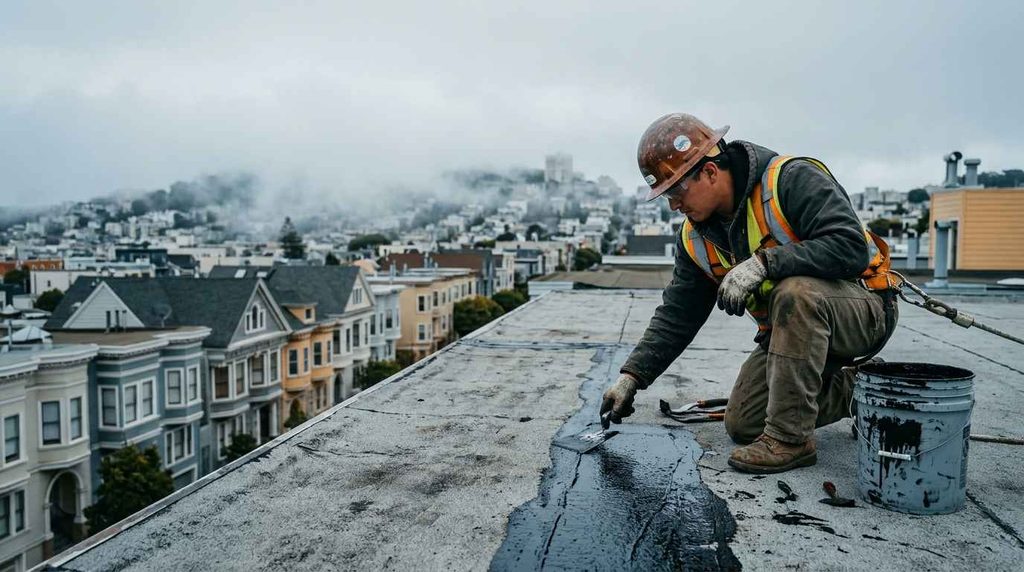
Per the Henry 208R and Black Jack 2172 data sheets. 1. Check the temperature and the label. Black Jack 2172 wants 50 to 120 degrees; Henry 208R adheres from 5 to 120 degrees and on wet surfaces. 2. Find and clean the leak source. Sweep off debris, remove embedded gravel, cut away old cement. Do not repair a tar-and-gravel roof with blisters — patching over a blister fails. 3. Trowel on the first coat. Spread cement 1/8 to 1/4 in thick and at least 2 in past the damage, feathering the edges. For a shingle tear, lift the tab, spread cement underneath, press it back down, re-nail, and cover the tear and each nail head. 4. Embed reinforcing fabric. If the damage is over 1/4 in wide or 2 in long, press Henry 181 or 183 fabric — or polyester or glass fabric — into the wet cement, then trowel a second coat over it until the mesh disappears. Polyester fleece, not cotton. 5. Let it cure, then coat. Wait 30 days before a Henry roof coating over 208R, or 30 to 60 days before a reflective coating over Black Jack 2172. Treat any rain repair as an emergency — flat roof repair in wet weather covers the rain-day rules.
Tar and Gravel (BUR) Roofs in San Francisco
Built-up roofing — layers of hot bitumen and felt topped with gravel — is the oldest low-slope system in the city, common on 1950s and 1960s homes, lasting 20 to 30 years. Clear the gravel back, repair with compatible bitumen and felts, and restore the gravel. Tar smeared over gravel cracks. Do not repair a blistered BUR at all. A user post from one day ago asks about tar-and-gravel roof replacement, TPO vs IB PVC, in the SF Bay Area. Asbestos — felts, mastics and coal-tar pitch from the 1960s and 1970s can contain asbestos, so test before any tear-off is bid. Heat — a tar-and-gravel roof transfers heat; a reflective coating is the usual answer.
Roofing Tar in San Francisco: Fog, Ponding and Torch-Down
San Francisco’s flat roofs live under the marine layer — fog from the Pacific, damp mornings, and a rain season that runs November through March. Tar cement needs a dry surface unless the label claims wet use, and fog stretches cure times. That is why the wet-rated product matters here: Henry 208R is rated for wet-surface adhesion and adheres down to 5 degrees. A dry-surface cement on a fog-damp roof in the Richmond (94118, 94121) or the Sunset (94122, 94116) will not bond. Second, ponding: silicone tolerates it; tar does not. If your roof holds water for more than 48 hours after rain, a tar patch is the wrong spend. Our silicone roof coating guide is the comparison to read next. Third, the roof itself: most residential flat roofs in the Mission (94110), the Castro (94114), Potrero Hill (94107), Bayview (94124), the Excelsior (94112) and North Beach (94133) are torch-down — and the makers say tar may not bond to some APP membranes. That is a detailed inspection question. San Francisco is Climate Zone 3 — see the Title 24 guide — where the prescriptive cool-roof rule does not apply to low-slope nonresidential roofs.
What a Tar Patch Costs in San Francisco
| Fix | What You Pay | What It Is |
| DIY tar patch, 2×2 ft | About $40 materials | 1 gal Henry 208R + fabric roll |
| Pro small repair | 361–439 | HomeWyse, Jan 2026, national benchmark |
| SF flat roof repair | 350–2,500 | Site figure, San Francisco |
| Silicone coating, SF | 3.50–6 / sq ft | Site figure, San Francisco |
| Coating restoration | 2–5 / sq ft | Madison guide; 4–8 in Torrance |
| Full flat replacement, SF | 7–13 / sq ft | Site figure, TPO to torch-down |
The 361–439 HomeWyse figure is a national benchmark for a small pro repair; the 350–2,500 site figure is San Francisco flat roof repair. The $40 DIY patch is materials only, for a 2 ft by 2 ft area, and it buys 2–5 years — see our guide to reading a roofing quote.
When Tar Will Not Save Your Roof
Tar covers a symptom: a patch hides the problem while water keeps moving inside the assembly. Call a roofer instead when you see multiple leaks, soft or sagging decking, daylight through the deck, an asphalt roof past roughly 20 years, leaks around chimneys, skylights, or valleys, blisters on a built-up roof, ponding water that stays more than 48 hours, or a tar patch that has already failed once in the same spot.
Safety: Fumes, Fire and Asbestos
Roofing tar is not a harmless bucket of glue. Coal-tar pitch volatiles are classified as an occupational carcinogen. Hot tar runs near 500 degrees in the kettle, and torch work reaches 2,000 degrees at the flame. Work in a well-ventilated area, wear a mask, and keep the kettle off the roof. Asbestos is the other safety rule: felts, mastics and coal-tar pitch from the 1960s and 1970s can contain asbestos. Test before any tear-off is bid.
How We Checked This
Sources: the four competitor pages received with the brief, ten more found by live search, about 84 social media post titles, seven People Also Search items, and three video transcripts. Prices are Google Shopping listings checked October 19, 2026. No Semrush data arrived.
Frequently Asked Questions
Is roofing tar good for a roof leak?
Yes, as a fast temporary fix on asphalt roofs — 1/8 to 1/4 in thick, 2 in past the damage, fabric over 1/4 in wide.
How long does roof tar last?
A cement patch: 2 to 5 years. Hot-applied tar on a built-up roof: 20 to 30 years.
Can you put tar on a roof in the rain?
Only with a product labelled for wet use — Henry 208R is rated 100% wet-surface adhesion under ASTM D3409.
What is the difference between roofing tar and roofing cement?
They overlap: roofing cement is a trowel-grade asphalt mastic made to ASTM D4586; roofing tar is a looser term for the same cold cement.
Can you use roofing tar on a rubber roof?
No. Henry 208R is not recommended over rubber or PVC, and Black Jack 2172 excludes EPDM, Hypalon and PVC.
Can you put tar on a torch-down roof in San Francisco?
Ask the membrane maker first: Henry’s sheet says its cement may not give satisfactory results over some APP membranes.
Is coating your roof a good idea?
Yes, when the roof is sound and dry: silicone costs 3.50–6 per sq ft and lasts 10–20 years. No, when the insulation is wet or the roof ponds water.
How much does roofing tar cost in San Francisco?
A DIY patch on a 2×2 ft area is about $40 in materials. A pro small repair runs 361–439; San Francisco flat roof repair runs 350–2,500.
Does roofing tar work on shingles?
Yes, as a spot patch for a torn tab or a popped nail. Lift the tab, spread cement underneath, press it back down, and re-nail.
What is tar and gravel roofing, and is it still used?
Tar and gravel is built-up roofing — layers of hot bitumen and felt topped with gravel — common on 1950s and 1960s homes, lasting 20 to 30 years.
Do roofers still use tar in 2026?
Hot tar is declining — kettles, fumes and fire risk have pushed the trade toward cold cements and coatings.
Bottom line
Roofing tar is the cheapest, fastest emergency patch you can buy — about $40 in materials for a 2×2 ft area — and the right call for a small emergency repair on an asphalt roof. It is the wrong call on EPDM, TPO, PVC, slate, wood shingles and silicone-coated roofs, and it may not bond to the torch-down membrane on most San Francisco flat roofs. A silicone coating at 3.50–6 per sq ft lasts 10–20 years against 2–5 for a tar patch — but only on a sound, dry roof. NAICS Code 238160 – Roofing Contractors. Call +1 833-804-6249 for a detailed inspection.


