

Flat Roof Repair in Wet Weather in San Francisco: What Works in Rain, What Must Wait
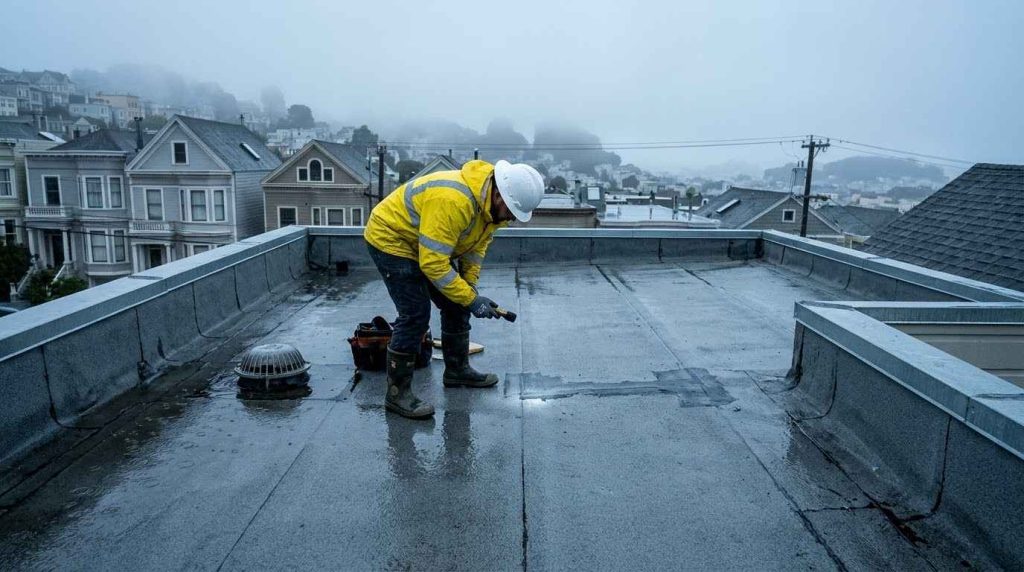
Key Facts
- A flat roof in San Francisco is a low-slope roof, not a truly flat roof. A properly built one carries a deliberate pitch, typically a quarter inch per foot, to move water to a drain before it finds a seam.
- Emergency cover in rain: yes. Permanent seam, adhesive, torch, and coating work: no, until the surface and the insulation underneath are dry.
- Water still present 48 hours after rain is ponding that needs correction. It is not a puddle to ignore.
- Ponded water adds about 5 pounds per square foot per inch of depth, and it sits on every marginal seam until it finds a way in.
- Leaking every winter is not normal. It is a failed seam, flashing, drain, or ponding problem that was not fixed.
- Call +1 833-804-6249 for a detailed inspection. This article does not offer a free inspection, and it does not promise a same-day or overnight response time.
Quick Answer: Can you repair a flat roof in wet weather in San Francisco?
Yes for emergency cover, no for a permanent repair while the roof is wet. In rain, you tarp, you contain water inside, you photograph damage, and you make the roof watertight as a temporary measure. You do not heat-weld a TPO seam, glue an EPDM seam, torch modified bitumen, or coat over wet insulation in rain. Those jobs need a dry surface, dry insulation, and a seam that can be tested. If a roofer tells you a winter leak is normal, or starts a full replacement with rain in the forecast and no tarp plan, that is the problem to fix first, not the roof.
What should you do tonight if your flat roof is leaking in rain?
Do not go up on a wet flat roof at night to find a leak. A wet membrane is slick, a saturated deck can be soft underfoot, and a leak inside rarely sits directly under the hole outside. Water runs down, along a deck, and along a joist before it drips.
Inside first, in this order:
- Move furniture, electronics, and anything that cannot get wet out from under the drip.
- Put a bucket under the drip, and a second bucket nearby for when the first fills. In an attic that is not boarded out, put planks across the joists first, then a tarpaulin over that area, then buckets on the planks. Do not put a full bucket on unsupported ceiling drywall.
- If you can reach the attic safely, find where water is coming in from inside. Look for a drip line, a wet joist, or a stain near a wall, a skylight, or rooftop equipment. Photograph it with a date stamp.
- Turn off power to any light or outlet in the wet ceiling area if water is near it. Do not touch a wet switch.
- Outside, only if it is safe and daylight allows, a tarp over the suspect area, overlapped downhill so water runs over it and off the roof, not under it, will buy time. Weight or secure the edges. A tarp is not a repair. It is a cover until a dry window arrives.
- Call for a detailed inspection and emergency cover, and tell the roofer in plain words: roof is leaking in rain, interior drip location, roof system if you know it, and whether anyone has already tarped it.
Check your roof again after the rain stops, not during it, for a permanent fix. That is the rule every competitor page and every Reddit thread in this set points to, even when they disagree on everything else.
What can be done in rain, and what must wait for dry weather?
This table is the core of the article, because no competitor page in the set gave it. Use it to judge any quote you get in wet weather.
| Situation | What We Do | What We Do Not Do | Why |
| Raining now, active leak | Tarp outside if safe, contain inside, photograph | No seam weld, no adhesive, no torch, no coating | Wet seams do not bond, coatings do not cure, torch on wet deck is unsafe |
| Rain stopped, roof still wet | Clear drains and scuppers, inspect, moisture check | No adhesive, no coating, no new membrane | Surface water hides wet insulation and breaks adhesion |
| Fog, roof damp but not raining | Inspect, clear debris, plan patch, dry test area | No coating over damp felt or membrane unless product sheet says so | Fog keeps a flat roof damp long after rain stops in SF |
| Dry window, surface dry, insulation dry | Patch, weld, adhere, coat, replace as scoped | No coating over wet insulation, ever | Wet insulation never dries in place, it rots deck and kills thermal performance |
| Dry window, insulation wet | Remove wet section, dry or replace insulation, then membrane | No coating over wet section to hide it | Coating over wet insulation traps moisture and buys nothing |
A wet-patch product marketed as usable on damp surfaces is an exception, not a rule. Some products in the YouTube transcripts — a rubberized wet patch for torch-down, a damp-surface liquid repair for felt, a wet-surface flashing cement — are shown being applied in rain or on damp surfaces. Those are product-specific claims from creators, for specific membranes. A product that works on felt does not automatically work on TPO or EPDM, and a wet patch is still a temporary or spot repair, not a full system replacement. Check the product sheet for your membrane before you accept a wet patch as permanent.
Which flat roof systems can be repaired wet, and which cannot?
All 6 competitor pages list systems. None of them gave a wet tolerance per system. Here it is, in plain terms, with no invented cure times. For an exact dry window or temperature limit, check the manufacturer sheet for the product actually on your roof.
- TPO single-ply: Heat-welded seams need a dry, clean seam to weld and probe-test. Rain on a weld is not a repair, it is a future leak. White TPO also helps with Title 24 cool-roof rules on a re-roof, which matters in San Francisco, but that does not make it a wet-weather repair system.
- PVC single-ply: Same rule as TPO for welding. PVC resists grease and chemicals better than TPO, which matters over restaurant kitchens, but it still needs a dry seam to weld.
- EPDM rubber: Adhesive and tape seams do not bond reliably on a wet surface. The YouTube EPDM videos show patch after patch failing because glue and cover tape lift at every corner, and a silicone seal with fleece is shown as an alternative that stretches with the membrane. That silicone claim is a creator claim, not a manufacturer guarantee. Clean, dry, and test any EPDM patch, and do not accept “it will never leak” as a warranty.
- Modified bitumen, torch-applied: Torch work in rain and on a wet deck is unsafe and does not bond as specified. Emergency cover first, torch later. A hot-work permit and fire watch apply to torch work in San Francisco, which is another reason not to rush it in rain.
- Modified bitumen, cold-applied and self-adhered: Safer than torch in other ways, but still needs a dry surface for adhesion. Cold does not mean wet.
- Built-up roofing, tar and gravel: Old BUR roofs are durable and repairable, but a repair still needs a dry, clean area to bond, and gravel displacement after wind exposes membrane to UV.
- Silicone coatings: More damp-tolerant than acrylic, and often used as a restoration coating, but still not a rain-day application, and never over wet insulation. A coating renews a sound, dry roof. It does not fix a failed roof.
- Acrylic coatings: Less damp-tolerant than silicone. Rain before cure is the exact question Reddit asks most about coatings, and the answer is: check the product sheet, and do not assume a coating that got rained on during cure is sound. It may need to be recoated.
If you are patching constantly, in the words of one YouTube creator on torch-down, it is time to look at a new system, not another patch. That judgment — patch count, patch age, and whether drainage is fixed — is what a detailed inspection should give you, not just another tube of mastic.
Why is San Francisco wet weather different for a flat roof?
San Francisco does not get the same wet weather as a dry inland city, and it does not get the same wet weather in every neighborhood. That is why a general flat-roof page fails here.
- Fog belt: The Sunset, Richmond, and coastal neighborhoods stay damp long after rain stops. Fog keeps a flat roof wet, grows moss and algae, and hides seam failure until a big storm finds it. A roof that looks dry at noon in the Mission can still be damp in the Sunset at the same hour.
- Wind-driven rain: Hilltop and coastal homes get rain blown sideways under flashing and into parapet joints. A seam that holds in still rain can fail in wind-driven rain, especially at walls, curbs, and skylights.
- Atmospheric river rain: Heavy, sustained rain ponds faster than drains clear, especially if scuppers and drains are clogged with leaves, branches, and debris after the first storm. Ponding is not just a summer problem. It is a first-big-storm problem.
- Microclimates: SoMa and Mission flat-row homes, with tight side access, shared parapets, and lightwells, leak differently from a standalone Sunset row house with a flat roof behind a facade. Access, parapet ownership, and drain location change the repair, even if the membrane is the same.
- Salt air and UV: Coastal salt air corrodes metal flashing and termination bars, and inland sun breaks down membrane over time. A flat roof in San Francisco fails from both ends: fog and salt on the coast, sun and heat inland.
Local areas where this matters most, with ZIP codes for search, not as a service-area promise for every street:
- Sunset, 94122 — Inner Sunset, and 94116 for Parkside and Outer Sunset areas, fog belt, flat roofs behind facades, ponding after fog and rain
- Richmond, 94121 Outer Richmond, and 94118 Inner Richmond — fog belt, near Golden Gate Park, wind-driven rain, moss and algae
- Mission, 94110 — flat-row homes, tight access, shared parapets, drains that serve more than one building
- SoMa, 94103 — lofts, commercial flats, rooftop equipment, drains and curbs that multiply leak points
Landmarks that help you place a roof, not as an address claim: Golden Gate Park borders the Richmond and Sunset districts, and SoMa sits south of Market Street near Moscone Center. If your building is near the park or in SoMa, fog and equipment load are more likely factors than a simple seam failure alone.
Call +1 833-804-6249 for a detailed inspection if your roof is in one of these areas and it leaks every winter, ponds after 48 hours, or has had three or more patches in the same area.
What does ponding, a seam failure, and a flashing failure actually look like in rain?
Competitor pages list these problems. They do not tie them to rain. Here is the rain version:
- Ponding water: Water that remains 48 hours after rain. It accelerates membrane degradation, grows biological material, adds load, and finds every marginal seam by sitting on it. Fix it with tapered insulation to rebuild positive slope, added drains, or cleared drains and scuppers — not with another coat over a low spot. Only a re-roof with tapered insulation truly removes a structural low spot, in the words of Reddit users who have tried patching it.
- Seam separation: Seams lift, split, or wrinkle from thermal movement, poor original welding, age, and foot traffic by other trades. In rain, an open seam is water getting under the membrane, and it spreads laterally once it does. A patch over a seam must be clean, dry, and feathered at the edges, or it peels.
- Flashing and edge failure: Edges, penetrations, and transitions are the most common failure points. Metal flashing corrodes, membrane terminations fail, termination bars loosen, pitch pans shrink and crack. In San Francisco, interior stains near walls or equipment usually point to a flashing or curb detail, not to the open field of the roof. Those are typically repairable, if they are found.
- Blisters and soft spots: Air or moisture trapped beneath the membrane causes bubbles. A spongy or soft area underfoot means trapped moisture or saturated insulation below, and soft decking means water has already reached the structure. Do not walk a soft deck to “check” it in rain.
- UV and weather degradation: California sun breaks down membrane over time, membrane becomes brittle and cracks, and fog keeps it damp in between. A coating can help a weathered but sound roof. It cannot save a brittle, cracked, wet roof.
If your roof has always had a puddle after rain, and a roofer told you it is okay because there is no leak inside yet, get a second opinion with a moisture check. No interior leak yet does not mean no damage yet.
How do you patch a flat roof properly, once it is dry?
The YouTube transcripts in this set show three patch methods, each for a different membrane. Do not mix them. A method that works on one system can fail on another.
Mastic patch with webbing, for modified bitumen and similar asphalt systems:
- Scrape off loose mastic only, sweep the area clean. Do not scrape sound material off.
- Use an asphalt-based primer to lock dirt and granules in, so mastic can stick to a clean surface.
- Apply a thin bed, about 1/8 inch in the middle, feathered down to about 1/16 inch at the edges, like a small mole hill, thick on top and thinner on the sides, so it does not peel.
- Lay webbing or mesh into the wet bed, press it down without voids, until the bed saturates the fabric. Then apply a light top coat over the mat.
- Creator claim, labelled: webbing takes a patch that would last 1 to 2 years to 5 to 10 years. That is one creator’s claim, not a warranty, and it still depends on a dry surface and fixed drainage.
Wet patch with mesh, for torch-down, as shown in the transcripts:
- Lay a thin layer of rubberized wet patch, lay repair mesh cut to size, press it in until tar comes through and turns the mesh black, then lay a second layer over it and feather it out.
- Creator claim, labelled: this can be done in rain and cold, and one product in the video carries a 10-year warranty claim from the creator. Do not treat that creator warranty claim as a manufacturer warranty for your roof. If you are patching the same area constantly, the system, not the patch, is the problem.
Silicone seal with fleece, for EPDM, as shown in the transcripts:
- Clean thoroughly, wash out crud, dry the area. You cannot expect anything to stick to dirt.
- Paint a thick coat of silicone seal, lay polyester fleece cut to size, paint a second coat completely over the fleece, covering it fully.
- Creator claim, labelled: silicone stretches with EPDM and will not come loose like tape. That is a creator demonstration, not a guarantee, and it still needs a clean, dry surface to start.
What not to do, from Reddit and competitor evidence combined:
- Do not coat over wet insulation.
- Do not torch in rain.
- Do not install new membrane over a wet deck or wet insulation and hope it dries out. It will not.
- Do not use low-expansion foam to fill and waterproof a void on a title alone. Foam is not a roofing membrane.
- Do not keep applying wet patch until a leak stops, without finding the source. A patch over a ponding low spot, a failed drain, or a flashing failure will fail again.
- Do not walk on a saturated deck, a blistered area, or near an unguarded edge in rain to “check” a leak.
Repair, coating, or replacement: which one fits a wet-weather roof?
This is the decision framework Keith Roofing uses, and it is the strongest framework in the competitor set. It works for wet weather if you add one rule: moisture check first, always.
| Factor | Repair | Coating / Restoration | Replacement |
| Existing membrane | Mostly sound, problem localized | Broadly intact, weathered, seams sound | Failed, severe damage, multiple leaks |
| Insulation underneath | Dry and functional | Dry and functional | Wet, compressed, or saturated |
| Ponding water | Minor or none, drains clear | Minor or none | Severe, structural low spot, tapered insulation needed |
| Cost range SF | Flat repair 350–2,500 | Silicone 3.50–6 per sq ft | Full replacement 17,000–42,000 |
| Disruption | Targeted, shortest | 1–2 days for coating in dry weather | More involved, tear-off, deck repair, new insulation |
| Life extension | Buys time, not a new roof | 10–15 years if substrate is dry | 20–30 years for a new system, by system |
Repair is right when the field membrane has remaining life and the problem is localized: a seam, a drain, a penetration, a section of damaged membrane.
Coating is right when the membrane is broadly intact and dry but weathered, the seams are sound, and you want another decade without a tear-off. Coating over a wet or failed substrate is one of the more expensive mistakes in flat roofing, and it is a common one.
Replacement is right when the membrane is at end of life, when there are multiple leaks across the field, or when there is saturated insulation beneath the membrane. Wet insulation never dries out in place. It destroys thermal performance and it will rot the deck.
A competitor-listed Bay Area price for context, labelled as competitor-listed, not as this site’s price: ROOF EXPRESS lists flat roof patch and membrane repair at 600-2,000, and emergency tarp and temporary repair at 400-1,200, in its 2026 Bay Area cost guide. Those ranges overlap the San Francisco ranges above, but they are Bay Area general prices, not a San Francisco wet-weather quote for your roof. Your quote depends on size, access, deck condition, drain work, and system, and it should be in writing after a detailed inspection.
How much does flat roof repair in wet weather cost in San Francisco?
Use the San Francisco ranges below for planning, not as a quote. A quote needs a roof size, a system, a deck condition, and a drain plan.
| Work | San Francisco Range | Notes |
| Flat roof repair, targeted patch | 350–2,500 | Seam, flashing, drain, or section patch, dry window required |
| Emergency cover, tarp and containment | Varies by size and access | Temporary only, not a permanent repair; confirm scope in writing |
| Silicone coating, restoration | 3.50–6 per sq ft | Only if membrane and insulation are dry and sound |
| TPO new system | 7–11 per sq ft | Heat-welded, reflective, Title 24 context on re-roof |
| Torch / modified bitumen new system | 8–13 per sq ft | Hot work, dry deck required, fire watch as required |
| Full flat roof replacement | 17,000–42,000 | Tear-off, deck repair, insulation, membrane, flashing, permit as required |
Do not use the 500-700 patch anecdote from the Reddit summary as a San Francisco price. That figure in the summary has no location, no roof size, and no system attached, and it is a single comment about a one-hour cleaning and drying patch. It is not a San Francisco quote.
If a quote is far below these ranges for a full replacement, ask what is excluded: deck repair, insulation, tapered insulation for ponding, flashing, drains, permit, or warranty in writing. If a quote is far above them, ask what system, what insulation, and what drain work justifies it.
What should a proper wet-weather inspection include?
A proper inspection is not a look from the ground and a price. It is, in order:
- Walk the roof in dry weather, map drainage, drains, scuppers, and low spots.
- Examine seams, penetrations, terminations, parapets, curbs, skylights, and equipment supports.
- Check for blisters, soft spots, seam lifting, flashing corrosion, and pitch pan cracking.
- Check the substrate for moisture, not just the surface. That moisture check decides repair vs coating vs replacement.
- Photograph details throughout, with a written report showing what was found and what is recommended, before work begins.
- After a permanent repair, water-test the repair to simulate heavy rainfall and verify it is watertight before leaving. That water test is the step ROOF EXPRESS uses, and it is the step that separates a patch from a proven repair.
- Give a written scope, a written workmanship warranty, and a maintenance schedule. Low-slope warranties generally require documented service, so keep the report.
Call +1 833-804-6249 for a detailed inspection that includes a moisture check and a photo report. Bring your previous patch history, if you have it, because patch count and patch location tell a roofer more than a single leak photo does.
Do you need a permit, and what does Title 24 mean for a flat roof in San Francisco?
Short answer: a full re-roof in San Francisco needs a Department of Building Inspection, DBI, reroofing permit. A minor patch does not automatically need one, but the exemption is limited.
From DBI via sf.gov, checked for this article: you need a permit before installing, repairing, or removing roofing material, subject to exemptions in San Francisco Building Code Section 106a.2, item 13. A third-party summary of DBI rules puts the reroofing exemption at no more than 25 percent of the roof surface in any 12-month period, so a full tear-off always needs a permit, and the online reroofing route only works when the job needs no plans and replaces no structural components such as framing or decking. If structure is involved, it becomes an over-the-counter building permit. Landmark historic buildings need Planning approval and photos of the existing roof.
Do not rely on that summary alone for your building. Verify with DBI or your contractor for your address, your building type, and your scope, before work starts. Repeated patches that add up to more than the exempt area can become a permit job, even if each patch alone looks minor.
Title 24, California’s energy code, sets cool-roof rules for low-slope roofs on re-roofing projects. That is a large part of why white TPO and reflective cap sheets dominate new low-slope work in San Francisco, and why a dark torch-down system without a reflective cap may not comply on a re-roof. Sources in this set conflict on the exact Solar Reflectance Index number, so this article does not lock an SRI figure. Check the current Title 24 and DBI requirements for your project before you choose a system.
For torch-applied systems, a hot-work permit and fire watch protocols apply, which is another reason torch work is not a rain-day rush job.
What are the most common issues with flat roofs in San Francisco, and how do you prevent them?
- Ponding: Clear drains and scuppers after every big storm, check for crushed scuppers and low spots after equipment work, and fix drainage before you coat. A coating over a low spot does not fix ponding.
- Debris: Keep the roof free of leaves, branches, and debris. Debris clogs drains, holds moisture, and grows moss and algae, especially in fog-belt neighborhoods.
- Foot traffic: Every trade that walks a flat roof can puncture it, crush a scupper, or open a seam. Keep a record of who has been on the roof and when, especially for solar and HVAC work.
- Sealant and flashing: Pitch pans shrink, termination bars loosen, sealant splits at conduits and curbs. Those are ordinary aging, and reliable leak sources if nobody attends to them. Check them on a maintenance visit, not just after a leak.
- Coating cure: Do not schedule a coating with rain in the forecast during cure, and do not accept a coating that was rained on during cure without a recoat check. Ask the contractor what the product sheet says about rain during cure, in writing.
- Maintenance: Regular inspections catch minor issues before they become expensive repairs. A pre-rain-season check in fall, and a post-storm check after the first big rain, are the two visits that matter most in San Francisco.
How we checked this page
This page was built on Oct 31, 2026 from:
- 6 competitor pages received, no URLs, so no slug or meta audit was possible from that dump: Infinite-type, Eco Smart Roofer, ROOF EXPRESS, Keith Roofing, Royal Roofing CA, and San Francisco Roofing Contractors.
- About 150 Reddit thread titles with votes and comments, no comment bodies, across r/Roofing, r/DIYUK, r/HomeImprovement, and other communities. Votes are demand evidence only, not repair success rates.
- 8 YouTube transcripts: mastic seam patch, emergency shingle patch, Everbuild UK flat roof, Karnak wet-surface repair, Henry wet patch for torch-down, EPDM silicone seal in two versions, and a garage felt coating. Product claims in those videos — “never leak,” “permanent,” “10-year warranty” for one wet patch product, “can be used underwater” — are creator and seller claims, labelled as such in this article, not verified facts.
- 6 “People also search for” items: how to waterproof a flat roof effectively, flat roof repair options, effective methods for fixing flat roof leaks, best flat roof repair methods, DIY tips for flat roof repairs, and one noise item about thatched roofs, which was excluded.
- San Francisco ZIP codes and DBI permit guidance checked via search on Oct 31, 2026: SoMa 94103, Mission 94110, Inner Richmond 94118, Outer Richmond 94121, Sunset 94122, and DBI via sf.gov for reroofing permits.
- No Semrush keyword file was received for this topic. No Semrush volumes, difficulties, or CPC figures are quoted in this article. Keywords here come from Reddit titles, People also search for, and competitor headings, used naturally in headings and content, not stuffed.
What we did not do, on purpose:
- We did not copy competitor testimonials, project addresses, review counts, license numbers, business years, or warranty years. Those are theirs, and your site rules do not allow license numbers or warranty years in copy.
- We did not claim a free inspection, a same-day response, or a 24-hour service. Those are competitor claims, not confirmed for this site.
- We did not present UK felt, GRP fiberglass, loft, or pound prices as San Francisco advice. UK terms were translated: loft becomes attic, felt becomes modified bitumen or built-up roofing, GRP becomes a UK fiberglass system, not a standard San Francisco flat system.
- We did not use the 500-700 single-comment patch anecdote as a San Francisco price, and we did not use Tucson, Chicago, or Brooklyn quote threads as San Francisco pricing.
- We did not present Reddit votes as “most common leak” or YouTube product claims as “best product.” Where sources conflict — for example, Title 24 SRI numbers, EPDM patch longevity, and wet-patch permanence — we showed the conflict and told you to check the product sheet or DBI for your building.
If a price, a permit rule, or a product claim on this page differs from your local DBI requirement or your manufacturer sheet, the DBI requirement and the manufacturer sheet win.
NAICS Code 238160 – Roofing Contractors
Call +1 833-804-6249 for a detailed inspection of your flat roof in San Francisco, with a moisture check, a photo report, and a written scope. If your roof is leaking tonight, contain water inside, photograph the drip, and do not walk a wet, soft deck to find it in the dark.


