
Green Roofing in San Francisco: Cost, Law and Best Living Roofs (2026)
Key Facts
- Bay Area cost: extensive 15-25 per sq ft, intensive 30-50+ per sq ft (Pacific Coast Roofing Service). Most Bay Area residential projects, 1,000-2,000 sq ft, run 18,000-45,000. No San Francisco-specific installed-cost figure exists.
- National cost: 10-30 per sq ft, average $18,000, most projects 10,000-25,000 (Angi, October 27, 2026).
- The Better Roofs law: new buildings must cover 15% of the roof with solar OR 30% with a living roof, or a blend. It is a choice, not both.
- Weight, saturated: extensive 12-50 lb per sq ft, intensive 80-150 lb per sq ft, conventional roof 10-12 lb per sq ft (RoofScour, 2026).
- SF reroofing permits: $514 and up (single-family/duplex), $714 and up (other buildings).
Quick Answer
A green roof in the San Francisco Bay Area costs 15-25 per sq ft for an extensive system and 30-50+ per sq ft for an intensive system (Bay Area roofing company range). Most Bay Area residential projects of 1,000-2,000 sq ft cost 18,000-45,000. The 2017 Better Roofs law does not force both solar panels and a living roof. It requires 15% of the roof as solar OR 30% as a living roof, or a blend at 2 sq ft of living roof per 1 sq ft of solar.
What a green roof is: extensive vs intensive
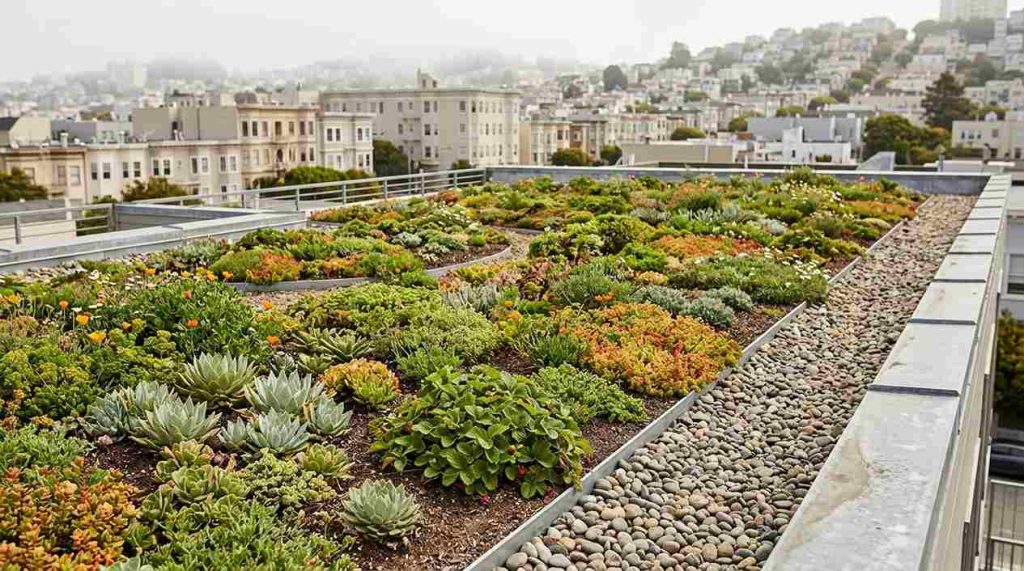
A green roof is a roofing system with a waterproof membrane, a root barrier, a drainage layer, growing medium, and living plants. There are three types, and the difference is soil depth. Extensive roofs have 2-6 in of soil and low, hardy plants such as sedums. Semi-intensive roofs have deeper soil and a mix of grasses, herbs, and small shrubs. Intensive roofs have 6 in or more of soil and can carry shrubs, small trees, lawns, and walkways. For most San Francisco homes, the real choice is extensive or nothing.
| Type | Soil depth | Plants | Weight saturated | Maintenance | Installed cost |
| Extensive | 2-6 in | Sedums, native grasses | 12-50 lb per sq ft | Low | 10-25 per sq ft |
| Semi-intensive | 6-12 in | Grasses, herbs, small shrubs | Between the two | Medium | 15-30 per sq ft |
| Intensive | 6 in and more | Shrubs, trees, lawns | 80-150 lb per sq ft | High | 25-35 per sq ft |
Sources: RoofScour 2026 (types, weights); HomeGuide 2026 (costs); Angi October 2026 (national averages).
The 5 living roofs to visit in San Francisco
Five living roofs show the full range.
1. California Academy of Sciences, Golden Gate Park
The California Academy of Sciences has the green roof with the most published performance data in the city: 2.5 acres, about 1.7 million plants in 50,000 coir biotrays, seven undulating hills designed by Renzo Piano, at 55 Music Concourse Dr, San Francisco, CA 94118. A 3,500 sq ft observation deck at roof level holds up to 200 people. The Landscape Architecture Foundation case study of August 2024 measured it: more than 70% of the plant species are native to California, the roof attracts at least 36 species of pollinators and insects, its solar panels generate about 213,000 kWh per year (a 10% offset), and it reduces average surface temperatures by up to 18 degrees F. The roof budget was $4.5 million. The museum reopened on September 27, 2008. The museum’s press-release figures run higher (10 degrees cooler inside, 98% of storm water absorbed). Use the measured 18 degrees F surface reduction when you quote performance.
2. Salesforce Park, 425 Mission St
Salesforce Park is the biggest living roof in the city and the one every top-10 ranking page leaves out: a 5.4-acre rooftop park, 1,400 ft long and 70 ft above the Grand Hall of the Salesforce Transit Center, at 425 Mission St, opened on August 11, 2018. It holds 600 trees and 16,000 plants in 13 botanical areas, with soil from 18 in to 4.5 ft deep. The transit center cost $2.26 billion, the park budget was $33.28 million, and the park saves about 5 million kWh per year. It is open to the public.
3. California Pacific Medical Center, Van Ness campus
When Sutter Health rebuilt the California Pacific Medical Center in 2019, it built five green roofs totaling 25,000 sq ft near Van Ness. The Elizabeth C Peters garden is the best example: a living roof that flanks and partly conceals the air conditioning compressors, with a metal cutout that casts the garden’s name across the roof, sundial-style, at noon. It hosts native plants as habitat for pollinators and monarch butterflies, and as a healing vista for patients.
4. STEM Kitchen and Garden, Mission Bay
STEM Kitchen and Garden in Mission Bay, at 499 Illinois St, puts its roof to work: vegetables, fruits, and herbs from a quarter-acre roof garden go into its food and cocktails. Every dish uses at least one item grown on the roof, and the roof produces at least 30 lb of produce per week. STEM is open for lunch Monday to Friday only, and closed on weekends.
5. BART and Muni Market Street canopies
The smallest living roofs in the city are also the most public. BART is building living roofs on its Market Street station canopies, 650 sq ft per canopy, with 21-23 planned from Embarcadero to Civic Center. The pilots are at Montgomery and Powell stations, planted with Nature in the City as habitat for the western tiger swallowtail butterfly.
The Better Roofs Ordinance, explained correctly
The top-ranking article about San Francisco living roofs gets the law wrong in its opening line, saying a 2017 law “requires the newest construction to incorporate solar panels and living roofs.” The law requires one or the other, not both. San Francisco’s Better Roofs Ordinance, Planning Code Section 149, took effect on January 1, 2017. It was the first mandate of its kind in the United States. It applies to new construction with 2,000 sq ft or more of floor area, 10 or fewer occupied floors, and a permit on or after January 1, 2017. For those buildings, the roof must have 15% of the roof area as solar or 30% as a living roof, or a blend at 2 sq ft of living roof for every 1 sq ft of solar. The living-roof alternative also requires a Large or Small Development Project under the Stormwater Management Ordinance. One update matters for SoMa: a 2026 policy update says SoMa requires 15% solar plus 50% living roof, a both-and rule unlike the either-or rule for the rest of the city. For a homeowner, the practical point is simple: the ordinance covers new construction, not your existing roof. If you want the solar side of that choice explained as a roofing project, see the guide to commercial solar reroofing in San Francisco.
What a green roof costs in San Francisco
No San Francisco installed-cost figure exists in any published source. The closest real figure comes from Pacific Coast Roofing Service, a Bay Area roofing company: extensive 15-25 per sq ft, intensive 30-50+ per sq ft, with most Bay Area residential projects of 1,000-2,000 sq ft costing 18,000-45,000. Nationally, Angi’s guide updated October 27, 2026 puts the average at $18,000 and most projects at 10,000-25,000. Labor runs 5-15 per sq ft, irrigation adds 1,000-5,000, and drainage and waterproofing add 2-8 per sq ft.
| Roof size | Extensive (national) | Intensive (national) |
| 1,000 sq ft | $15,000 (range 10,000-22,000) | $25,000 (range 20,000-35,000) |
| 2,000 sq ft | $30,000 (range 20,000-44,000) | $50,000 (range 40,000-70,000) |
Sources: Angi October 2026. The Bay Area range in the paragraph above (15-25 extensive, 30-50+ intensive, most residential projects 18,000-45,000) is from Pacific Coast Roofing Service. For comparison, a roof repair in San Francisco runs 450-1,800, from the guide to roof repair cost in San Francisco. Maintenance is a real yearly cost, and the sources conflict. Angi puts it at 0.75-2 per sq ft per year for extensive roofs and 1.50-4 for intensive roofs. New England Metal Roof puts it far lower, at 0.15-0.60. Repairs run 10-25 per sq ft and replacement 15-35 per sq ft nationally, according to Angi. The ARUP cost-benefit study found the upfront cost largely offset by avoided one-time stormwater management equipment costs. A green roof also captures 65-90% of storm water in national figures.
How a green roof is built
A green roof is built in layers, and every layer has a job. From the deck up: structural deck, waterproof membrane, root barrier, insulation, drainage layer, filter fabric, growing medium, and plants. Common membrane choices under a green roof are EPDM roofing and built-up roofing, and the choice is one to make with your roofer before the plants arrive. The plants and soil protect the membrane from sun and weather, which is why it lasts 40-50 years instead of about 20. The drainage layer lets excess water flow to the drains instead of pooling. The growing medium is a light engineered mix, mostly mineral. The membrane is flood-tested before anything covers it. A green roof is a roofing job first and a garden second.
The downsides: weight, leaks, maintenance, earthquakes
Weight: an extensive roof weighs 12-50 lb per sq ft saturated, an intensive roof 80-150 lb, a conventional roof 10-12 lb. An existing roof designed for 10-12 lb per sq ft cannot take 50 without a structural review, and it certainly cannot take 150. Leaks are harder to find: under soil, water travels sideways before it drips through, so the stain on your ceiling can be feet from the actual hole. Finding it means lifting plants and soil. Without a root barrier, roots grow into seams and punctures. Maintenance is real: a green roof needs weeding, drain and flashing checks, plant replacement, and a post-storm inspection. Earthquakes: San Francisco is earthquake country. A green roof adds mass high up on a building, and the structure and soil system need to be engineered for seismic loads. Salesforce Park’s soil system was engineered to balance seismic shifting, which is the standard to ask for.
Can you put a green roof on your SF house?
Flat and low-slope roof: usually yes, after a structural check. Most San Francisco flat roofs can take an extensive system if the structure passes, and a gentle slope holds soil with simple retention at the edges. If the structure fails the check, the answer is no. Steep Victorian or Edwardian roof: usually no. A steep pitch sheds soil, needs retention systems, and costs far more for a worse result. The guide to slate roofing in San Francisco covers the material those homes were built with. Before you commit, run this checklist: get a structural engineer to confirm the roof can carry the saturated weight, plus seismic loads; get a detailed inspection of the existing membrane and deck, and fix rot and failed flashing first; confirm the roof drains; choose extensive, not intensive, unless the building was designed for a roof garden; and plan who maintains it. If the answer is nobody, do not build it. The guide to roof repair vs replacement in San Francisco sets out how to make that call, and a green roof is a replacement, not a repair.
Plants that survive San Francisco fog
San Francisco fog is the planting problem: cool, damp mornings, strong afternoon sun, and wind off the ocean. The plants that work are native and drought-tolerant, and the Cal Academy roof is the best field test in the city. Armeria, or sea thrift, failed despite a two-year trial mound. Stonecrop failed because the roof was not sheltered enough. Prunella vulgaris was too successful and turned invasive. Dudleya farinosa and Oenothera were surprise successes. Beach strawberry, Salvia spathacea, yarrow, western columbine, and Rocky Point blue-eyed grass all grow there. Grasses are not planted on purpose: they offer little to pollinators, turn invasive, and their rootballs grow out of the shallow beds. Wind and birds brought Gunnera, pines, and willows, which keep re-sprouting from seed trays grown years ago near Carmel. Plant native California species and drought-tolerant succulents such as Dudleya, avoid Armeria and stonecrop on exposed roofs, and budget time to remove willows.
Permits for a green roof in San Francisco
A green roof is a reroof, and a reroof needs a permit. The reroofing permit costs $514 and up for single-family homes and duplexes, and $714 and up for all other building types, with additional fees. You must be a licensed C-39 contractor to apply for a reroofing permit online, and you register for an AUTH number on PermitSF beforehand. The full process is set out in the guide to roofing permits in San Francisco. Three more rules touch a green roof project: the Better Roofs Ordinance, covered above; the Stormwater Management Ordinance; and the SFPUC Stormwater Control Plan, which shows how your site meets the storm water rules. The guide to the best roof coating for a leaking flat roof covers coatings as a repair option, which is a different job from a green roof.
Green roof vs solar: better together?
One discussion asks whether green roofs are finished, and the best answer says the opposite: plants cool the air around solar panels through evapotranspiration, keeping the panels cooler and more efficient. That combination is called a biosolar roof, and blue-green roofs add water storage under the planting. The Academy’s roof does both at once: 1.7 million plants edged by solar panels generating 213,000 kWh a year.
Frequently Asked Questions
What is a green roof?
A green roof, also called a living roof or vegetative roof, is a roof covered with plants growing in a lightweight engineered soil over a waterproof membrane, a root barrier, and a drainage layer. It captures, stores, and slowly releases rainwater instead of shedding it like a conventional roof, and the US EPA classifies it as green infrastructure.
How much does a green roof cost in San Francisco?
Based on a Bay Area roofing company’s published range, an extensive green roof costs 15-25 per sq ft and an intensive green roof costs 30-50+ per sq ft, with most Bay Area residential projects of 1,000-2,000 sq ft costing 18,000-45,000. Nationally, the average is $18,000 at 10-30 per sq ft.
Does San Francisco require green roofs on new buildings?
Not exactly. The Better Roofs Ordinance, in force since Jan 1, 2017, requires most new construction to dedicate 15% of the roof to solar or 30% to a living roof, or a blend. It applies to new buildings with 2,000 sq ft or more of floor area and 10 or fewer occupied floors, with a permit on or after Jan 1, 2017. A living roof can replace solar at 2 sq ft for every 1 sq ft of solar.
What is the difference between an extensive and an intensive green roof?
An extensive green roof has 2-6 inches of soil, low sedums and succulents, weighs 12-50 lb per sq ft saturated, needs little maintenance, and costs 10-25 per sq ft nationally. An intensive green roof has more than 6 inches of soil, supports lawns, shrubs, and small trees, weighs 80-150 lb per sq ft saturated, needs regular care, and costs 25-35 per sq ft nationally.
How much does a green roof weigh?
A saturated extensive green roof weighs 12-50 lb per sq ft, and an intensive green roof weighs 80-150 lb per sq ft, against about 10-12 lb per sq ft for a conventional roof. A structural engineer must confirm the building can carry the saturated weight before installation.
Do green roofs leak?
A green roof does not prevent leaks. Poor detailing around edges, drains, skylights, vents, and penetrations still lets water in, and a leak under soil and plants is harder to locate than a leak on a bare membrane. Roots can penetrate the waterproofing if the root barrier fails. The membrane must be in excellent condition before the green roof goes on.
Can I put a green roof on my house in San Francisco?
An extensive system is possible on many flat and low-slope roofs after a structural check. An intensive roof garden is unlikely unless the house was designed for the load. Get a detailed inspection from a licensed and insured C-39 contractor and a structural engineer first, and settle any repair or replacement decision before adding plants.
What plants grow on a green roof in San Francisco?
Native and drought-tolerant species do best: sedums, succulents, beach strawberry, Salvia spathacea, yarrow, western columbine, Erigeron, and Rocky Point blue-eyed grass all established on the California Academy of Sciences roof. Dudleya farinosa and Oenothera were surprise successes there, while Armeria and stonecrop failed. Grasses are not recommended on a shallow extensive roof.
Which green roofs can I visit in San Francisco?
Five are open to the public: Salesforce Park at 425 Mission St, the California Academy of Sciences at 55 Music Concourse Dr, the CPMC Van Ness campus green roofs, STEM Kitchen and Garden at 499 Illinois St in Mission Bay (Monday to Friday lunch, closed weekends), and the BART/Muni canopy living roofs along Market Street.
Do green roofs work with solar panels?
Yes, and the combination is called a biosolar roof. Plants cool the air around solar panels through evapotranspiration, keeping the panels cooler and more efficient. San Francisco’s Better Roofs Ordinance treats the two as interchangeable, at 2 sq ft of living roof for 1 sq ft of solar.
Is a green-painted roof a green roof?
No. A roof painted green is waterproofing paint, not a living roof. A green roof is a planted system with soil, drainage, and vegetation over a waterproof membrane. The two share only a color.
Do I need a permit for a green roof in San Francisco?
A retrofit on an existing house does not trigger the Better Roofs Ordinance, which covers new construction, but a retrofit that changes the roof structure, adds weight, or alters drainage still needs a building permit and a structural review. The reroofing permit costs $514 and up for a single-family home or duplex and $714 and up for other buildings. New construction using a living roof to meet the Better Roofs requirement also needs a Stormwater Control Plan approved by the SFPUC.
Bottom line: A green roof in San Francisco is a real roofing system with a real cost, a real weight, and a real law behind it. Visit Salesforce Park and the Academy first, get the structure checked, and let the ordinance and the Bay Area cost range decide. NAICS Code 238160 – Roofing Contractors. Call +1 833-804-6249 for a detailed inspection.