

Standing Seam vs Corrugated Metal Roof (2026): Cost, Lifespan, SF Guide
Key Facts
- Standing seam: $10 to $16 per sq ft installed (2026), lasts 40 to 70 years, 24 gauge standard, concealed fasteners.
- Corrugated: $7 to $12 per sq ft installed (2026), lasts 25 to 45 years, 26 to 29 gauge, exposed fasteners.
- Corrugated needs a 3:12 slope. Mechanically seamed standing seam works at 1:12. Many San Francisco flat roofs sit below 3:12.
- Standing seam costs about twice as much as corrugated. Labour is most of the difference.
- No San Francisco installed cost exists in any source. The figures in this guide are national, labelled by source.
Quick Answer
Standing seam costs more and lasts longer. A standing seam metal roof costs $10 to $16 per square foot installed and lasts 40 to 70 years. A corrugated metal roof costs $7 to $12 per square foot installed and lasts 25 to 45 years. The difference is the fastener: standing seam hides its fasteners under clips, while corrugated drives screws through the panel face.
In San Francisco, the slope rule often decides the question before price does. Corrugated needs a roof slope of 3:12. Mechanically seamed standing seam works at 1:12. Many flat roofs in the Sunset, the Mission, SoMa and Bayview sit below 3:12.
What Is a Standing Seam Metal Roof?
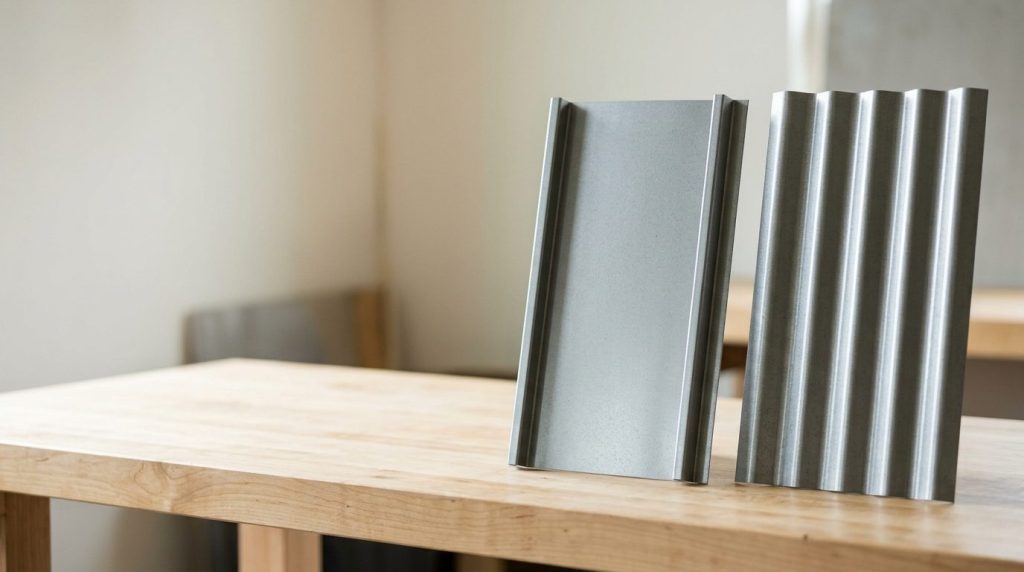
A standing seam metal roof is made of flat, wide panels with raised vertical seams. The seams stand 1 to 2 inches high and the panels are typically 12 to 18 inches wide. The fasteners are concealed: each panel attaches through a clip, and the next panel locks over it, so no screw ever penetrates the panel face.
The trims interlock the same way, so no screw goes through the trim. The steel is usually Galvalume coated. Panels are roll-formed on site and run eave to ridge in one piece, with no seams, at any length up to 115 feet. No seam means no place to leak. Learn more about standing seam metal roofing in San Francisco.
What Is a Corrugated Metal Roof?
A corrugated metal roof is made of formed sheets with curved and wavy ribs. The common profiles are ⅞ inch and ½ inch deep, and the panels are typically 26 to 36 inches wide.
It is an exposed fastener panel: screws are driven straight through the panel face into the deck, with a rubber or neoprene washer under each screw head sealing the penetration. A typical roof ends up with several hundred screws, each a hole in the panel. A 30-foot run is commonly two 15-foot pieces lapped and screwed down the seam, and those laps can rust and leak. See how metal roofing in San Francisco handles the fog belt.
Standing Seam vs Corrugated Metal Roof: 7 Key Differences
| Difference | Standing seam | Corrugated |
| Fasteners | Concealed clips, no screws through the panel | Exposed screws through the panel face |
| Panel width | 12 to 18 inches | 26 to 36 inches |
| Gauge | 24 gauge standard, 26 gauge budget | 26 to 29 gauge |
| Lifespan | 40 to 70 years | 25 to 45 years |
| Cost installed | $10 to $16 per sq ft (2026) | $7 to $12 per sq ft (2026) |
| Minimum slope | 1:12 (mechanically seamed) | 3:12 |
| Solar mounting | S-5 clamps, no drilling | Penetration through the panel |
The fastener drives everything else. Concealed fasteners mean no screw holes, no washers to fail, and far less maintenance.
Standing seam is 24 gauge as standard, which is thicker metal. Corrugated runs 26 to 29 gauge, which is thinner and easier to dent. One installer counters that thickness and coating depend on the roll stock ordered. Standing seam panels are 12 to 18 inches wide, so the crew installs twice as many panels, and the trim takes two to three times as long.
Why Is Standing Seam So Expensive?
Labour is most of it: a proper standing seam roof takes a lot more work than a corrugated roof, and that work is specialised. The trim is a system: a ridge cap is a cap plus two Z channels, three pieces that lock together. The seaming takes skill and tools: a bad seam is a leak.
One homeowner report describes a quote of $115,000 for standing seam and $145,000 for slate on the same house, about twice what the homeowner expected.
One homeowner report describes a snap lock shed roof quoted at $24,000, which the homeowner installed himself for $8,000 in materials plus 80 hours of his own time.
How Much Does a Standing Seam Metal Roof Cost in 2026?
| System | Cost installed, 2026 | Source |
| Standing seam | $10 to $16 per sq ft | roofpitch.net |
| Corrugated | $7 to $12 per sq ft | roofpitch.net |
| Standing seam, wider range | $7 to $30 per sq ft, avg. $33,300 | Angi, July 9, 2026 |
| Corrugated, wider range | $3.50 to $15 per sq ft, avg. $15,200 | Angi, July 9, 2026 |
Standing seam costs about twice as much as corrugated. The working ranges are $10 to $16 for standing seam and $7 to $12 for corrugated, installed, in 2026.
The lifetime math changes the picture: corrugated may need one full replacement cycle plus fastener maintenance over 40 or more years, while one standing seam roof lasts. Cost guides model the break-even at about 12 years: sell inside 12 years and corrugated is cheaper; stay longer and standing seam usually wins. That is a model, not a fact.
No San Francisco installed cost exists in any source we checked. Use the national ranges above, and compare them with roof repair costs in San Francisco.
How Long Does Each Roof Last? Lifespan and Maintenance
The working ranges are standing seam 40 to 70 years and corrugated 25 to 45 years. Angi lists up to 80 years for standing seam and up to 60 for corrugated: top-of-range figures, not working ranges. One homeowner report says a corrugated roof is still a 50-plus year roof, if you replace the fasteners over its life.
| Task | Standing seam | Corrugated |
| Routine inspection | Once a year | Once a year |
| Fastener checks | Not needed | Every 2 to 3 years |
| Screw replacement | Not applicable | Often at 7 to 10 years |
| Fastener re-sealing | Not applicable | Commonly every 10 to 15 years |
Standing seam is a set-and-forget roof: keep it clear of debris and inspect it yearly. Corrugated needs the same, plus the fastener work in the table, on the schedule from roofpitch.net, the only source that puts years on it.
The Washer Is the Weak Point
With corrugated, the only thing stopping water at each screw is a little neoprene washer. One manufacturer video puts washer failure at 9 to 12 years in the Midwest. Roofers who install corrugated every day put the washers at 20 to 30 years.
Screws belong on the ridges, not the valleys: the practice in New Zealand and Australia, where a cup screw protects the washer and installers report 30-plus years. The washers can be maintained: one homeowner report describes a neighbour who dabs each screw with silicone sealant and replaces the worn ones in about 10 to 12 years.
The deeper problem is expansion and contraction: standing seam floats on clips and slides as the day heats and cools. Corrugated is pinned with screws through the face, so the metal heats up and pushes the screws out. That is why a roof repair in San Francisco so often starts with a loose screw.
Minimum Slope: The San Francisco Flat Roof Rule
No competitor guide states this as a rule. Corrugated needs 3:12, or 0.5:12 with lap sealant. Snap lock needs 3:12. Mechanically seamed standing seam works at 1:12 with butyl sealant (building code: 0.25:12), so on any roof between 1:12 and 3:12, corrugated is not an option.
That rules out corrugated on a large share of San Francisco roofs: the Sunset (94122), the Richmond (94121), Parkside (94116), the Mission (94110), SoMa (94103 and 94107) and Bayview (94124) are full of flat and low-slope roofs.
One caution: a mechanical-lock installer reports that he would not install standing seam on a 1.3:12 pitch roof, because you are relying on the sealant or the underlayment, and both will fail well before the roof itself. That conflicts with the 1:12 guide figure. Get the installer’s own slope limit in writing.
Weather in San Francisco: Fog, Salt Air and Atmospheric Rivers
San Francisco is hard on a roof in ways the national guides never mention. The marine layer rolls in off the Pacific most summer evenings, and the fog belt covers the Sunset, the Richmond and Parkside (94122, 94121, 94116). The fog carries salt air, which corrodes exposed fasteners and coatings faster than inland air. Standing seam uses PVDF paint, known as Kynar, with a 35-year paint warranty. Corrugated often uses siliconized polyester paint, which chalks and fades in 10 to 15 years.
Winter brings the atmospheric rivers: the year’s rain arrives in a few big storms, and a roof in the Mission, Bernal Heights or Noe Valley (94110, 94114) can take a hard, wind-driven downpour in one night. Metal roofs are rated for winds up to 140 miles per hour, and standing seam above 120 miles per hour.
San Francisco has no snow or ice.
Wind: The Zipper Effect Nobody Mentions
Standing seam is rated for high wind, but the failure mode is different. Roofers who inspect storm damage report that FEMA has found snap lock panels the worst performing in wind storms. When the first panel peels away, it takes out a row with it. Installers call it a zipper effect. Exposed fastener panels perform well in wind storms: if one panel comes off, only one comes off.
During Storm Eunice, with a record 120 mile per hour gust on the Isle of Wight, the roofs that blew off were all standing seam types. Both are installer and homeowner reports, not settled engineering. Snap lock is the weakest in wind; mechanically seamed, double lock, is the strongest.
Solar Panels on a Metal Roof
Standing seam wins on solar: an S-5 clamp attaches the solar panel to the seam with no drilling into the roof. Corrugated needs penetrations through the panel to mount solar.
Roofers in Australia push back: installers remove a few fasteners and replace them with larger solar fasteners holding L-shaped brackets, so no extra holes are added. They also install insulation blankets under the sheets, which help with heat, cold, noise and condensation. For a new roof in San Francisco, the solar question points to standing seam. For commercial roofs, the same logic applies at scale: see commercial solar reroofing in San Francisco.
Oil Canning and Appearance
Oil canning is the waviness that appears on a metal roof. It does not affect performance. Corrugated shows less, because the corrugations stiffen the panel. Standing seam’s flat pans can show it, and the thinner the panel, the more it shows. Roofers report that most common standing seam panels are 24 gauge, and they would not use anything thinner.
Oil canning is so normal that roofers report making homeowners acknowledge it in writing. On looks, clients generally prefer standing seam: more modern and sleeker, with more colour options. Corrugated is rustic and wavy, and it suits a shed or garage better than a street-facing Victorian in Pacific Heights (94115), the Marina (94123) or North Beach (94133).
The Three Types of Standing Seam Metal Roof
Standing seam is not one product: there are three types. Snap lock has male and female legs that snap together on clips, with no rubber washers to fail. It is the most popular type and the least expensive to install.
Mechanically seamed panels are locked with a seamer. A single lock folds once; a double lock folds twice. Double lock is the most weather-tight and the preferred choice for very low slopes, and the most expensive.
Nail strip, also called fastener flange, is a snap lock system with concealed fasteners. The male flange has 1-inch slots spaced 6 inches apart, fastened directly to the deck. The slots let the panels move, but installers often fasten too tightly and pin them, and the metal around the fastener head rips apart. Nail strip is the cheapest and easiest system, and the worst performing: not for commercial work, limited to 30-foot lengths, no weather-tight warranty.
Some roofers say snap lock is not real standing seam. What matters is which type is on your quote.
Verify What You Are Actually Getting
The biggest thread in the public roofing forums is a homeowner who asked for a standing seam roof and came home to 5V barn roofing installed directly on sheathing. The thread has 708 votes and 305 comments.
The names sound alike, and the panels do not: standing seam, snap lock, nail strip, 5V crimp, R-panel and corrugated are different products at different prices. Red flags: exposed screws on a standing seam roof, panels installed sideways, metal on top of metal. Confirm the panel type, gauge, paint system and seam type in writing before work starts, and check the roof while the work is happening, not after it is finished.
Which One Is Right for Your San Francisco Home?
- Steep Victorian or Edwardian in Pacific Heights, the Marina, North Beach or Noe Valley: standing seam.
- Flat or low-slope roof in the Sunset, the Richmond, Parkside, the Mission, SoMa or Bayview: mechanically seamed standing seam.
- Shed, garage or garden building: corrugated.
- Tight budget and a short stay: corrugated.
- Staying long term: standing seam.
- Solar planned: standing seam.
- Canopy spanning purlin to purlin: corrugated.
- Doing it yourself: corrugated.
- Mixing the two: standing seam on the street-facing roof, corrugated elsewhere.
Standing seam is harder to fix and harder to find pieces for than corrugated, and it needs a very flat substrate: if the deck is not flat, the panels will show it. Metal shingles are a third option, but a separate product from the two panels compared here.
Permits and Title 24 in San Francisco
A reroofing permit in San Francisco costs $514 and up for a single-family home or duplex, and $714 and up for all other buildings. Only a licensed C-39 contractor can apply online. The only exemption is reroofing 25 percent or less of the roof surface in any 12 months.
San Francisco is Title 24 Climate Zone 3. The alteration trigger is more than 50 percent of the roof area or more than 2,000 square feet. Full detail is on the roofing permits in San Francisco page.
How We Checked
This guide is built from 10 competitor guides (Angi, roofpitch.net, renovate.com, roof-magazine.com, Western States Metal Roofing, Buckeye State Roofing, Recon Roofing and Construction, Hansons, Cladco and Benchmark Fabricated Steel) plus public roofing forums, manufacturer video channels, question-and-answer sites and social posts from roofers and suppliers. Roofer and homeowner reports are labelled as such. Where sources conflict, both figures are shown and labelled.
Frequently Asked Questions
Which is better, standing seam or corrugated metal roof?
Standing seam wins on life, maintenance and looks. Corrugated wins on cost, speed and parts. In San Francisco, the slope rule often decides it: corrugated needs 3:12.
How much does a standing seam metal roof cost per square foot?
A standing seam metal roof costs $10 to $16 per square foot installed in 2026, according to roofpitch.net. Angi publishes $7 to $30, average replacement $33,300. Premium copper or zinc runs $20 to $35.
How much does a corrugated metal roof cost per square foot?
A corrugated metal roof costs $7 to $12 per square foot installed in 2026, according to roofpitch.net. Angi publishes $3.50 to $15, average replacement $15,200.
How long does a standing seam metal roof last?
A standing seam metal roof lasts 40 to 70 years, the working range most sources agree on. Angi lists up to 80 years, the top of the range.
How long does a corrugated metal roof last?
A corrugated metal roof lasts 25 to 45 years, the working range most sources agree on. Angi lists up to 60 years, the top of the range.
Is corrugated metal roofing cheaper than standing seam?
Yes. Corrugated costs $7 to $12 per square foot installed, against $10 to $16 for standing seam, in 2026. Over a long stay, standing seam can still be cheaper.
Which roof is better for heavy rain?
Standing seam. It has no screw holes, so no washer can fail in a storm. Corrugated has several hundred screws, each a hole that wind-driven rain can find.
Can you put a corrugated metal roof on a low slope roof?
No, not below 3:12. Corrugated needs 3:12, or 0.5:12 with lap sealant. Mechanically seamed standing seam works at 1:12 with butyl sealant.
Is a standing seam roof better for solar panels?
Yes. Solar panels clamp onto the standing seam with S-5 clamps, with no drilling into the roof. Corrugated usually needs penetrations through the panel.
Does a standing seam roof require less maintenance?
Yes. A standing seam roof needs an annual inspection. A corrugated roof needs the same, plus fastener checks every 2 to 3 years and screw replacement often at 7 to 10 years.
What is oil canning on a metal roof?
Oil canning is waviness on a metal roof: stress wrinkling on the flat surface of a panel. It does not affect performance. Corrugated shows less, because the corrugations stiffen the panel.
Is a metal roof worth it in San Francisco?
Yes, if the panel fits the roof. Metal handles the fog, salt air, storms and ocean wind better than asphalt, and it is non-combustible. In San Francisco the choice is usually decided by your roof slope, your budget, and whether you stay or sell.
Bottom Line
Standing seam is the better roof and corrugated is the cheaper roof, and in San Francisco the slope of your roof often makes the decision for you. Below 3:12, corrugated is not an option. If your roof is steep and your budget is tight, corrugated will last 25 to 45 years. If you plan to stay, standing seam is one installation for 40 to 70 years.
Whichever panel you choose, confirm the panel type, gauge, paint system and seam type in writing before work starts, and get a detailed inspection from a licensed and insured C-39 contractor. Call +1 833-804-6249 to book one.
NAICS Code 238160 – Roofing Contractors


