

Best Roof Coating for a Leaking Flat Roof in San Francisco | Silicone vs Acrylic
Quick Answer
If your flat roof is leaking, do not buy a coating first. Check whether the roof is coatable: wet insulation underneath, or more than about a quarter of the seams failing, means a coating seals moisture in and buys months, not years. If the roof is sound and dry, silicone is the best roof coating for a leaking flat roof that holds ponding water, acrylic is the best value on a roof that drains cleanly, and polyurethane is the best choice where people walk the roof. In San Francisco, silicone runs 3.50–6 per square foot installed, and the marine layer plus the November-to-March rain season mean ponding sits longer here than in most cities — which is why silicone wins most SF decisions.
Is Your Flat Roof Coatable? Check This First
A coating restores a sound roof. It does not resurrect a failed one. Three checks decide the job:
- Moisture scan and test cuts. A scan finds wet insulation you cannot see from the surface. If the insulation is wet, it comes out down to the deck. The American WeatherStar guideline requires wet insulation and damaged membrane to be removed and replaced before any coating goes down.
- The seam test. If more than about 25% of the seams are failing, or there are widespread soft spots, you are looking at a tear-off, not a coating.
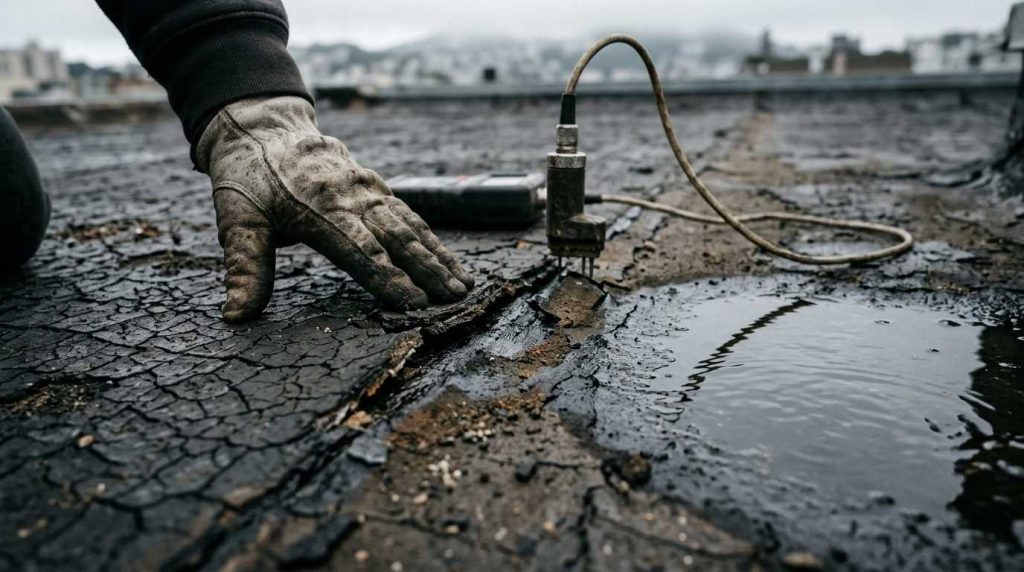
- The deck test. If the deck feels spongy underfoot, or the membrane is alligatored — a cracked, dried-out surface like alligator hide — the roof is done. One roofer in the research put it bluntly: anything you do with a coating on an alligatored torch-down roof “is going to crack and peel almost immediately. Start getting quotes for replacement today.”
Pass all three and a coating can buy 10 to 20 years. Fail any one and a coating is money thrown at a roof that needs replacing. If the roof fails the test, the decision shifts to commercial roof restoration vs replacement, where the same moisture and seam checks decide whether restoration is still on the table.
Reroof or Coat? The Chicago Case That Answers It
The clearest answer comes from a real building owner in Chicago. He owned a 3-unit building, buy-and-hold, long term. The roof was 1,700–1,800 square feet. One leak, near the skylight, that kept coming back through hard rain after several patch attempts. One company had sealed the skylight as tight as possible — and the owner himself noted the skylight might not be the leak at all; the water could be coming from smaller cracks elsewhere.
Two companies quoted. Company A, a top brand, quoted $7,300 for a layer of Gaco silicone coating with a 5-year labor warranty — or $20,000 to $30,000 for a complete tear-off and reroof. Company B, a smaller company with many good reviews, quoted $7,400 to install modified bitumen over the existing rubber — or $11,500 for a complete tear-off and reroof, including tuck-pointing a falling-apart chimney.
Five years later, the owner posted the outcome: he paid $11,500 for the reroof. “The contractors actually did a great job overall and it’s just one less problem to have to worry about over the next 15–30 years or so. The Gaco solution would’ve just been a bandaid for the real problem for me.”
The commenters had called it in advance. A roofer with 25 years of inner-city work said the mod-bit reroof was the way, that $3.50 a square foot was a solid price for a 20-year roof, and that coatings were unproven. Another said the hold period decides it: “If you only plan on keeping it 5 years then coat it. If you want to keep it for longer than that I would go for the cheaper one.” The $30,000 quote was called “a fuck off kind of quote.” And the $7,400 quote was attacked on specification: $500 a square foot was impossible anywhere in the US, the quote did not say what the “base” was, where the insulation was, or what coverboard was included — and mod bit is two plies: “One ply is a shed roof.”
Those Chicago prices are Chicago prices, from seven years ago — not San Francisco prices. What travels from Chicago to San Francisco is the decision rule: if you are keeping the building long term and the roof is rough, reroof. If you are keeping it five years and the roof is sound, coat it.
Silicone vs Acrylic vs Polyurethane: The Three Coatings Compared
Three chemistries cover nearly every flat-roof coating job. Since the 2021 International Building Code, Section 1509 requires a roof coating to meet one of the material standards in Table 1509.2 — ASTM D6083 for acrylic, ASTM D6694 for silicone, ASTM D6947 for moisture-cured polyurethane — and to keep the roof assembly’s fire classification under Section 1505. Look for the ASTM number on the pail label before you buy.
| Coating | ASTM standard | Ponding water | Best for | Installed cost per sq ft |
| Silicone | ASTM D6694 | Sits submerged | Ponding, fog, rain | 1.50–4.50 national |
| Acrylic | ASTM D6083 | Breaks down | Drained roofs, budget | 0.50–3.00 national |
| Polyurethane | ASTM D6947 | Better than acrylic | Foot traffic, equipment | 1.50–4.00 national |
Costs are HomeGuide national ranges (April 2024), labelled as national — not San Francisco prices.
Silicone is a moisture-cured hydrophobic film. Henry’s 887 Tropi-Cool is 91% solids by volume, with 280% minimum elongation and 300 psi tensile strength. It applies from 35°F to 120°F and is rain-safe in 15 minutes. It sits in standing water without softening. Its weaknesses: the cured surface is extremely slippery when wet, and almost nothing bonds to cured silicone except more silicone — once you coat in silicone, every future recoat must also be silicone.
Acrylic is a water-based reflective skin. Henry’s 587 Dura-Brite is 47% to 51% solids, so about half of every wet gallon evaporates, with 100% minimum elongation and 305 psi tensile. It needs 50°F and rising to apply and two hours to dry at 68°F and 50% humidity. It is the cheapest option, but it breaks down under standing water.
Polyurethane is the toughest film of the three against tearing and abrasion. American WeatherStar’s Urethane 522 lists 350% elongation and 975 psi tensile — more than triple silicone’s. It comes as an aromatic base coat (UV-sensitive) with an aliphatic UV-stable topcoat, and it is the right call where people walk the roof or rooftop equipment gets serviced.
Elastomeric is a category, not a fourth chemistry. It means the cured coating stretches and returns, so it can span hairline cracks. When a product is marketed as “elastomeric”, check the resin base and the ASTM standard — that base decides ponding and UV behaviour, not the label.
Best Roof Coating by Membrane: San Francisco Reality First
The membrane already on your roof is the first filter, because a coating only lasts if it bonds to that substrate. Most San Francisco flat roofs are torch-down modified bitumen or built-up roofs — not the EPDM and TPO that most national guides write about. For the full silicone picture, see the silicone roof coating guide for San Francisco.
| Existing membrane | Best-matched coating | Prep and caution |
| Torch-down / modified bitumen | Silicone if it ponds, acrylic if it drains | Prime bleed-through spots; granulated caps drink coating |
| Built-up roof (BUR) / gravel | Silicone or urethane after spudding loose gravel | Heavy base or fleece-reinforced system to bridge voids |
| EPDM (rubber) | Acrylic or silicone over an EPDM-rated primer | Two adhesion tests; prime at 1 gal per 200 sq ft if needed |
| TPO | Silicone or acrylic, membrane-specific primer | Weathered TPO oxidizes; abrade and prime; adhesion test first |
| PVC | Coat only if the manufacturer approves; often recover instead | Plasticizer migration can undermine adhesion |
| Metal (low-slope) | Acrylic or silicone; rust-inhibitive primer at seams | Treat rust first, seal fasteners and laps, then field-coat |
| Spray foam (SPF) | Silicone (best) or acrylic | Bare foam chalks and erodes in UV; it must be coated |
For EPDM, the American WeatherStar rule is strict: pressure-wash at a minimum 3,000 psi, run two adhesion tests (one with its Acrylic Bonding Primer 905, one without), and prime at 1 gallon per 200 sq ft if bare silicone fails to stick. For PVC, the honest answer is often to recover rather than coat. For spray foam, coating is not optional: bare SPF chalks and erodes in UV, which is why both ASTM D6694 and ASTM D6947 are written specifically as coatings for SPF roofing systems.
Best Henry Roof Coating for a Leaking Flat Asphalt Roof
This is the question the keyword asks directly, and no competitor answers it directly. For a leaking flat asphalt roof — torch-down modified bitumen or a built-up asphalt roof — the best Henry coating is Henry 887 Tropi-Cool 100% silicone, with one condition: prime the bleed-through spots first. Asphalt plasticizers leach into silicone and change its colour. A Gaco representative in the research put it plainly: the quote “should include a BleedTrap primer for asphalt roofs. The plasticizer in the asphalt will leach into the coating and change the color.” The same applies to an aluminum-coated asphalt roof, where the A4271 primer adds adhesion. A Flat Roof Doctor video shows the result of skipping this step: silicone sprayed over an old asphalt roof turned brownish from asphalt bleed-through after seven or eight years.
Henry 887 is also the easiest true 100% silicone to buy off the shelf — Home Depot listed the 4.75-gallon white pail at $369 on October 19, 2026, about $78 per gallon. The alternative, GacoRoof 100% Silicone, was ranked the best silicone coating overall in a 2026 ranking at about $220 to $290 for a 5-gallon pail. Either one works on asphalt if the prep is right: clean first, prime the bleed-through, repair the seams and flashings, then coat. If the asphalt roof is saturated underneath, neither product saves it.
How Much Does It Cost to Coat a Flat Roof? Reconciled, Not Averaged
No competitor reconciles the cost figures. Here are the published ranges, labelled by source and date, plus the San Francisco anchor:
| Coating | HomeGuide, Apr 2024 | AmazingFlash, Jun 2026 | Roofr, 2026 |
| Acrylic, installed | 0.50–3.00 | 1.50–3.50 | 0.50–2.00 |
| Silicone, installed | 1.50–4.50 | 2.50–5.00 | 1.50–4.50 |
| Polyurethane, installed | 1.50–4.00 | 3.00–5.50 | 1.50–4.00 |
The ranges disagree because they measure different prep, mil thickness, markets, and years. Use them as a band: acrylic cheapest, silicone middle to upper, polyurethane premium. For a 1,500 sq ft roof, AmazingFlash’s 2026 totals are acrylic 2,250–5,250, silicone 3,750–7,500, and polyurethane 4,500–8,250 installed.
The San Francisco anchor is silicone 3.50–6 per square foot installed, from the site’s commercial restoration cost table — the only SF-verified figure in this article. A Brooklyn contractor’s installed silicone range of 3.50–5.50 lines up with it, but Brooklyn is not San Francisco and its figure is labelled as Brooklyn. Everything else above is national.
Retail pails: Henry 887, 4.75 gallons, $369 at Home Depot (October 2026). GacoRoof, 5 gallons, 220–290. Super Silicone Seal, 5 gallons, approximately $400. Henry 887 requires 1.5 gallons per 100 square feet for its 22-mil minimum, so a 1,500 sq ft roof needs roughly 22 gallons before primer, fleece, and sealant.
How Many Mils, and What Warranty Does That Buy?
Warranty tracks dry film thickness in mils, not brand promises. American WeatherStar ties its terms to thickness: 20 mils for 10 years, 30 mils for 15 years, 35 mils for 20 years, using 2, 3, or 3.5 gallons of Silicone 410 per 100 sq ft in two coats. Henry 887 sets a 22-mil minimum at 1.5 gallons per 100 sq ft.
Check any quote with one formula: one US gallon over 100 sq ft leaves a wet film of 16.04 mils, and dry film equals wet film times volume solids. Henry 887 at 1.5 gallons and 91% solids is 16.04 × 1.5 × 0.91 = 21.9 mils, matching its 22-mil minimum. Henry 587 acrylic at 1 gallon and about 49% solids leaves roughly 7.9 mils. A granulated surface drinks more: Acrylux rates Sil-Flex at 100 sq ft per gallon on smooth surfaces and 50 sq ft on granulated cap sheet.
Three warranties get confused in this market. A labor warranty (the Chicago Gaco quote carried 5 years) covers workmanship. A material warranty (20 years offered on a 5,400 sq ft roof) covers the product, usually with conditions. A full-system NDL warranty (Gaco licensed contractors can offer up to 20 years for a fee) covers the system and requires a licensed contractor, a core sample, and a specification. Ask which one is in your quote, in writing.
How long does silicone coating really last? The field disagrees, and this page states the disagreement. Published ranges say 10 to 15 years, or 15 to 20. One verified commercial roofer says to expect 3 to 8 years before maintenance or recoating, and that “no coating will last 20 years”. Another says proper industrial installs last 25 to 30-plus years. The difference is prep, mils, and whether the roof was coatable in the first place.
San Francisco: Fog, Rain, and Title 24
Marine-layer fog. The Sunset (94122), the Richmond (94118), and the western neighbourhoods sit in fog for much of the year, and fog keeps a flat roof damp long after the rain stops. A coating that needs a dry surface and 50°F — acrylic — has fewer good application days here than one that cures with moisture and applies from 35°F — silicone. In the Mission (94110) and SoMa (94103), where fog burns off earlier, the acrylic window is wider, but ponding still decides it.
November-to-March rain. San Francisco’s rain season runs November through March, and flat roofs here pond in the same low spots every winter. Ponding is water that remains on a roof 48 hours or longer (Asphalt Roofing Manufacturers Association). In a foggy SF winter, 48 hours passes easily. That is why silicone is the safe default here: ponding failure is the most expensive mistake to reverse, and acrylic degrades under ponding. A coating does not remove ponding — tapered insulation or added drains come first — but silicone is the only chemistry that survives it while you fix the drainage. For the wet-weather side of that problem, see flat roof repair in wet weather.
California Title 24. A cool-roof coating can qualify the assembly for cool-roof energy credit under California Title 24 and ASHRAE 90.1. Henry 887 is rated by the Cool Roof Rating Council (ID 0620-0051) at 0.88 initial and 0.73 three-year aged solar reflectance, an SRI of 111 falling to 90. In San Francisco’s mild climate the reflectance is a bonus, not the reason to coat. The reason to coat is the leak.
Sealant vs Coating vs Patch vs Replace
- Sealant is a tube for seams, penetrations, and flashings — Loctite PL S30, Geocel Ultima caulk, Gorilla Patch & Seal Tape. It fixes a detail, not a roof.
- Coating is a field-applied system over the whole roof, measured in mils, with a warranty tied to thickness.
- Patch is a localised repair: fleece reinforcement embedded in coating over a seam or crack, the method the Flat Roof Doctor demonstrates with Super Silicone Seal.
- Replace is a tear-off to the deck, with new insulation and a new membrane — the answer when the moisture scan fails.
Identify your existing coating before you recoat. Silicone is shinier, especially when spot-cleaned with a rag and alcohol; acrylic is more matte. SEBS coatings feel sticky; urethane yellows with age. If the existing coating is silicone, your recoat must also be silicone — nothing bonds to cured silicone except silicone. Torch-down over silicone will not adhere, and neither will TPO or EPDM without a mechanically fastened layer in between.
Skylights, Gutters, and Flashings: Where Leaks Actually Start
Most leaks occur through failed flashing details, split seams, and loose fasteners — not through the middle of the field. Before the coating question, run the diagnostic steps in roof leak detection in San Francisco.
Skylights. A leak near a skylight is not necessarily a skylight leak. In the Chicago case, the skylight was sealed as tight as possible and the leak continued — the water was coming from smaller cracks elsewhere. Confirm the water is actually entering there before you replace one. If you do replace it, a curb-mounted Velux is the recommendation that recurs in the research, and a standard skylight runs about $600 extra on a reroof. If you are cool with scrapping the skylight, say so in the quote — one less penetration is one less leak path. For the skylight-specific version of this problem, see skylight leak repair in San Francisco.
Gutters. On a 5,400 sq ft mod-bit roof, the leaks ran along the central edges where a built-in gutter was flooded and compromised. The field of the roof was not in bad shape. The fix was the gutter, not the coating: reconfigure or replace it first, because there is no cheap way to fix that style of gutter.
Flashings and penetrations. Chimneys, vents, pipes, and drains are where water gets in. A chimney that is falling apart needs tuck-pointing — it was in the Chicago $11,500 quote for exactly that reason. Detail seams, penetrations, and flashings with coating plus polyester fabric before the field coat, extending the fabric 2 inches either side of a crack.
How to Check a Roofing Quote Before You Sign
Before you compare prices, compare specifications. The full line-by-line method is in how to read a roofing quote:
- What is the existing roof? Membrane type, number of plies, and whether the insulation is wet. A core sample and a moisture scan should be in the specification.
- What is the base sheet, insulation, and coverboard? Mod bit is two plies. Insulation should be R-30 polyiso (5.2 inches) to meet code where no ceiling insulation exists. Wood fiber coverboard has no compressive strength and soaks up water like a sponge — DensDeck or Securock are better, about $0.30 per square foot more.
- What is the coating system? Product name, ASTM standard, primer (BleedTrap for asphalt, A4271 over aluminum coat), mils, gallons per 100 sq ft, and number of coats. The warranty in writing — labor, material, or full-system NDL — and what it excludes.
- Is it installed to the manufacturer’s specification? Get those words in the contract. Consider paying roughly $1,000 extra for a manufacturer’s warranty, which puts quality control on a third party with skin in the game.
- What is the payment schedule? In California, the deposit cap is 10% or $1,000 under Business & Professions Code §7159, with a 3-day right to cancel. A 50% deposit may be legal in Illinois — it is not the California rule. A reasonable schedule is 10–20% at signing, a further payment on material delivery, the balance on completion, and 5% retention after inspection.
- What is the recoat plan? Silicone locks you into silicone. Ask what happens at recoat time and what maintenance the warranty requires.
If a quote is far below the others — $500 a square foot for a tear-off in a major city — the specification is where the money was saved. Find it before you sign.
How We Checked This Page
This page was built from the Roofing Brief’s silicone-versus-acrylic guide and coating-types comparison (last reviewed October 2026), the Roofr, AmazingFlash, Allied, RoofHelp, FlatTop Brooklyn, US Made Supply, and CertaRoof guides found in live search, the Gaco silicone ranking, and the Henry 887 and American WeatherStar data sheets those guides cite. Reddit threads are quoted as user and worker posts with their vote counts, never as official facts — including the Chicago case with its real quotes and five-year-later outcome, the 5,400 sq ft mod-bit case, the torch-down recoat thread, and the coating-identification thread. LinkedIn posts from Elliot Ervin (August 2026) and Nicole Morgon (March 2025), the KARNAK material-types article, and six YouTube transcripts supplied the professional and video layer. Prices are labelled by source, place, and date, and the only San Francisco figure is the silicone 3.50–6 anchor from the site’s own commercial restoration cost table. Where sources conflict — silicone lifespan 10–15 versus 15–20 years, coating life 3–8 years versus 25–30-plus, installed silicone 1.50–4.50 versus 2.50–5.00 versus 3.50–5.50 — the conflict is stated, not averaged. No search volume or difficulty is claimed for any keyword, because every keyword row arrived with “-” for volume, CPC, and competition. Neighbourhoods and ZIP codes are area examples only, not a business address.
Frequently Asked Questions
Bottom line
Start with water, then membrane, then climate. If the insulation is wet or the seams are failing, reroof. If the roof is sound and dry and it ponds, coat it in silicone. If it drains cleanly and the budget is tight, acrylic delivers. If people walk it, polyurethane earns its premium. Then confirm the coating meets its ASTM standard, buy the mil thickness that matches the warranty you want, and get the specification in the contract before you compare the price.
For a detailed inspection of your flat roof, call +1 833-804-6249.
NAICS Code 238160 – Roofing Contractors


