
Slate Roofing in San Francisco: Cost, Lifespan, Types and Repair (2026)
Key Facts
- Natural slate installed: 10-30 per sq ft (national, most-repeated 2026 range); synthetic slate 8-15 per sq ft. No San Francisco-specific installed-cost figure exists.
- Lifespan: 75-150+ years for natural slate; the National Park Service gives 60-125 years for historic slate roofs.
- Weight: 800-1,500 lb per roofing square (100 sq ft). A structural review comes before any install.
- Minimum slope: 4:12. Standard headlap: 3 in. Two 11-gauge copper nails per slate.
- SF reroofing permits: $514 and up (single-family/duplex), $714 and up (other buildings).
- SF is Climate Zone 3. Steep-slope re-roofs have no prescriptive cool-roof requirement under Title 24.
Quick Answer
Natural slate roofing in San Francisco costs 10-30 per sq ft installed at the national level, with a tighter 2026 band of 15-30 per sq ft. No San Francisco-specific installed-cost figure exists in any published source. A natural slate roof lasts 75-150+ years; the National Park Service gives 60-125 years for historic slate roofs. It weighs 800-1,500 lb per roofing square, so a structural review comes first. Slate fits steep-pitched Victorian homes best. Synthetic slate costs 8-15 per sq ft and weighs far less, but lasts 40-60 years. Repair beats replacement when under about 20% of the slates are damaged.
What slate roofing is
Slate roofing is a roof covering made from natural stone: metamorphic rock, quarried, then split along its natural grain into thin, flat tiles. Each tile is laid in overlapping courses and hung on nails rather than screwed down.
Hard slate is denser, stronger, longer-lived, and comes in varied colors. Soft slate is less dense, lasts about half as long, and costs less. Color comes from minerals: chlorite makes green, hematite makes purple, carbon makes gray and black. Unfading slates keep their color; semi-weathering slates shift toward buff and brown.
Slate sizes run from 8 by 6 in to 24 by 12 in, with standard thickness of 1/4 to 3/8 in. Most North American slate comes from Vermont, New York, Pennsylvania, Virginia (Buckingham), and Quebec. Water absorption is 0.25% or less for the top grade.
Slate roof cost in San Francisco
Start with the honest limit: no San Francisco or Bay Area slate installed-cost figure exists in any source checked. The figures below are national, labelled by source and date.
The national installed range for natural slate is 10-30 per sq ft (Spruce, Angi, Fixr, 2026), with a tighter 2026 band of 15-30 (Black Bear, EcoWatch). Synthetic slate runs 8-15 per sq ft (Black Bear, Puetz), and hybrid runs 10-18 (Fixr 2026).
The averages conflict because Angi averages small and repair jobs while Fixr averages full replacements: Angi gives $13,257 (August 4, 2026) and $13,348 (September 15, 2026); Fixr gives $40,000 (2026).
| Roof size | Natural slate, installed |
| 1,500 sq ft | $15,000-$45,000 |
| 2,000 sq ft | $20,000-$60,000 |
| 2,500 sq ft | $25,000-$75,000 |
| 3,000 sq ft | $30,000-$90,000 |
Source: Spruce, September 25, 2024.
Is slate roofing expensive? Up front, yes. The fair comparison is cost per year: LaPeyre Roofing (2026) puts synthetic slate at $600 per year and natural slate at $400 per year, on a typical 2,000 sq ft roof.
Natural slate vs synthetic slate
Natural slate is quarried stone. Synthetic slate is manufactured polymers or recycled rubber compounds, molded and colored to copy stone. The table adds hybrid slate and clay tile, covered on the tile roofing page.
| Material | Installed cost | Lifespan | Weight per sq ft | Warranty | Fire | Hail | Historic fit | Cost per year |
| Natural slate | 10-30 | 75-150+ yrs | 8-15 lb | 75 yrs | Class A | Class 3-4 | Yes | $400 |
| Synthetic slate | 8-15 | 40-60 yrs | 2.7-3.7 lb | 50 yrs | Class A | Class 4 | No | $600 |
| Hybrid slate | 10-18 | 75-100+ yrs | Not published | Not published | Not published | Not published | Maybe | Not published |
| Clay tile | Not published | 50-100 yrs | Not published | 75 yrs | Class A | Class 3 | Yes | Not published |
Sources: Black Bear, Puetz, Fixr, LaPeyre Roofing (2026); DaVinci technical sheet (2019); North Country Slate and Ludowici comparison table. Synthetic lifespan is a conflict: North Country Slate says unknown, Black Bear 40-60, Fixr about 50, HomeAdvisor 50-100.
Composite options are DaVinci, Brava, EuroShield, and Boral Inspire. DaVinci is Class 4 impact rated under UL 2218 and Class A fire rated. Its wind figures conflict: the header claims certification up to 180 mph, the FAQ says 110 mph, and the warranty covers wind only up to 90 mph (Roofing Brief, October 2026).
A creator’s test: Vermont natural slate at 800 lb per square, Boral Inspire at 180 lb per square, and the real slate shattered with a hammer while the synthetics survived.
Choose natural slate when the house is historic, the frame can carry the weight, and you plan to stay. Choose synthetic when the framing is weight-limited or the budget will not stretch.
Slate roof types
The National Slate Association lists eight slate roof types. Standard slate uses tiles of one length and width, laid in even courses. Patterned slate adds different colors or shapes in a design. Random-width slate uses one length and thickness in a variety of widths. Multicolored slate mixes two to four colors. Graduated-length slate uses varying lengths, longest at the eaves and shortest at the ridge. Graduated-length and graduated-thickness adds three or more thicknesses, thickest at the eaves. Textural slate mixes rough, uneven thicknesses for a rugged look. Hang-down slate uses longer slates that project past the butt line below.
Graduated vs standard slate: how to choose
Standard slate suits a clean, formal roof and a straightforward budget. Graduated slate suits a large, historic roof, and it costs more because it needs sorting and thicker slates at the eaves. Patterned and multicolored slate suit a roof that is meant to be seen.
How long does a slate roof last
The National Park Service gives 60-125 years for historic slate roofs. Natural slate in general is rated 75-150+ years (Black Bear, 2026).
ASTM C406 grades slate by service life, water absorption, and strength. The SRCA architectural standard calls for S1.
| Grade | Min. service life | Max. water absorption | Modulus of rupture |
| S1 | Over 75 years | 0.25% | 9,000 psi or more |
| S2 | 40-75 years | 0.36% | 7,200 psi or more |
| S3 | 20-40 years | 0.45% | 5,400 psi or more |
Source: ASTM C406, via the National Slate Association and Newmont Slate. One source gives S3 modulus of rupture as 6,000 psi; the NSA figure of 5,400 psi is used here.
By quarry: Vermont and New York about 125 years, Buckingham VA 175+ years, Pennsylvania hard-vein about 100 years, Peach Bottom 200+ years, Pennsylvania soft-vein 60+ years (Roofs Wiki, 2026).
A homeowner post about a 126-year-old Pennsylvania slate roof and another about a 1929 home with its original slate roof make the same point: the stone outlasts the metal around it.
How much does a slate roof weigh
Natural slate weighs 800-1,500 lb per roofing square, where one square is 100 sq ft (Black Bear, 2026). The range is driven by thickness: 3/16-in Vermont slate runs about 700-750 lb per square (Newmont Slate), 1/4-in about 935 lb (NSA), and 1/2-in about 1,870 lb (NSA).
That weight decides the job before any slate is ordered. The structural review is done by a structural engineer, and in California the check looks at earthquake loads, not just sag (US Power Roofing). The engineer checks rafters, trusses, and decking. The usual reinforcement is sistered rafters, added bearing points, and upgraded connections. Reinforcement runs 1,000-10,000 (Fixr 2026). Switching from shingles at 3 lb per sq ft to slate at 18 lb per sq ft on a 3,000 sq ft roof adds about 45,000 lb, or 22 tons (1 Source Roofing, GA).
If the frame cannot carry stone, synthetic slate is the honest answer.
How slate roofs are installed
Slate roof installation is not a do-it-yourself job. The sequence below is what a qualified crew does.
- Structural review and deck. The engineer confirms framing, decking, and seismic load path; the deck is solid sheathing under 30-lb felt (ASTM D226 Type II).
- Underlayment and ice shield. Ice and water shield goes at eaves, valleys, and flashings, over 30-lb felt.
- Sorting and blending. Slates are sorted by thickness and color on the ground.
- Copper flashing. Copper flashing goes at valleys, chimneys, vents, and walls, and is never nailed through.
- Field courses from eaves to ridge. Headlap by slope: 4 in below 8:12, 3 in from 8:12 to 20:12, 2 in above 20:12 (Roofs Wiki). Exposure is (length minus headlap) divided by 2.
- Ridge and hip caps. Slate caps are installed at ridges and hips.
- Final inspection. Slipped or cracked slates are replaced before the crew leaves.
Nailing is where a bad install shows. The standard is 11-gauge smooth-shank copper slating nails, two per slate, with nail length at twice the slate thickness plus 1 in (NSA Guide Specification 07 31 26, 2020). One DIY install video claims four hooks per slate; that is a creator claim, and it conflicts with the NSA two-nail standard.
A homeowner post with 11,000 votes and 568 comments showed a slate replacement where the crew screwed through the slates to attach the hip flashing. That is not a method; it is damage. Other posts flag center nailing, face-mounted screws, and a roof cupping one year after install (206 votes, 208 comments).
Slate roof repair vs replace
Two published rules decide it. The 20% rule, from TurnKey Roofers, Roof-Installation.com, and NPS Preservation Brief 29: when under about 20% of the slates are damaged, repair beats replacement. The 50% rule, from Fixr and Roof-Installation.com: when the repair cost exceeds 50% of a replacement, replace.
Slate roofs fail in a known order: flashing first, then fasteners, then the slate itself (TurnKey Roofers, citing NPS Preservation Brief 29). A roof with sound stone and failed flashing is a repair. The age of the roof alone does not decide it.
The ring test is a quick field check: tap the slate and listen. A clear ring means the stone is sound; a dull thud means it is damaged or delaminating (TurnKey Roofers).
Repair costs, all national: a single tile 250-500, a minor repair 500-750, sectional work 1,000-3,000 per square, a full restoration 15,000-45,000, flashing repair 800-2,500 (Roof-Installation.com, 2026; TurnKey / HomeGuide, 2026; Westchester, 2026). Reclaimed tile runs 3-5 times standard cost.
Two user claims on the same post: two slate specialists said 70% of the tiles were delaminated, while another user said at most 10% needed replacing. A homeowner post reported a repair quote of 30,000-37,000 against $22,000 to re-roof in shingles on an 1890 home, and a roofer’s bid claim put a mansion slate replacement at $350,000 or more.
Finding that crew is the practical problem. Most roofers are shingle installers and will not touch slate, as one homeowner post put it. The Slate Roofers Association is the screening source suggested in homeowner posts. Get a detailed inspection from a slate specialist, and read the how to choose a roofing contractor guide and the how to read a roofing quote guide before you hire.
Replacement-cost insurance pays to replace damaged slate with more slate, according to a homeowner post. Solar installs on slate have failed in homeowner posts. Tar is a damage signal, not a repair, and coating or painting slate can damage the stone.
Slate on San Francisco Victorian homes
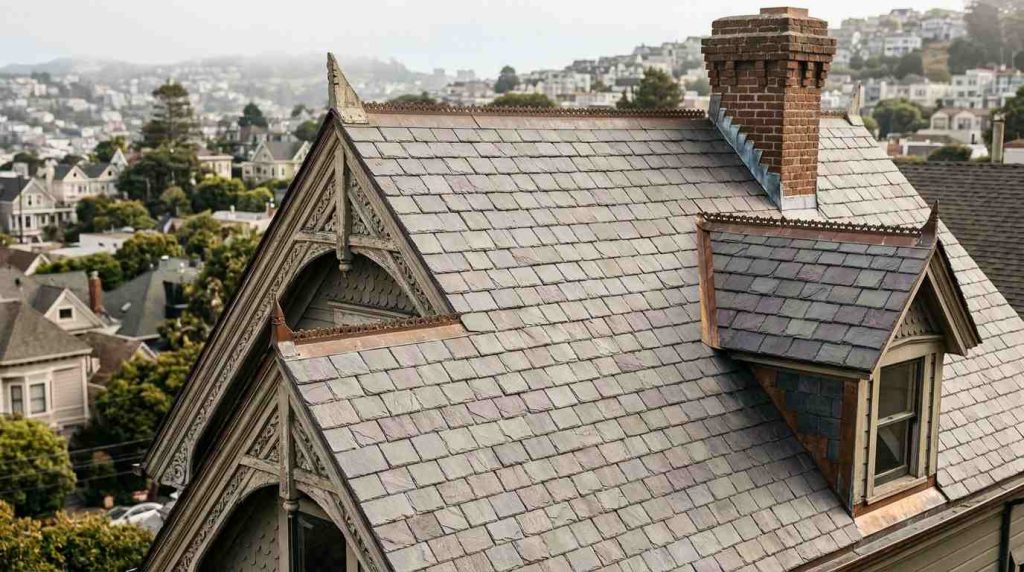
San Francisco is where slate belongs in California. Victorian homes, built roughly 1860 to 1890, have steep gabled roofs, and the Bay Area has the largest concentration of Victorian homes anywhere in the world (Central Bay Roofing). For Queen Anne homes, built roughly 1880 to 1910, slate is the most common roofing material. Victorian roofs run steep pitches of 8:12 and more (Royal Roofing CA).
The one citable San Francisco example is 1057 Steiner Street, the Chateau Tivoli, an 1892 Queen Anne with “colorful slate patterns” (Corcoran Inhabit). Grace Cathedral is not slate; its roof is lead-coated copper.
Slate is most at home in Alamo Square (94117), Pacific Heights (94115), and Noe Valley (94114). Those ZIP codes are area examples only, not a business address.
Annual rainfall is 22.89 in (NOAA, 1991-2020 downtown normals), with about 90% falling from November to April. Snow is 0 in per year; the last measurable snow was February 5, 1976. Fog and salt air keep roofs damp, and the marine layer drives roof leak detection work after the first winter rains.
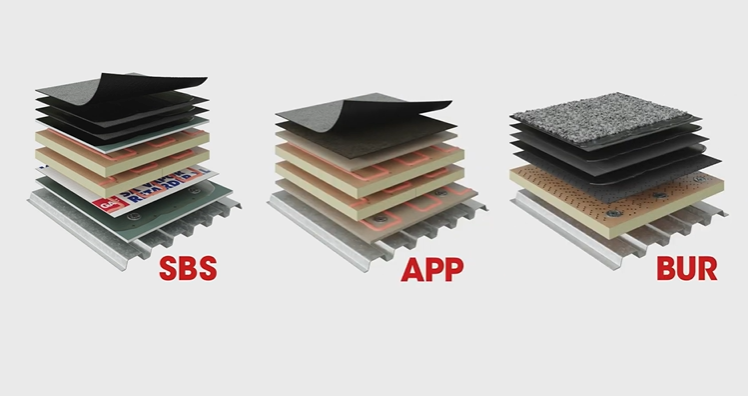
Slate does not belong on every San Francisco roof. The flat-roofed housing in the Sunset and Richmond districts cannot take slate, because slate needs a minimum slope of 4:12. Those roofs need a low-slope system instead: built-up roofing, EPDM, PVC, or a roof coating where ponding water is the first sign of trouble.
Title 24 and permits
San Francisco is Climate Zone 3 under Title 24. For a steep-slope residential re-roof, there is no prescriptive cool-roof requirement (Mid-Mod Homes, November 2026). Slate is not considered a cool roof. Roofs of 25 lb per sq ft or more are exempt from reflectance rules, and most natural slate exceeds that weight. The low-slope picture is a conflict: one source says the cool-roof rule applies statewide in all 16 zones (RoofVista), another says a Climate Zone 3 re-roof sets no prescriptive cool roof (Mid-Mod Homes), and a third says low-slope is not required (Wade Energy).
Reroofing permits in San Francisco are $514 and up for single-family and duplex buildings and $714 and up for all other buildings (verified November 17, 2026). The fee is set by building type, not by roofing material. The full permit process is covered on the roofing permits page.
Slate roofing pros and cons
Pros: a lifespan of 75-150+ years, the longest of any common steep-slope material. Class A fire rating and Class 3-4 hail rating. Water absorption of 0.25% or less for S1 grade. No rot, no insects, and no chemical treatment. Slate in good condition can be reused or salvaged. The right look on a Victorian or historic home.
Cons: the highest installed cost per sq ft of any common steep-slope material. Weight of 800-1,500 lb per square, which can force a structural review. Brittle under foot traffic and impact. Specialist installation, with few crews qualified to do it. Matching replacements are hard to source years later. Slippery to walk on. Needs a minimum slope of 4:12, so it does not work on flat roofs.
Slate roof maintenance
Inspect every year, from the ground and from the attic: look for slipped or cracked slates and check the flashing at valleys and chimneys. Keep gutters clear, because backed-up water finds the flashing first. Replace cracked or slipped slates promptly, with matching slate, before water reaches the deck. Never walk on a slate roof: one homeowner post notes that just walking on a slate roof the wrong way can cause a ton of damage. If streak marks bother you, hire a soft washing company familiar with slate, and do not let a pressure washer near it. Buy spare slates when the roof is installed and store them.
Frequently asked questions
How long does a slate roof last?
75-150+ years (Black Bear, 2026); the National Park Service gives 60-125 years for historic slate roofs. ASTM C406 S1 lasts over 75 years, S2 40-75, S3 20-40 years.
How much does a slate roof cost?
Natural slate costs 10-30 per sq ft installed nationally (15-30 tighter 2026 band). Synthetic costs 8-15. A 2,000 sq ft roof is 20,000-60,000 (Spruce, 2024).
Is slate roofing expensive?
Yes, up front. Over a full service life it is cheaper per year than synthetic: $400 per year for natural slate against $600 for synthetic, on a typical 2,000 sq ft roof (LaPeyre Roofing, 2026).
How much does a slate roof weigh?
800-1,500 lb per roofing square, where one square is 100 sq ft (Black Bear, 2026). By thickness: 3/16-in about 700-750 lb, 1/4-in about 935 lb, 1/2-in about 1,870 lb.
Will my home structurally support a natural slate roof?
Only a structural engineer can answer that for your house. The check covers rafters, trusses, and decking, and in California it includes earthquake loads.
Should I choose natural slate or synthetic slate?
Natural slate when the house is historic, the frame can carry the weight, and you plan to stay for decades. Synthetic when the framing is weight-limited or the budget will not stretch to stone.
Can a damaged slate be replaced individually, or do I need a full re-roof?
Yes. The NPS method is a slate ripper, a matched replacement, one nail through the vertical joint, and a copper bib over the nail head.
Is it OK to walk on a slate roof?
No. Slate is brittle and cracks under foot traffic, and it is slippery even when dry. A slate roofer works from hook ladders.
How long does it take to install a slate roof?
No published national figure exists. Local installer pages commonly say several weeks. Premium Vermont slate carries a 4-8 week lead time (Newmont Slate).
What wears out first on a slate roof?
The flashing wears out first, then the fasteners, then the slate itself (TurnKey Roofers). Corroding steel nails, called nail sickness, are the biggest issue on old roofs.
Does a slate roof add value?
No published figure measures the resale premium for slate in San Francisco. Slate is the expected material on Victorian and historic homes.
Bottom line
Slate roofing is the right call for a steep-pitched San Francisco Victorian when the frame can carry the weight and the owner plans to stay. Natural slate costs 10-30 per sq ft installed nationally and lasts 75-150+ years. Get a structural review and a detailed inspection from a slate specialist before you commit. Call +1 833-804-6249. NAICS Code 238160 – Roofing Contractors.