
Commercial Roof Insulation & Title 24 in San Francisco: R-Values, Costs & Code
Key Facts
- San Francisco = California Climate Zone 3.
- 2025 Title 24 Part 6 in effect for permits filed on/after Jan 1, 2026.
- Prescriptive cool roof does NOT apply to low-slope nonresidential roofs in CZ 3 (CRRC 2025 chart: CZ 2, 4, 6–15). Steep-slope nonresidential in CZ 1 & 3: aged SR 0.20 / TE 0.75 / SRI 16.
- Where cool roof applies (low-slope): aged SR 0.63 / TE 0.75 / SRI 75.
- Table 141.0-C alterations, CZ 3 (group 1–5, 9–16): R-23 continuous, U-0.037, min R-10 above deck. CZ 6–8: R-17, U-0.047, min R-10 above deck.
- Trigger: >50% of roof area OR >2,000 sq ft, whichever is less (§141.0(b)2B).
- Exemptions: recoat renewal = no insulation; reroof with new R-10 above deck = exempt from full 141.0-C; equipment-not-lifted; tapered at drains.
- Polyiso R-5.6–6.0 per inch → R-23 ≈ 4 in; R-17 ≈ 3 in.
- Site SF figures: TPO 7–11, torch/mod-bit 8–13, silicone 3.50–6, replacement 17,000–42,000, repairs 450–1,800.
- National insulation figures (labelled): polyiso 0.70–1.20/sq ft per inch; 2–3 in typical 1.40–3.60/sq ft; tapered 4.50–16/sq ft installed, most 7–10.
Quick Answer: The R-23 Rule Is the One That Matters in San Francisco
If you are reroofing a commercial building in San Francisco and the job covers more than 50% of the roof area or more than 2,000 square feet, whichever is less, Title 24 requires the roof to be insulated to R-23 continuous insulation, U-0.037, with at least R-10 above the deck. That is Table 141.0-C of the 2025 standards. San Francisco is Climate Zone 3.
The surprise is what Title 24 does not require here. The cool-roof rule that every guide leads with — aged solar reflectance 0.63, thermal emittance 0.75, SRI 75 — does not apply to low-slope commercial roofs in Climate Zone 3 under the prescriptive path. The state sets that requirement for Zones 2, 4, and 6 through 15.
What Title 24 Is, and Which Part Governs Your Roof
Title 24 is California’s Building Standards Code, and Part 6 is the energy code. It is updated every three years by the California Energy Commission, and the current version is the 2025 standards. The version that applies to your project is set by the permit application date, not the construction start date.
When people say “Title 24” about a roof, they usually mean the energy part — the Title 24 energy report and its compliance forms.
| Requirement | San Francisco (Climate Zone 3) | Source |
| Low-slope cool roof, nonresidential | Not required (prescriptive path) | CRRC 2025; BayREN 2025 |
| Steep-slope cool roof, nonresidential | Aged SR 0.20 / TE 0.75 / SRI 16 | CRRC 2025; §140.3(a)1 |
| Low-slope cool roof where it applies | Aged SR 0.63 / TE 0.75 / SRI 75 | CRRC 2025 (CZ 2, 4, 6–15) |
| Alteration insulation, low-slope | R-23 continuous, U-0.037, minimum R-10 above deck | 2025 Table 141.0-C |
| Trigger | More than 50% of roof area or more than 2,000 sq ft, whichever is less | 2025 §141.0(b)2B |
| Code version in force | 2025 standards; permits filed on or after Jan. 1, 2026 | California Energy Commission |
The Cool-Roof Myth for San Francisco Flat Roofs
Open any Title 24 guide and the first number you see is 0.63. It is the aged solar reflectance a low-slope roof must hit, with thermal emittance 0.75, or an SRI of 75. Those numbers are real. What the guides skip is the zone list. The 2025 prescriptive requirement for low-slope nonresidential roofs applies in Climate Zones 2, 4, and 6 through 15. San Francisco is Zone 3.
That does not mean a white roof is a bad idea in San Francisco. White TPO, at a typical aged reflectance of 0.70–0.80, passes the 0.63 threshold easily wherever it applies. It means the cool roof is a choice here, not a mandate — and a contractor who prices your job as if SRI 75 were mandatory in Zone 3 is working from the wrong zone.
Steep-slope roofs are different. A pitched commercial roof in Zone 3 does have a prescriptive cool-roof requirement: aged solar reflectance 0.20, thermal emittance 0.75, or SRI 16. There is also a trade-off: Table 141.0-B lets you trade insulation for reflectance.
The Insulation Rule: R-23, and What 4 Inches of Polyiso Means
When a low-slope roof alteration crosses the trigger, the altered area must be insulated to the level in Table 141.0-C. For Climate Zone 3, that is R-23 continuous insulation, U-factor 0.037, with at least R-10 above the deck. Zones 6 through 8 require R-17. The insulation applies only to the roof area above conditioned or indirectly conditioned space, and not to areas covered by photovoltaic or solar thermal panels.
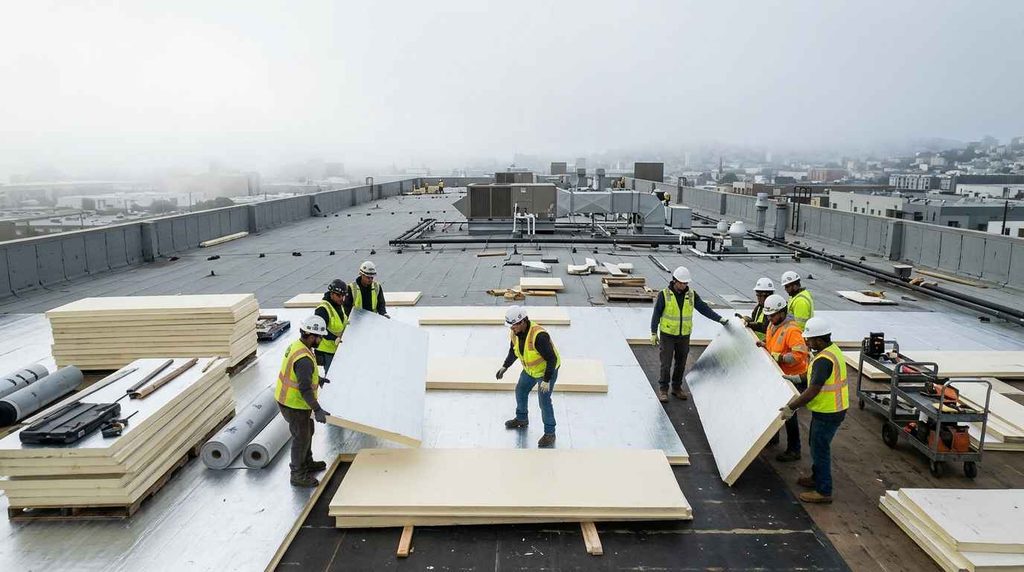
The most common insulation in commercial roofing is polyisocyanurate, known as polyiso — a dense foam board that packs a lot of R-value into a little thickness. Published polyiso values run about R-5.6 to R-6.0 per inch. The arithmetic is simple: R-23 divided by 5.6 is 4.1 inches, and divided by 6.0 is 3.8 inches. So R-23 means about 4 inches of polyiso above the deck, and R-17 means about 3 inches.
Two details matter at the deck. First, the R-10 above the deck is a minimum, not the total — the R-23 is the whole assembly. Second, tapered insulation is allowed at drains and other low points, where a thinner section is needed for water to flow, provided the insulation is thicker at the high points so the average still meets Table 141.0-C.
When Title 24 Triggers — and When It Does Not
The trigger is specific, and it is the most misunderstood part of the code. A roof alteration triggers Title 24 when it covers more than 50% of the roof area or more than 2,000 square feet, whichever is less. A small localized repair is generally exempt.
Renewing an existing coating is exempt from the insulation requirement. A reroof with new R-10 insulation added above the deck is exempt from the full Table 141.0-C level. And when rooftop equipment will not be disconnected and lifted, the insulation added is the greater of R-10 or the maximum thickness that keeps flashing height within the manufacturer’s instructions.
| Project | Title 24 consequence in San Francisco |
| Small localized repair | Generally exempt |
| Recoat / renew existing coating | Cool-roof product rules apply over the trigger; no insulation required |
| Recover (new surface over old) | R-10 minimum above deck; full Table 141.0-C unless the R-10 exception applies |
| Full replacement / tear-off | Full Table 141.0-C: R-23, U-0.037, minimum R-10 above deck |
Three Paths: Recoat, Recover, Replace
Every commercial roof decision in San Francisco is one of three paths.
Recoat. If the existing surface is dry, structurally sound, and drains, a reflective coating can meet compliance without a tear-off. Silicone resists UV damage and stays stable even where water ponds occasionally. Acrylic is cheaper but deteriorates with persistent ponding. Urethane gives the impact resistance a roof needs when HVAC technicians walk it every week. Renewing a coating does not trigger the insulation rule. But a coating over a failing roof seals in trapped moisture, and as that moisture expands it rots the insulation and then the deck below. Our best roof coating guide has the silicone figures.
Recover. A recover installs a new surface over the old one, which cuts debris and disruption to the business below. It is only an option if the roof has no saturated insulation and does not already carry multiple existing layers — the code bars a recovery over a water-soaked roof. A recover over the trigger requires at least R-10 of new insulation above the deck.
Replace. A full tear-off is required when the roof has widespread moisture, saturated insulation, or drainage problems that cannot be corrected. This is the path that triggers the full Table 141.0-C requirement. One owner posted about a $60,000 commercial replacement that turned into a $34,000 structural change order after tear-off, when rotted wood framing was found. Another posted an 8,500-square-foot estimate at $55,000 and was told by other roofers that the same job should start at 90,000–120,000.
Insulation Types Compared
Polyiso is the default, but it is not the only material.
| Material | R-value per inch | What it is good for | Watch out for |
| Polyiso (polyisocyanurate) | 5.6–6.0 | Highest R-value per inch; default for R-23 | Needs a cover board |
| EPS (expanded polystyrene) | ~3.6–4.2 | Economical; good for tapered systems | Needs more thickness |
| XPS (extruded polystyrene) | ~5.0 | Strong and moisture-resistant | Costs more than EPS |
| Tapered polyiso / EPS | Varies | Creates drainage and meets R-value requirements | Costliest line after the membrane |
| Closed-cell spray foam | ~6.5 | Seamless; air-seals | Needs a coating; 2 in minimum as a vapour barrier |
| Cover board (gypsum / fiber) | Negligible | Protects insulation from traffic and hail | Not insulation; not counted toward R-23 |
Two field facts are worth knowing. First, the cover board is not insulation and does not count toward R-23. It is a firm board — gypsum or wood fiber — above the insulation and below the membrane, and its job is durability. Second, the question to ask any bidder is the one a roofer asked on a new commercial install with 90 comments behind it: how thick was the top layer of ISO?
Moisture is another field fact. An adjuster cannot cut a roof open to see the insulation, cover board, or vapour barrier. That is why moisture scans matter before a recover: a mid-wave infrared camera runs about 1,000–3,000, and a long-wave camera for white single-ply roofs runs more like 50,000–80,000, according to roofers in the threads.
What It Costs in San Francisco
San Francisco prices on this site are the locked figures, and they are the only San Francisco numbers in this guide.
| Item | San Francisco figure | Source |
| TPO single-ply, installed | 7–11 per sq ft | Site figure |
| Torch-down / modified bitumen | 8–13 per sq ft | Site figure |
| Silicone coating | 3.50–6 per sq ft | Site figure |
| Full commercial replacement | 17,000–42,000 | Site figure |
| Commercial repairs | 450–1,800 | Site figure |
| Polyiso, per inch (national) | 0.70–1.20 per sq ft | National guides |
| 2–3 in polyiso installed (national) | 1.40–3.60 per sq ft | National guides |
| Tapered insulation system (national) | 4.50–16 per sq ft, most 7–10 | National guides |
A worked example, using only the figures above: a 10,000-square-foot flat roof in Dogpatch at the site’s TPO range runs 70,000–110,000 for the membrane system. The insulation to reach R-23 — about 4 inches of polyiso — runs 2.80–4.80 per square foot at the national per-inch figures, or 28,000–48,000 for the roof. Ask for insulation as its own line on the bid. A detailed inspection before you sign finds the wet insulation behind the 60,000-to-94,000 change-order story. Our guide to reading a roofing quote shows how to compare three line-item bids.
The San Francisco Layer: Fog, Rain, Salt, and Seismic
San Francisco’s climate is the reason the code treats it differently, and it is also the reason the work is harder here than the guides admit. The marine layer rolls in most summer mornings, the fog keeps cooling loads low — which is why Zone 3 escapes the prescriptive cool-roof rule — and the rain arrives in a concentrated season from November to March. Salt air off the Bay accelerates corrosion at edge metal and fasteners.
The buildings are the other local fact. Dogpatch (94107) and Bayview-Hunters Point (94124) hold the city’s warehouse and light-industrial stock, much of it around Pier 70 and the Port of San Francisco. SoMa (94103) and Mission Bay (94158) hold the newer office and lab buildings. Visitacion Valley (94134) and the Excelsior (94112) hold the smaller commercial storefronts. A warehouse in Bayview and a storefront in the Excelsior are both Climate Zone 3, but they are not the same job: different deck types, different parapet heights, and different flashing constraints when four inches of insulation has to fit under an existing parapet cap. The commercial roofing hub covers the building types.
The Paperwork: What the Inspector Actually Wants
Commercial roofing contractors in the threads ask the same question: how do you sort through all the paperwork?
The item that stalls projects is the CRRC Product ID. Every product used to meet a cool-roof requirement must be certified by the Cool Roof Rating Council, and the Product ID must be searchable in the CRRC Rated Products Directory. A manufacturer’s brochure or a colour name cannot be used for permit approval. Only a verified CRRC-rated product listing is valid, and the values that count are the aged values.
What the Competitors Get Wrong
Four errors recur across the guides in this review.
- “SRI 75 to 85.” The code says SRI 75 for low-slope roofs where the rule applies. There is no 85.
- “Mandatory solar and battery storage for major renovations.” The code requires solar-readiness on certain new construction. It does not require photovoltaic panels and batteries on a reroof.
- “R-14 or higher above the deck.” The code says a minimum of R-10 above the deck, with R-23 total in Climate Zone 3. R-14 is not the code number.
- “The 0.63 reflectance rule covers Climate Zones 1–9.” Under the 2025 code, the low-slope prescriptive requirement covers Zones 2, 4, and 6–15. San Francisco, in Zone 3, is not in that list. A second guide misapplies the hotel and motel guest-room threshold — aged reflectance 0.55, SRI 64 — to all commercial buildings. That number is for guest rooms only.
Pipe Insulation, the Building Code, and the Residential Numbers
Three keyword rows in the research point at different subjects. Pipe insulation is a different Title 24 subject: rooftop unit condensate rules are not in the energy part of Title 24 at all — they are in the California Plumbing Code (Part 5), section 814, and the California Mechanical Code, section 310. The California Building Code is Title 24, Part 2, covering structure, fire, and life safety; the energy code is Part 6. The residential numbers are different: a homeowner’s Title 24 compliance report quoted in the threads required R-13 in the roof and R-38 in the ceiling. The commercial alteration figure for San Francisco is R-23 continuous with R-10 above the deck, from Table 141.0-C.
How We Checked This Guide
This guide was checked on November 11, 2026. The code numbers — R-23, U-0.037, R-10 above deck, the 50% / 2,000-square-foot trigger, the exemptions, and the Zone 3 cool-roof scope — were verified against the BayREN 2025 Nonresidential Roofing Permit Guide, the Cool Roof Rating Council’s 2025 Title 24 summary chart, and the California Energy Commission’s 2025 Building Energy Efficiency Standards. The San Francisco prices are the site’s locked figures. The national insulation costs come from published cost guides and are labelled national. Field facts come from reader threads and are labelled as user claims. No Semrush data and no local search-volume file arrived with the material for this guide, so none is claimed.
Frequently Asked Questions
What is the Title 24 insulation requirement for a commercial roof in San Francisco?
R-23 continuous insulation, U-0.037, with at least R-10 above the deck, from Table 141.0-C of the 2025 standards. San Francisco is Climate Zone 3.
Does Title 24 require a cool roof on a flat commercial roof in San Francisco?
Not under the prescriptive path. The low-slope cool-roof requirement (aged SR 0.63 / TE 0.75 / SRI 75) applies in Climate Zones 2, 4, and 6–15. San Francisco is Zone 3.
When does Title 24 trigger on a commercial reroof?
When the alteration covers more than 50% of the roof area or more than 2,000 square feet, whichever is less.
Does recoating a commercial roof trigger the insulation rule?
No. Renewing an existing coating is exempt. A recover requires at least R-10 above the deck, and a full replacement triggers the full R-23.
How thick does polyiso insulation need to be for R-23?
About 4 inches, at R-5.6–6.0 per inch. R-23 divided by 5.6 is 4.1 inches; divided by 6.0 is 3.8 inches.
What is the R-value of polyiso insulation?
About R-5.6–6.0 per inch, by published product data.
Can I put a lower-reflectance roof on a commercial building in California?
Yes, through the trade-off in Table 141.0-B. A lower aged solar reflectance is allowed if the roof/ceiling U-factor meets the table.
What does commercial roof insulation cost in San Francisco?
TPO 7–11, torch down / modified bitumen 8–13, silicone 3.50–6 per square foot installed, and full replacement 17,000–42,000. National guides put polyiso at 0.70–1.20 per square foot per inch.
What paperwork does the building department want for a Title 24 roof?
Plans showing the roof system and insulation values, product data sheets, the energy compliance forms, and a final inspection sign-off.
Does Title 24 apply to pipe insulation on a commercial roof?
No. Pipe insulation and rooftop unit condensate fall under the California Plumbing Code (Part 5), section 814, and the California Mechanical Code, section 310.
How long does a commercial roof last in San Francisco?
It depends on the system and the maintenance, not on the code. A detailed inspection once a year is how wet insulation and short flashing heights are found before they become a tear-off.
Bottom line
In San Francisco, Title 24 is an insulation rule before it is a cool-roof rule. Climate Zone 3 escapes the prescriptive low-slope cool-roof requirement, and the number that governs your reroof is R-23 continuous insulation with at least R-10 above the deck — about four inches of polyiso — whenever the job crosses 50% of the roof or 2,000 square feet. A recoat needs no insulation, a recover needs R-10, and a replacement needs the full R-23. Get the insulation line on the bid, check the CRRC Product ID, and have the roof inspected before you sign.
NAICS Code 238160 – Roofing Contractors. For a detailed inspection, call +1 833-804-6249.